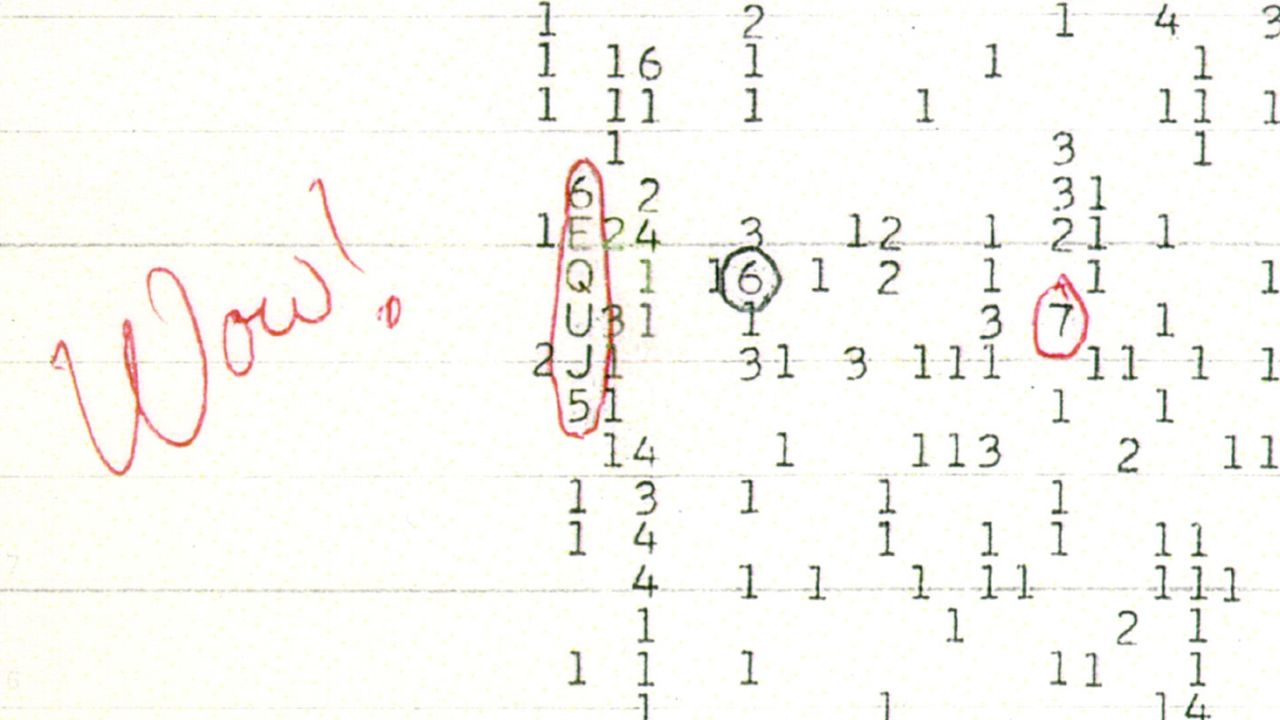
On August 15, 1977, the Big Ear radio telescope at Ohio State University picked up a signal that would define the search for extraterrestrial intelligence for decades to come. The detection occurred at 10:16 p.m. Eastern Daylight Time. A researcher named Jerry Ehman circled the anomalous data on a computer printout and scrawled "Wow!" in the margin, giving the event its enduring name.
The signal arrived on a frequency of 1420 megahertz, a wavelength associated with neutral hydrogen and considered a promising channel for interstellar communication. The Big Ear, a fixed parabolic reflector antenna covering nearly an acre, captured the narrow-band transmission for 72 seconds as it swept across the constellation Chi Sagittarii. The signal's strength exceeded background noise by a factor of 30, meeting the established threshold for a genuine detection.
What made the Wow! signal remarkable was its characteristics. It displayed the hallmarks of an extraterrestrial broadcast: a non-terrestrial frequency, narrow bandwidth, and movement consistent with a source beyond Earth's atmosphere. The signal did not match known satellite transmissions, military broadcasts, or natural cosmic phenomena like pulsars. When Ohio State astronomers repeated their observation the following night, they detected nothing. The one-time nature of the event has haunted researchers ever since.
The Big Ear operated from 1973 to 1998 as part of a systematic all-sky survey called the Ohio State University Radio Observatory. The telescope conducted continuous observations without pointing mechanisms, relying instead on Earth's rotation to scan the heavens. This design made it an ideal instrument for detecting transient signals, though it could not reposition quickly to confirm detections.
For more than four decades, the Wow! signal has resisted explanation. Skeptics have proposed terrestrial interference, stray signals, or instrumental artifacts. Others have suggested that two separate celestial sources might have created the appearance of a single detection across adjacent frequency channels. A 2018 study proposed that a hydrogen cloud surrounding a nearby comet could have amplified stellar radiation to mimic an artificial signal. Yet none of these hypotheses fully account for the signal's observed properties.
The detection galvanized SETI, the Search for Extraterrestrial Intelligence. It demonstrated that radio astronomy could detect anomalous signals consistent with alien transmissions, lending credibility to a field that faced considerable skepticism from the broader scientific community. The event elevated public interest in extraterrestrial life and influenced funding for radio SETI programs.
Modern observatories like the Allen Telescope Array and the upgraded Very Large Array continue the search that the Big Ear pioneered. They employ more sophisticated detection algorithms, wider frequency coverage, and rapid confirmation protocols to rule out false alarms. Yet the combination of sensitivity, sky coverage, and luck required to detect a genuine extraterrestrial signal remains extraordinary.
The Wow! signal endures as both a tantalizing mystery and a reminder that our knowledge of the cosmos remains incomplete. Whether generated by an alien civilization, a misidentified natural phenomenon, or pure chance, it stands as the closest humanity has come to detecting a potential message from beyond Earth.