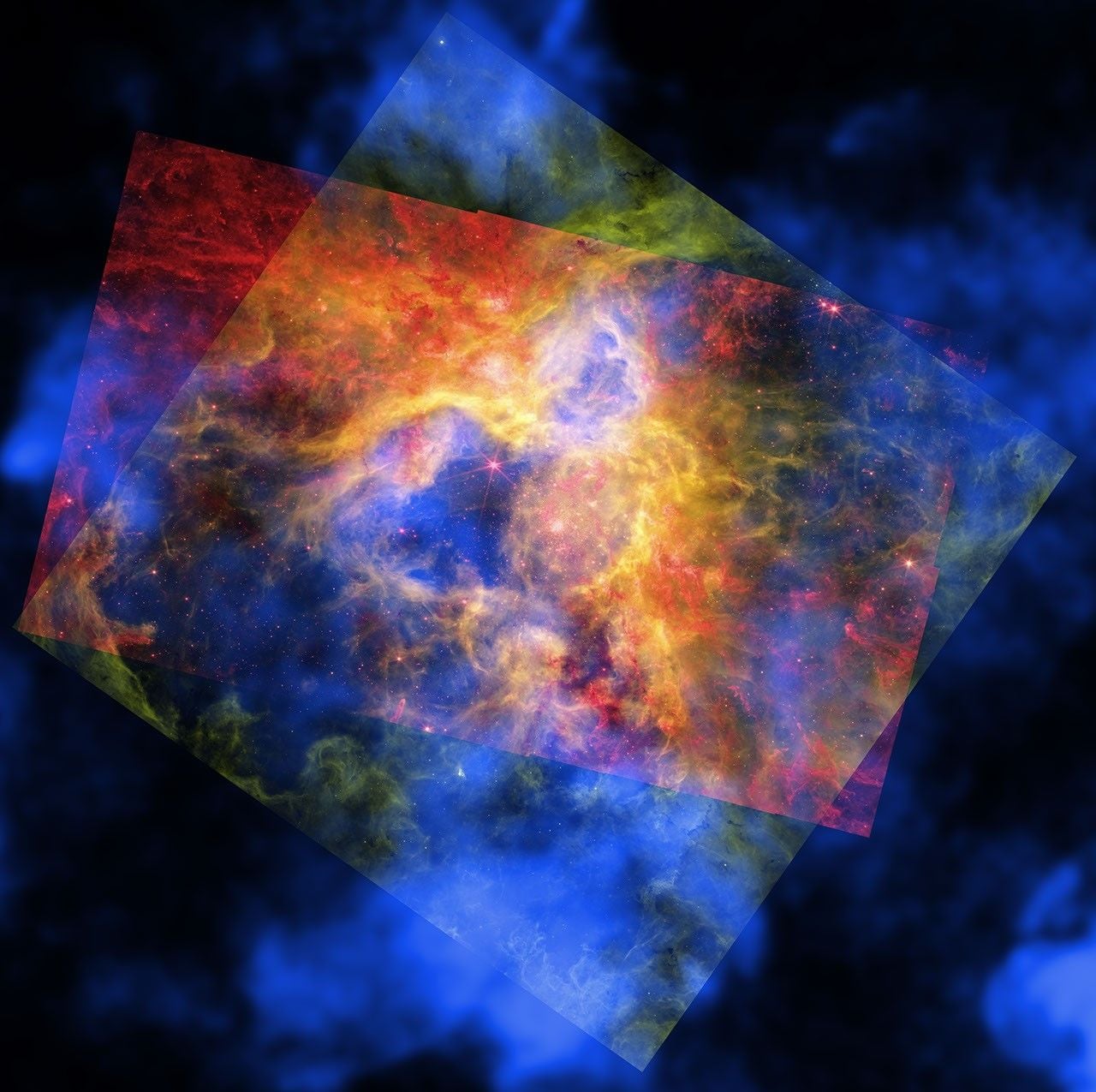
Astronomers have solved a decades-old energy mystery in the Tarantula Nebula using a rare combination of space telescopes operating across multiple wavelengths. The nebula, located 160,000 light-years away in the Large Magellanic Cloud, has been radiating far less energy than theory predicted for a region hosting some of the most massive stars in the galaxy.
The investigation used NASA's Chandra X-ray Observatory, the James Webb Space Telescope, the Hubble Space Telescope, and the retired Spitzer Space Telescope. By layering X-ray data from Chandra in blue, infrared from Webb in red, and optical observations from Hubble in green, astronomers traced where the nebula's missing energy escaped. This multiwavelength approach revealed that stellar winds from the massive young stars in the region carry away tremendous amounts of energy in the form of hot plasma and radiation.
The Tarantula Nebula, formally catalogued as 30 Doradus, spans roughly 1,000 light-years across and contains some of the largest known stars. These stellar monsters possess masses more than 100 times that of our Sun. The region actively forms new stars within roiling clouds of gas and dust, making it one of the most luminous star-forming regions in the local universe. Yet when astronomers measured the total radiant energy coming from 30 Doradus, it fell short of predictions by a factor of two or more.
For decades, this discrepancy puzzled researchers. Simple models suggested that the radiation from these massive stars, combined with energy released during stellar formation, should produce a certain predictable output. The missing energy represented a fundamental gap in understanding how massive stars shape their surroundings.
The solution emerged from examining how stellar winds operate in this extreme environment. The most massive stars in the Tarantula blow powerful winds at velocities exceeding 1,000 kilometers per second. These winds create shock waves that heat gas to millions of degrees. The Chandra observations revealed this hot, X-ray-emitting plasma expanding outward from the stellar clusters. This superheated material carries away energy that escapes the nebula entirely, never contributing to the optical and infrared radiation typically measured in surveys.
Additionally, the stellar winds create expanding bubbles and cavities that disrupt the surrounding gas cloud. This mechanical energy, distinct from radiation, represents another pathway through which the massive stars dissipate their output. Webb's infrared data revealed the structure of these wind-driven cavities, showing how the winds have sculpted the nebula's morphology over time.
The composite image demonstrates the power of multiwavelength astronomy. No single telescope could have revealed the complete picture. Chandra detected the hot gas. Webb mapped the dust and gas structure. Hubble provided optical context. Spitzer contributed additional infrared data. Together, these instruments showed that much of the energy from massive stars in star-forming regions escapes as kinetic energy in stellar winds rather than as radiation.
This finding has implications for understanding star formation across the universe. In distant galaxies, the energy-driven outflows from massive stars regulate how efficiently galaxies convert gas into new stars. The Tarantula Nebula serves as a nearby laboratory for studying these processes at high resolution.