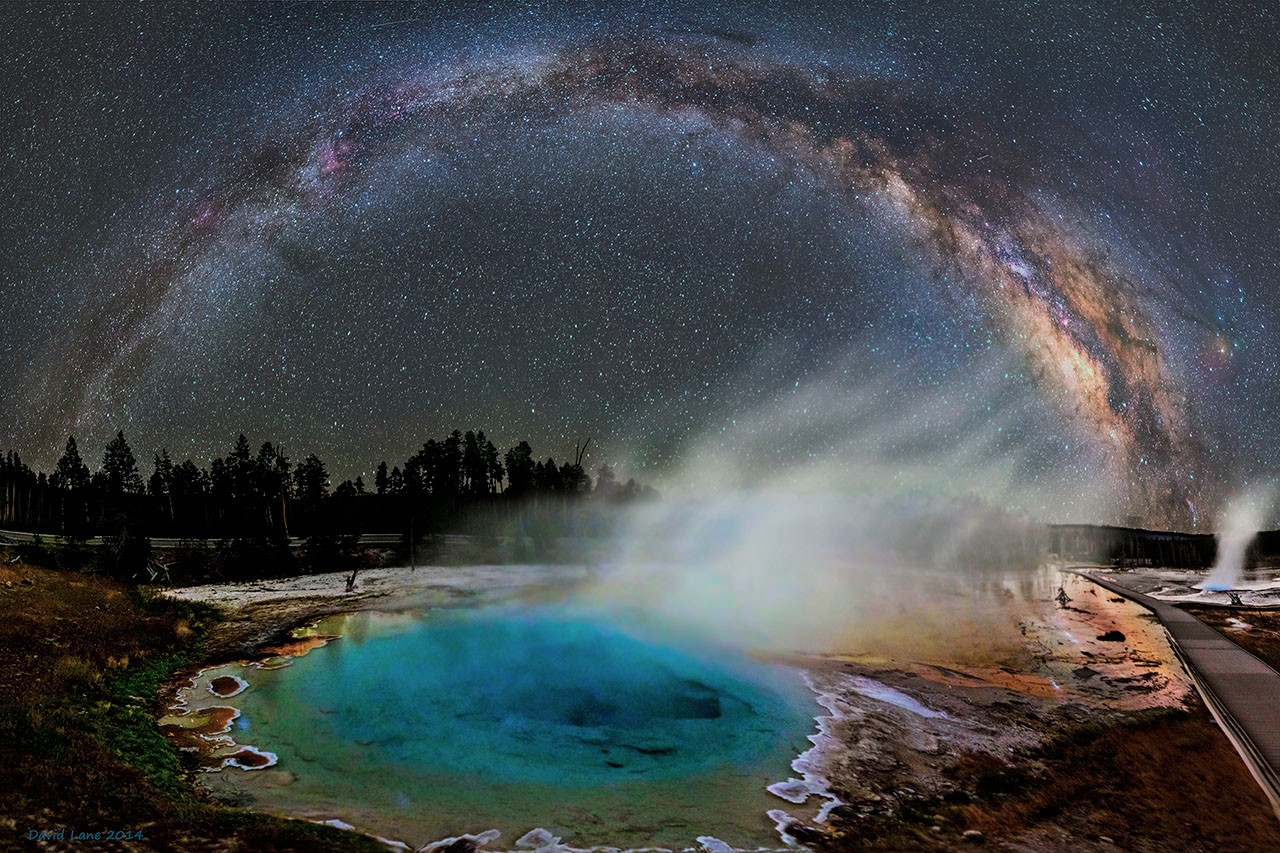
# The Milky Way Rises Over Yellowstone's Thermal Landscape
NASA's Astronomy Picture of the Day for August 16, 2026 captures the Milky Way galaxy sprawling across the night sky above Yellowstone National Park. The image pairs Earth's most recognizable thermal features with humanity's clearest view of our galactic home, creating a striking contrast between terrestrial geology and cosmic structure.
The photograph showcases the Milky Way's galactic disk as it appears from Earth. Our galaxy contains between 100 and 400 billion stars, and from our vantage point inside it, the densest concentration appears as a luminous band stretching across the sky. This view represents the plane of our galactic disk, where most of the galaxy's stellar population and interstellar material congregate. The image captures the subtle color variations within this structure. The warmer, reddish tones emerge from hydrogen gas ionized by young, hot stars. The bluish regions contain dust-enshrouded star-forming regions. Dark patches reveal dense molecular clouds that block visible light from distant stars behind them.
Yellowstone's geothermal features provide the terrestrial context. The park sits atop a hotspot where magma rises closer to Earth's surface than almost anywhere else on the continent. Hot springs, geysers, and colorful thermal pools emit their own light and heat, creating a dynamic landscape even in darkness. This contrast between the violent, ongoing geological activity below and the ancient light arriving from stars hundreds or thousands of light-years away encapsulates two fundamental scales of existence.
The Astronomy Picture of the Day program, run by NASA's Goddard Space Flight Center and the University of Maryland, publishes one image daily with explanations written by professional astronomers. The program reaches millions of viewers worldwide and serves as both public outreach and scientific documentation. Each image selection considers both aesthetic value and scientific merit, ensuring that featured photographs contribute to public understanding of astronomy and Earth science.
Photographing the Milky Way from locations like Yellowstone requires specific conditions. Dark skies free from light pollution remain essential. The park's remote location in northwestern Wyoming limits ambient artificial light. Clear atmospheric conditions allow maximum light transmission from distant stars. Summer months provide longer nights in the Northern Hemisphere, extending observation windows. Exposure times of several seconds to minutes capture sufficient light to reveal the Milky Way's structure while keeping stars sharp.
This image exemplifies a growing movement in science communication that contextualizes cosmic phenomena within recognizable Earth landscapes. Rather than presenting the universe as separate from human experience, such photographs anchor our galactic neighborhood within places people visit and understand. Yellowstone's status as a UNESCO World Heritage Site and the world's first national park adds historical weight to the composition.
The Milky Way itself orbits the supermassive black hole Sagittarius A*, located roughly 26,000 light-years from Earth. Our solar system completes one galactic orbit every 225 to 250 million years, a period sometimes called a galactic year. The light reaching Yellowstone in this photograph departed distant stars long before humans appeared on Earth, some before Earth itself formed.
Images like this one serve dual purposes. They inspire public interest in astronomy while documenting what our night sky actually looks like from specific locations at specific times. As light pollution increases globally, such records become increasingly valuable for understanding what previous generations of humans regularly observed above them.