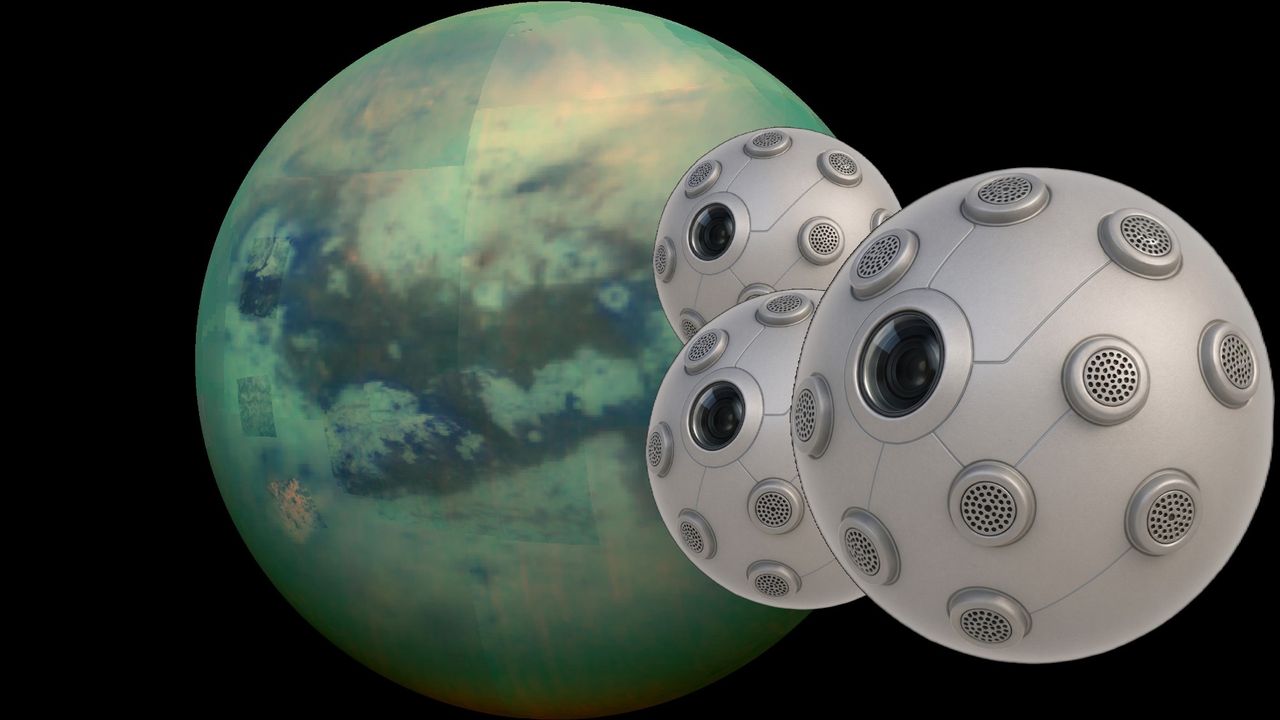
NASA has awarded early-stage funding to develop spherical robotic explorers, or "Aerobots," designed to navigate the cave systems of Titan, Saturn's largest moon. These innovative probes would operate similarly to the Ingenuity helicopter, which demonstrated aerial exploration on Mars, but adapted for Titan's unique environment.
Titan presents extraordinary challenges for exploration. The moon possesses a thick nitrogen atmosphere denser than Earth's, along with surface temperatures around 94 Kelvin. Its methane-ethane lakes and organic-rich chemistry make it one of the most scientifically compelling worlds in the solar system. Caves on Titan could harbor protected environments potentially suitable for prebiotic chemistry or even microbial life.
Spherical Aerobots would offer distinct advantages over wheeled rovers or fixed landers. Their shape enables rolling and bouncing across terrain while their aerial capabilities allow vertical movement through cavern passages. The spherical design provides protection for sensitive instruments while reducing engineering complexity compared to legged or winged alternatives. This approach builds directly on lessons learned from Ingenuity's four-year operational success on Mars, where the small helicopter completed numerous flights and exceeded its original five-flight mission parameters.
The grant represents NASA's commitment to developing next-generation planetary exploration architectures. Rather than relying solely on rovers confined to surface topography, Aerobots could access previously unreachable regions. Titan's caves offer particular scientific interest because subsurface environments shield instruments from harsh surface radiation and maintain more stable conditions for organic chemistry and potential biosignatures.
Titan remains a priority target for NASA's planetary science program. The agency is currently developing the Dragonfly rotorcraft lander, a substantial mission scheduled for launch in 2027 that will conduct comprehensive exploration of Titan's surface and atmosphere. The Aerobot concept could complement or enhance future Dragon