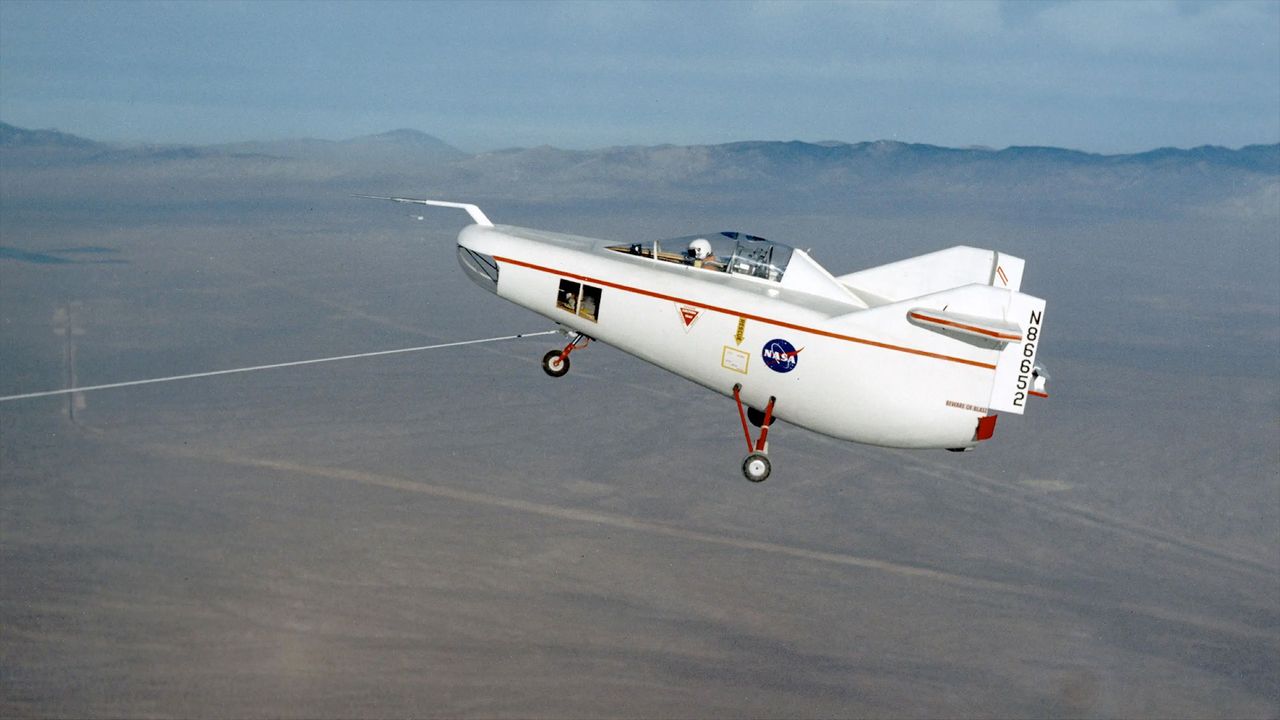
NASA's M2-F1 lifting body completed its maiden glide flight on August 16, 1963, marking a pivotal moment in hypersonic aircraft development. The wingless experimental vehicle launched from the Mojave Desert as a testbed for aerodynamic principles critical to spacecraft reentry and recovery.
The M2-F1 represented a radical departure from conventional aircraft design. Engineers at NASA's Flight Research Center (now Armstrong Flight Research Center) eliminated traditional wings entirely, instead relying on a bulbous fuselage shaped to generate lift through pressure distribution. This lifting body concept promised to solve a persistent problem in spaceflight: how to safely decelerate vehicles from orbital velocities while maintaining aerodynamic control.
The aircraft's first unpowered flight validated the core hypothesis. A tow vehicle hauled the M2-F1 to altitude, then released it for a glide descent. Pilot Milton Thompson handled the controls, testing the vehicle's stability and control characteristics across a range of speeds. The successful mission proved that a wingless configuration could generate adequate lift and remain controllable without conventional control surfaces.
The M2-F1's success sparked a generation of lifting body research that extended through the 1960s and beyond. NASA subsequently developed the larger M2-F2 with a rocket engine, achieving hypersonic flights that informed both spacecraft design and the eventual Space Shuttle program. The aerodynamic principles validated by the M2-F1 directly influenced how NASA engineered the Shuttle's delta wing configuration and thermal protection systems.
Lifting body research demonstrated that spacecraft needn't resemble aircraft to reenter Earth's atmosphere safely. This work bridged the gap between ballistic capsules like Mercury and the winged shuttles of the future, proving that multiple pathways existed for returning humans from space. The M2-F1's August 1963 flight