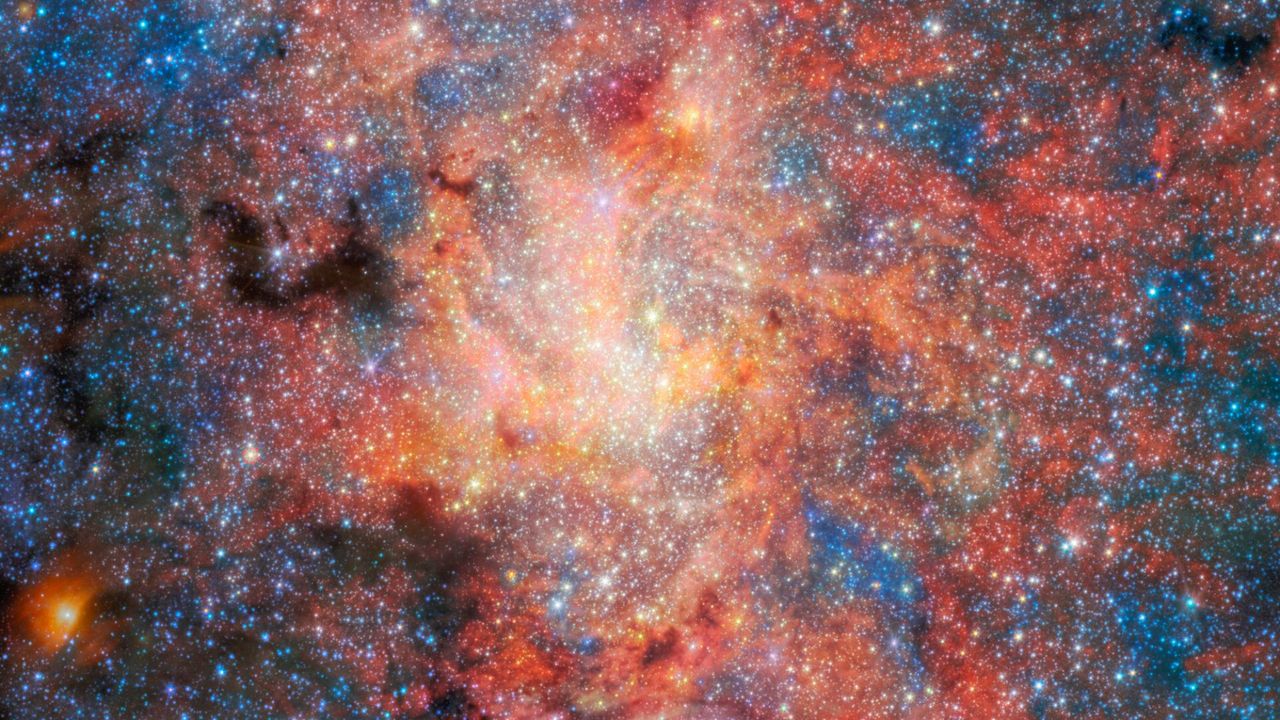
The James Webb Space Telescope has detected water molecules and cosmic dust persisting in regions closer to Sagittarius A* than astronomers previously thought possible. This discovery reshapes understanding of chemistry near the Milky Way's central supermassive black hole, where extreme radiation and gravitational forces should vaporize most materials.
Sagittarius A*, located roughly 26,000 light-years away in the constellation Sagittarius, contains about 4 million times the Sun's mass. The region immediately surrounding this black hole, known as the galactic center, experiences temperatures exceeding millions of degrees and intense radiation fields from nearby stars and accretion processes. Scientists expected water molecules to dissociate into hydrogen and oxygen atoms under these conditions. Yet JWST's infrared observations revealed intact water signatures in the dense molecular clouds orbiting the black hole.
The implications extend beyond simple chemical resilience. Water serves as a tracer for molecular cloud composition and structure. Its presence indicates where star formation might occur even in extreme environments. This alters models of how stars form and evolve near supermassive black holes, a process that remains poorly understood despite decades of study.
JWST's infrared capabilities proved crucial here. The telescope observes at wavelengths between visible light and radio waves, penetrating dust clouds that obscure optical telescopes' view. Earth-based observatories and earlier space telescopes like Spitzer lacked sufficient resolution and sensitivity to map water distribution so precisely near Sagittarius A*. JWST's 6.5-meter mirror and specialized instruments allowed researchers to detect specific molecular absorption lines indicating water's presence.
The dust findings parallel the water results. Cosmic dust particles, composed largely of silicates and carbon compounds, also appeared more abundant near the black hole than models predicted. This dust survives despite high temperatures and radiation that should erode grain surfaces. The dust particles may cluster in shielded pockets within dense molecular clouds, where self-gravity and magnetic fields provide partial protection.
Understanding chemistry near black holes connects to broader questions about black hole physics and galactic evolution. Infalling material feeds Sagittarius A*, driving jets and outflows that influence the entire galaxy's structure. Chemical composition of this inflowing material affects accretion efficiency and energy output. Water and dust observations provide direct evidence about what feeds the black hole and how it interacts with the surrounding environment.
These findings also inform exoplanet studies. Many exoplanets orbit stars near galactic centers of distant galaxies. If water and dust survive near supermassive black holes in the Milky Way, similar chemistry may persist around stars in similarly extreme environments. This expands the potential habitable zones scientists consider when searching for biosignatures in distant galaxies.
JWST observations continue mapping the galactic center at unprecedented detail. Future observations will track how water abundance changes across different regions and orbital velocities. This data feeds into computer models simulating black hole accretion and stellar dynamics. The discovery demonstrates that harsh cosmic environments retain more chemical complexity than anticipated, forcing scientists to reconsider where chemistry survives and chemistry fails in the universe.