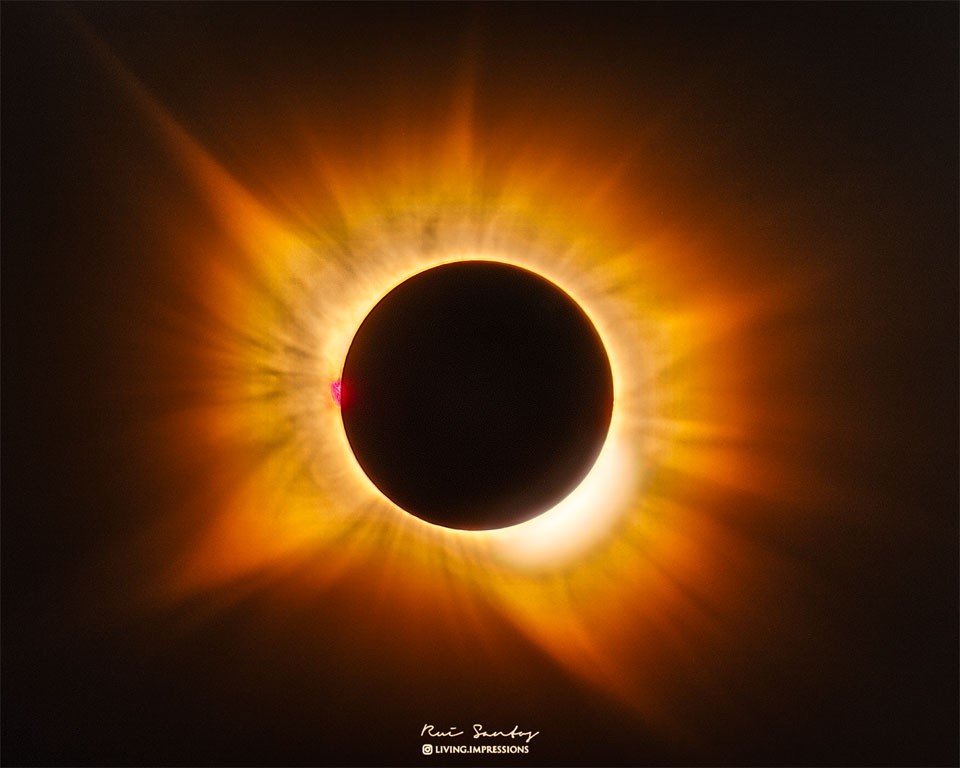
A total solar eclipse will traverse Earth on August 17, 2026, offering observers in the path of totality an unobstructed view of the Sun's corona. NASA's Astronomy Picture of the Day featured this upcoming event, highlighting the distinctive appearance of the solar corona during totality.
The corona, the Sun's outer atmosphere, becomes visible only during a total solar eclipse when the Moon completely blocks the Sun's bright photosphere. During the 2026 eclipse, the corona will display its characteristic golden hue, a result of its composition of ionized gases at temperatures exceeding one million Kelvin. This extreme heat contrasts sharply with the Sun's surface temperature of roughly 5,500 Kelvin, a phenomenon solar physicists continue to investigate.
The path of totality for the August 2026 eclipse will cross portions of Greenland, Spain, and Portugal, with observers along this corridor experiencing several minutes of totality. Those positioned outside the path of totality will observe a partial eclipse.
Total solar eclipses function as natural laboratories for studying solar physics. The temporary disappearance of the photosphere allows scientists to observe coronal structures, including coronal loops, prominences, and the extended corona itself. These observations have historically contributed to breakthroughs in understanding stellar atmospheres and solar dynamics.
The 2026 eclipse follows recent total solar eclipses, including the August 2017 event that crossed North America and the April 2024 eclipse visible across Mexico and the continental United States. Each eclipse provides updated data about solar behavior and atmospheric conditions.
Observers planning to witness the 2026 eclipse should prepare proper solar viewing equipment. Standard eclipse glasses with ISO 12312-2 certification provide safe viewing of the partial phases, though observers within the path of totality can view the corona safely during the brief moments of totality without optical aids.