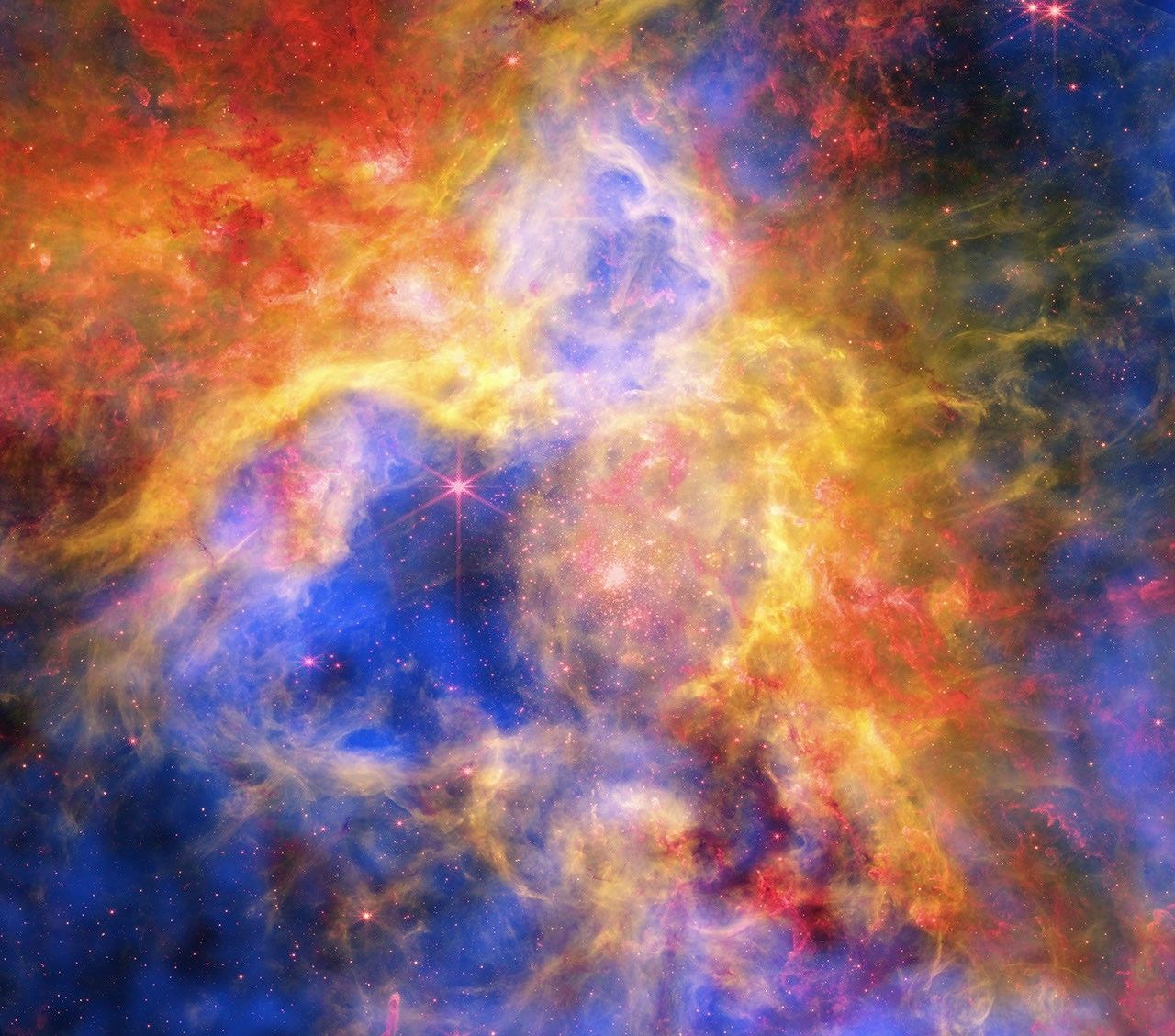
NASA's Chandra X-ray Observatory, James Webb Space Telescope, and Hubble Space Telescope have produced a composite image of 30 Doradus, commonly called the Tarantula Nebula, revealing the stellar nursery in unprecedented detail across multiple wavelengths.
The Tarantula Nebula sits in the Large Magellanic Cloud, a satellite galaxy orbiting the Milky Way approximately 160,000 light-years distant. This massive star-forming region ranks among the most luminous and energetic known to astronomers. The name derives from its appearance: radiating filaments of gas resemble a tarantula's legs.
Combining observations from three of NASA's premier observatories creates a powerful scientific tool. Chandra detects X-rays emitted by hot gas and energetic phenomena around massive stars. Hubble captures visible and ultraviolet light, showing stellar populations and nebular structure. JWST observes infrared wavelengths, penetrating dust that obscures regions invisible to other instruments. Together, these three observatories paint a complete picture of star formation across the electromagnetic spectrum.
The Tarantula Nebula contains some of the most massive stars known. These stellar giants burn intensely, live briefly, and explode as supernovae. The region's chaotic environment provides laboratory conditions for understanding how the most extreme stars form and evolve. Studying such regions illuminates stellar physics impossible to recreate in laboratories.
This composite image demonstrates the value of multi-wavelength astronomy. Different wavelengths reveal different astrophysical processes. X-rays expose violent shocks and superheated material. Visible light shows the nebula's structure and young stellar clusters. Infrared penetrates the densest dust clouds where new stars still form. No single observatory tells the complete story.
The Large Magell