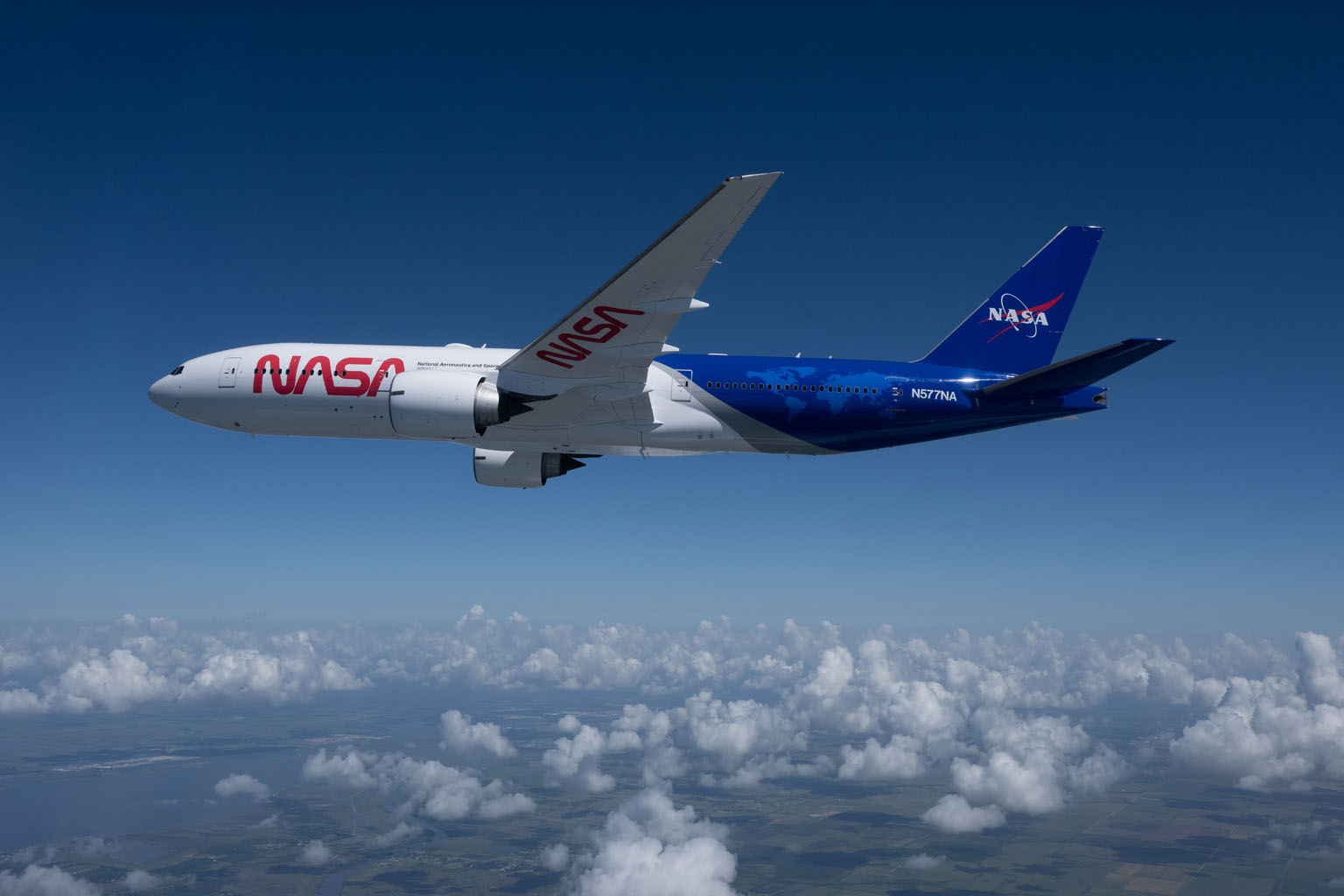
NASA has unveiled a freshly painted Boeing 777 aircraft that will enter service in 2027 as a replacement for the retired DC-8. The agency acquired the wide-body jet to expand airborne research capabilities beyond what its predecessor offered.
The B777 will operate from NASA's Langley Research Center in Hampton, Virginia, serving as a platform for earth science missions, atmospheric research, and technology demonstrations. The DC-8, which logged decades of service before retirement in 2024, conducted remote sensing studies and climate monitoring operations across thousands of missions. The newer aircraft brings modern avionics, greater fuel efficiency, and expanded payload capacity to extend NASA's observational reach.
The B777 represents a significant upgrade in range and instrumentation potential. Its larger fuselage accommodates advanced sensor packages for measuring atmospheric composition, cloud formations, ocean temperatures, and land surface changes. These measurements feed directly into climate models and weather prediction systems that inform policy decisions worldwide.
NASA's airborne research fleet operates at the intersection of fundamental science and practical application. Aircraft like the B777 gather data that ground-based and satellite instruments cannot obtain alone. Low-altitude passes allow scientists to validate satellite measurements and test new sensor technologies before they fly on orbital missions.
The paint scheme displayed in the August 2026 photograph marks the aircraft's transition from commercial configuration to research vessel. Technical modifications will outfit the fuselage with instrument racks, power systems, and data acquisition hardware tailored to specific mission requirements. NASA plans phased deployment, beginning with earth science flights before expanding to additional research domains.
The B777's entry into service extends NASA's commitment to sustained earth observation at a time when climate and weather monitoring demands unprecedented detail. Langley's location on Virginia's coast positions the aircraft for rapid deployment to atmospheric events and coastal studies. With approximately 30-40 years of potential operational life remaining, the B777 will conduct