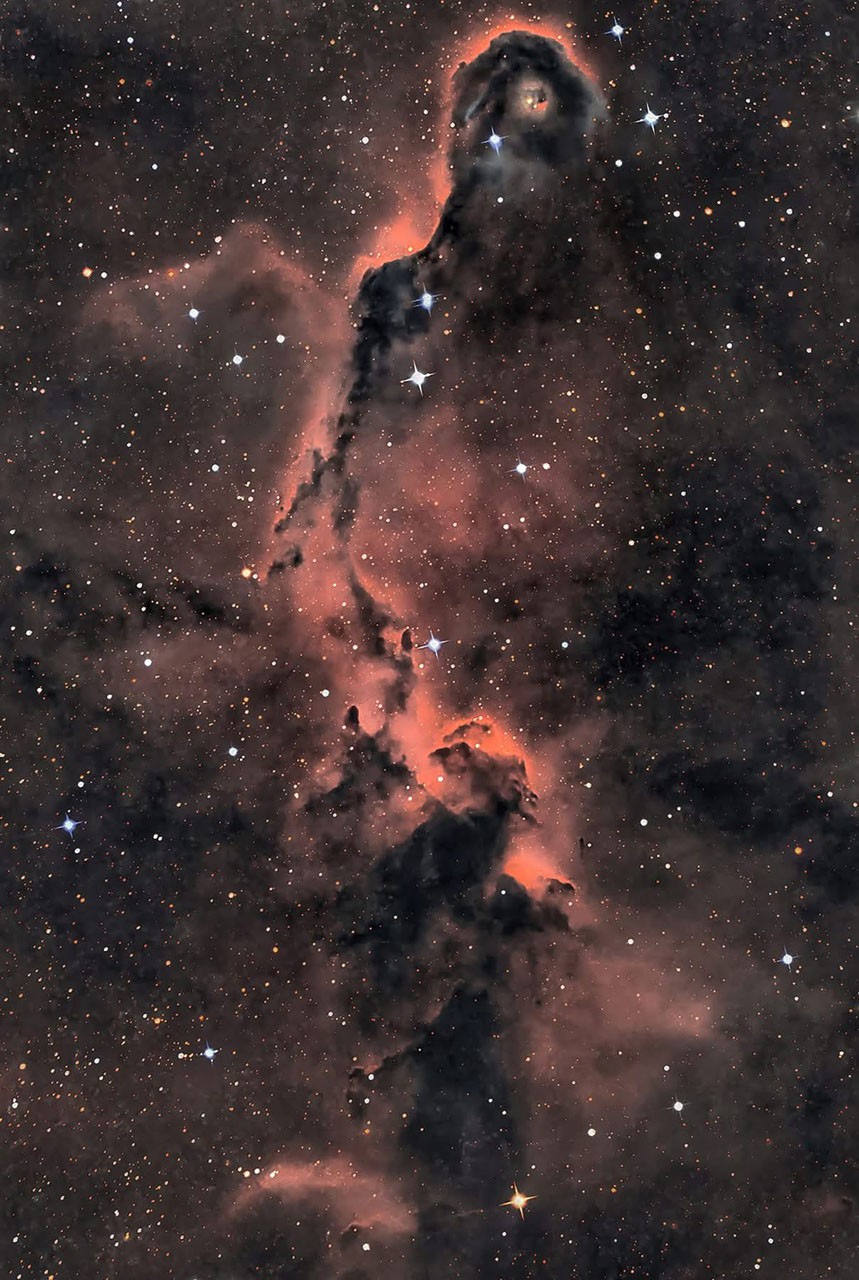
# The Elephant's Trunk Nebula Reveals Dense Star-Forming Regions
NASA's Astronomy Picture of the Day features the Elephant's Trunk Nebula, a dense molecular cloud located in the constellation Cepheus approximately 2,400 light-years from Earth. The distinctive trunk-like structure emerges from the larger IC 1396 emission nebula complex, shaped by stellar winds and radiation from massive young stars.
The nebula's appearance comes from dust and gas clouds illuminated by ultraviolet radiation from nearby hot stars. The dark filaments visible in the trunk represent regions of particularly dense material where gravity actively compresses gas and dust into new stars. Infrared observations penetrate these obscuring clouds, revealing active star formation hidden from visible-light telescopes.
The Elephant's Trunk spans roughly 20 light-years across its most prominent features. Within this region, astronomers detect signatures of protostars and young stellar objects at various evolutionary stages. The nebula serves as a natural laboratory for studying how stars form within collapsing molecular clouds and how radiation and stellar winds sculpt the surrounding environment.
Ground-based telescopes and space observatories including the Spitzer Space Telescope have mapped this region across multiple wavelengths. These observations show that the trunk contains several compact infrared sources, indicating recent and ongoing stellar birth. The interaction between newly formed stars and their natal clouds creates the complex structures visible today.
The Elephant's Trunk exemplifies how stellar nurseries remain dynamic environments. Radiation pressure from massive young stars compresses surrounding gas layers, paradoxically triggering additional star formation at the cloud's edges. This feedback mechanism has shaped the nebula's distinctive morphology over thousands of years.
APOD presents this image to illustrate fundamental astrophysical processes. The nebula demonstrates how gravity, radiation, and stellar winds interact to shape