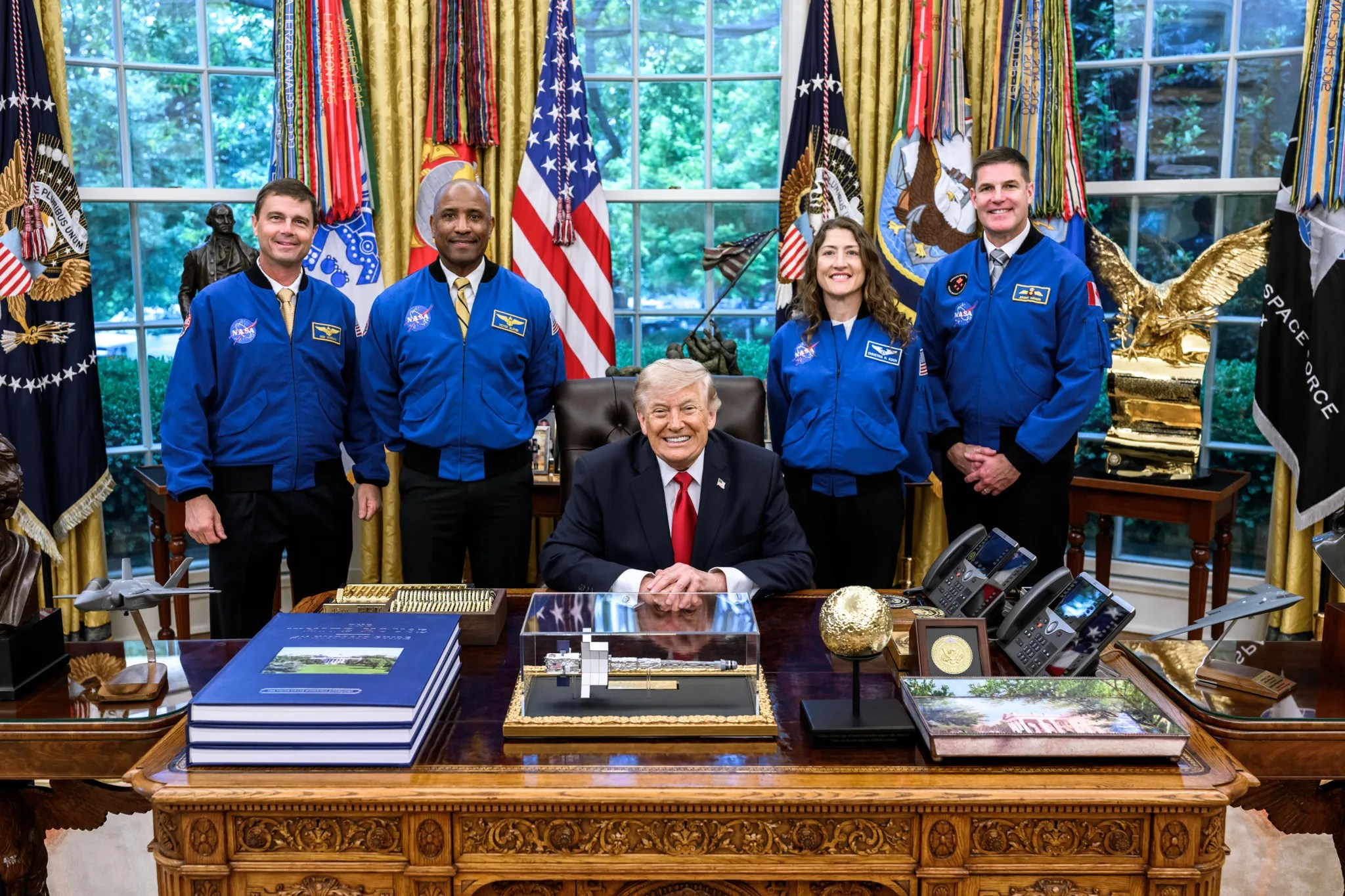
President Donald Trump will present the Congressional Space Medal of Honor to the four astronauts of NASA's Artemis II mission during a ceremony at Johnson Space Center in Houston on Friday, August 28, at 11 a.m. EDT. The honor recognizes NASA astronauts Reid Wiseman, Victor Glover, and Christina Koch, along with Canadian Space Agency astronaut Jeremy Hansen.
The Congressional Space Medal of Honor stands as the highest civilian space achievement award granted by the United States government. Congress established the medal in 1978 to recognize exceptional contributions to space exploration and advancement of human spaceflight. Recipients join an elite group of explorers and scientists who have fundamentally advanced humanity's reach beyond Earth.
Artemis II represents a watershed moment in lunar exploration. The mission will send a crewed spacecraft on a trajectory around the Moon, marking the first time humans have ventured beyond low Earth orbit since the Apollo 17 mission in 1972. Unlike Apollo, which landed humans on the lunar surface, Artemis II focuses on systems validation and crew operations in deep space. The mission tests the Space Launch System heavy-lift rocket and the Orion spacecraft in conditions approaching those required for Artemis III, which will attempt to land humans near the Moon's south polar region.
Reid Wiseman commands the mission, drawing on his experience from three previous spaceflights and over 400 hours in orbit. Victor Glover, the pilot, brings expertise from his work on the International Space Station and represents another milestone as an African American astronaut advancing beyond low Earth orbit. Christina Koch serves as mission specialist, her background spanning ISS expeditions and extensive spacewalk experience. Jeremy Hansen, the Canadian addition to the crew, becomes the first non-American to travel beyond low Earth orbit since the 1970s, strengthening the international partnership that defines modern space exploration.
The Artemis program, managed by NASA's Exploration Systems Development Mission Directorate, represents a multi-agency and international effort to establish sustainable human lunar exploration. The program builds on lessons from Apollo while leveraging modern technology, international partnerships, and commercial spaceflight capabilities. The Space Launch System, developed by NASA and contractors including Boeing, produces thrust exceeding that of the Saturn V rockets that powered Apollo missions. Orion, built by Lockheed Martin, incorporates advanced life support, radiation shielding, and autonomous systems.
The award timing reflects recognition of the crew's preparation and commitment to returning humans to deep space. These astronauts undertake years of intensive training, technical mastery, and physical conditioning to operate spacecraft in environments where communication delays reach several seconds and rescue options remain limited. Their selection for Artemis II places them at the forefront of humanity's next phase of lunar exploration.
The medal ceremony at Johnson Space Center, located in Houston, Texas, carries symbolic weight. Johnson Space Center remains mission control for human spaceflight operations and home to NASA's astronaut corps since the Mercury program began in the 1960s. The location anchors this recognition within the institutional continuity of American space exploration, from the initial efforts to reach orbit through current plans to establish a sustained human presence on the Moon and beyond.