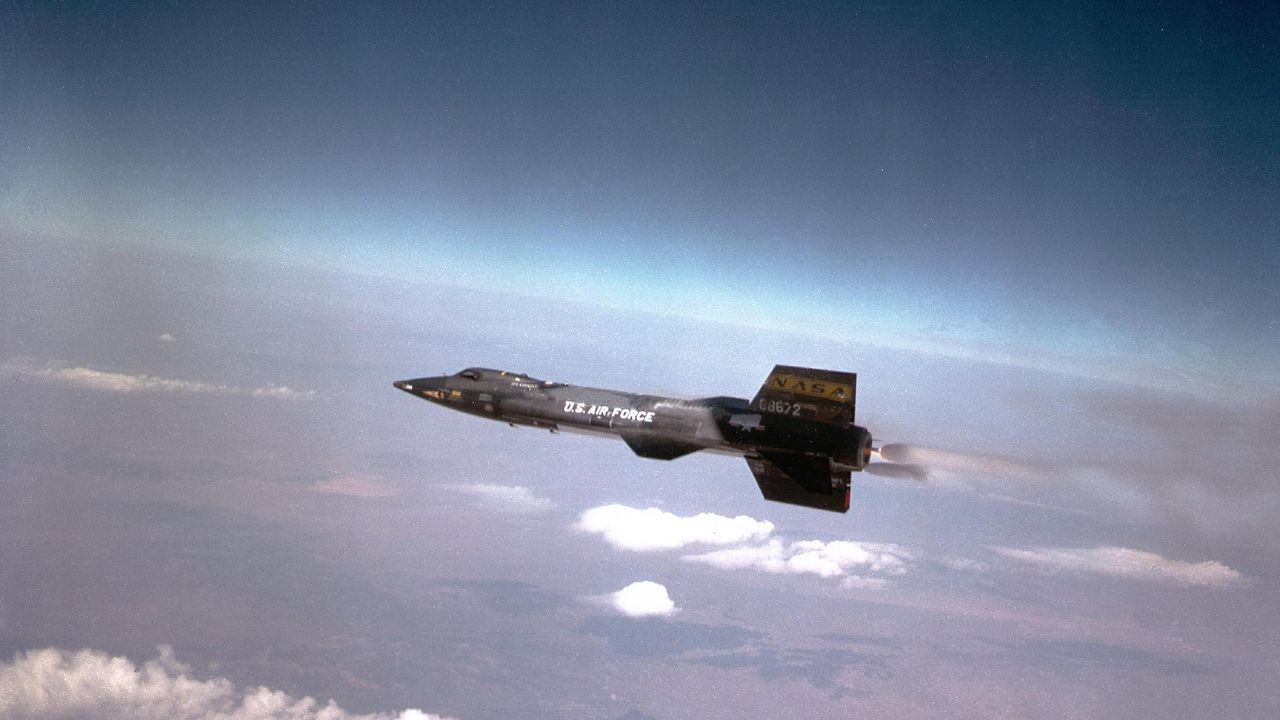
On August 22, 1963, U.S. Air Force Captain Joe Walker piloted the North American X-15 rocket plane to an altitude of 354,200 feet (107.96 kilometers), establishing a world altitude record that stood for decades and fundamentally advancing hypersonic flight research.
Walker's achievement marked a pivotal moment in aerospace history. Flying from Edwards Air Force Base in California, he pushed the X-15 beyond the boundaries of conventional aviation into the realm of spaceflight itself. The X-15 program, a collaboration between NASA, the U.S. Air Force, and North American Aviation, had spent years testing the limits of human-piloted hypersonic flight. Walker's record flight demonstrated that a crewed aircraft could operate reliably in the extreme conditions of the upper atmosphere.
The X-15 itself represented cutting-edge engineering for its era. The sleek, rocket-powered aircraft relied on a Reaction Motors XLR99 engine that produced 57,850 pounds of thrust. Pilots controlled the craft using unconventional methods at extreme altitudes where aerodynamic control surfaces became useless. Above a certain altitude, reaction control thrusters using hydrogen peroxide allowed pilots to maneuver the aircraft before re-entering the denser atmosphere.
Walker's August 1963 flight pushed the X-15 to Mach 5.51, traveling at speeds exceeding 3,600 miles per hour. At that altitude, he experienced weightlessness and saw the Earth's curvature. The data gathered during this flight proved invaluable for understanding how aircraft could transition between atmospheric and space flight regimes. Engineers and pilots learned lessons about thermal protection, stability control, and human performance that influenced later spacecraft design.
The record Walker set that day persisted as the highest altitude achieved by a crewed, winged aircraft for many years. It would not be surpassed by an aircraft until decades later, underscoring the extraordinary achievement of both pilot and machine. Walker himself became one of the most accomplished test pilots of the X-15 program, ultimately flying the aircraft 25 times.
The X-15 program itself operated from 1959 to 1968, producing data that proved essential to NASA's Mercury, Gemini, and Apollo programs. Test pilots who flew the X-15 gained experience with high-speed flight, emergency procedures, and physiological responses to extreme environments. Several X-15 pilots later transitioned to NASA's astronaut corps.
Walker's 1963 record flight embodied the experimental spirit of the early Space Age. At a time when human spaceflight remained extraordinarily dangerous and poorly understood, pilots like Walker volunteered to push aircraft into unexplored regimes. Their flights provided the foundation for safer, more reliable crewed spaceflight. The X-15 program demonstrated that human pilots could effectively control aircraft in near-space conditions, knowledge that informed spacecraft design and astronaut training protocols well into the space shuttle era and beyond.