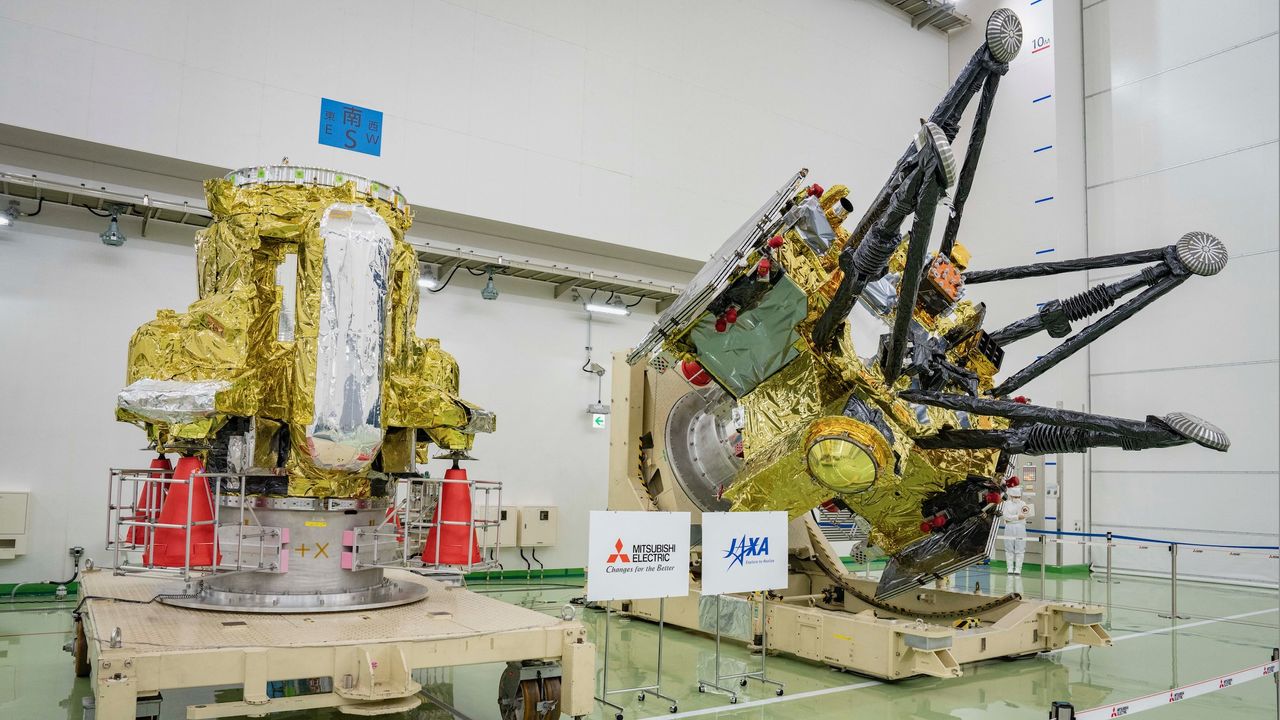
Japan's space agency JAXA unveiled the Martian Moon eXploration (MMX) spacecraft this month, revealing the orbiter and sample-collection hardware destined for one of humanity's most ambitious planetary science missions. The spacecraft launches October 19 from Japan's Tanegashima Space Center aboard an H-IIA rocket, beginning a seven-year journey to Mars' largest moon, Phobos.
MMX represents a rare international collaboration in deep space exploration. Japan leads the mission with contributions from the French space agency CNES, Germany's DLR, the United Arab Emirates, and NASA. The spacecraft carries sophisticated instruments to analyze Phobos' geology, measure its composition, and ultimately collect samples from the moon's surface for return to Earth.
Phobos, only 22 kilometers across at its widest point, orbits Mars every 7.6 hours. Scientists theorize the moon may be a captured asteroid, making it a window into the early solar system's formation and composition. Alternatively, Phobos could be debris ejected from Mars itself during a massive impact. Sample analysis will settle this fundamental question about planetary geology.
The MMX spacecraft includes a spherical main orbiter that will conduct remote sensing observations while circling Mars. A separate robotic lander will touch down on Phobos' surface to collect samples using a pneumatic collection mechanism. This approach avoids the contamination risks of drilling and preserves pristine geological material. The rover component, contributed by CNES, will also conduct ground-truth observations before sample collection begins.
The mission timeline demands precision. After launch in October 2024, MMX arrives at Mars in 2025. The spacecraft spends approximately one year in Mars orbit conducting reconnaissance and selecting optimal sample sites. The lander then separates and descends to Phobos, where it deploys collection equipment and gathers material from multiple locations on the moon's surface. A return capsule then ascends from Phobos, rendezvous with the orbiter, and begins the journey home.
Earth arrival occurs in 2029. Scientists anticipate receiving roughly 10 grams of Phobos material, a modest amount by terrestrial standards but transformative for planetary science. Laboratories around the world will analyze these samples using techniques impossible to perform remotely. Isotopic ratios will reveal Phobos' age. Mineral compositions will constrain formation models. Organic compounds, if present, will inform discussions about delivery mechanisms for Earth's prebiotic chemistry.
JAXA's MMX mission follows decades of Japanese deep space achievement. The Hayabusa missions returned samples from asteroid Ryugu and Itokawa respectively. The Akatsuki orbiter studies Venus' atmosphere. These successes positioned Japan as a leader in sample-return missions, a capability now being applied to the Mars system itself.
The October 19 launch window opens a critical opportunity. Mars and Earth alignment occurs only once every 26 months. Missing this launch window delays the mission by more than two years. NASA's Perseverance rover and China's Zhurong rover already operate on Mars' surface, but MMX targets a destination those rovers cannot reach. Phobos samples will answer questions that only returned material can resolve.