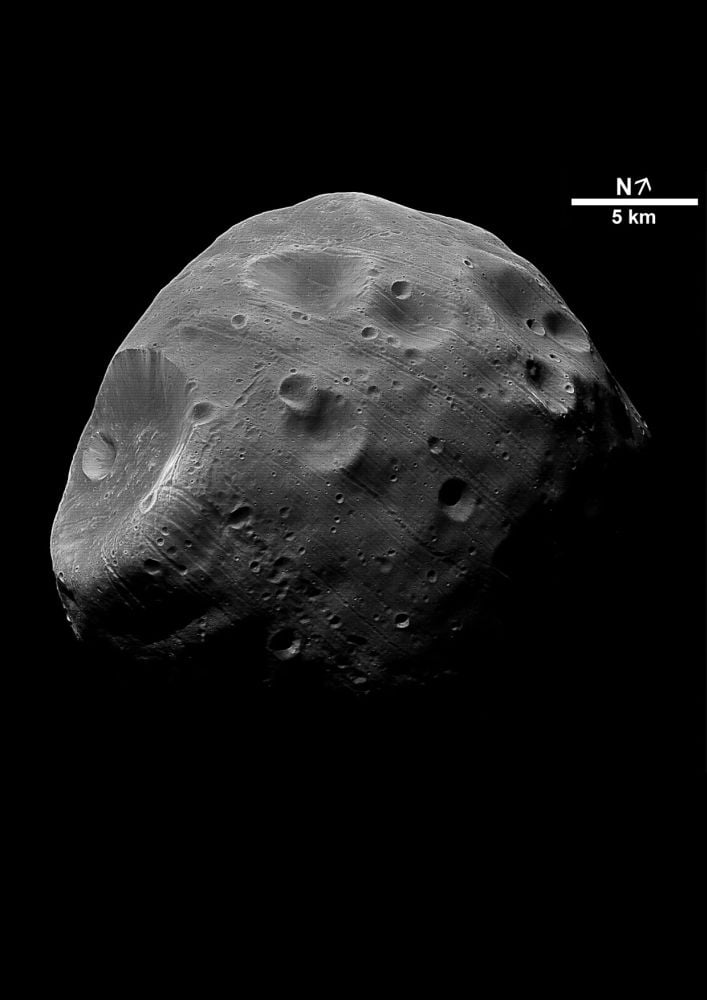
Japan's space agency JAXA launches its Martian Moons eXploration (MMX) mission next month to collect samples from Phobos, Mars's smaller moon. Before that touchdown, scientists have completed a new high-resolution surface atlas of Phobos that will guide where the spacecraft collects its samples.
The atlas builds on imagery from the ESA's Mars Express orbiter, particularly data captured by the High Resolution Stereo Camera (HRSC). Researchers at the Freie Universität Berlin processed that data to map Phobos in unprecedented detail, revealing features called Regolith Migration Pathways. These pathways track how loose surface material moves across the moon's cratered, potato-shaped terrain.
Understanding regolith migration matters for sample collection. Phobos lacks an atmosphere and substantial gravity, so surface material behaves in ways entirely different from Earth or even the Moon. Fine dust and rock fragments migrate along slopes and topographic features. By mapping these pathways, the MMX team can identify locations where fresh subsurface material has been exposed or where ancient material has accumulated.
The MMX spacecraft will perform an extraordinary feat. It will land on Phobos, collect multiple samples, and return them to Earth. This marks the first sample return from a Martian moon. The collected material could answer fundamental questions about how the Martian system formed and whether Phobos originated as an asteroid captured by Mars's gravity or accreted from the same disk of material that built Mars itself.
Phobos orbits Mars at roughly 9,000 kilometers per hour, completing one revolution every 7.6 hours. It sits so close to Mars that tidal forces gradually pull it inward. In roughly 30 to 50 million years, Phobos will either collide with Mars or break apart into a ring system. This urgency adds to the science case for sample collection now.
The MMX mission carries instruments from JAXA, the French space agency CNES, and the German space agency DLR. It includes a robotic arm capable of collecting material from multiple locations on Phobos's surface. The spacecraft itself was built through international collaboration, reflecting the complexity of reaching and sampling a target so small and so far from Earth.
The new atlas emerged from collaboration between planetary scientists who recognized that orbital imagery alone cannot answer every question about where to dig. The High Resolution Stereo Camera data provides stereo pairs of images that allow researchers to build three-dimensional models of the surface. From those models, they traced regolith migration patterns. Darker material in certain locations indicates that fresh material has been exposed, likely excavated by recent impacts.
JAXA's commitment to MMX reflects Japan's expanding role in deep-space exploration. The agency successfully executed the Hayabusa2 mission to asteroid Ryugu, returning samples in 2020. The MMX mission applies that expertise to an even more distant and dynamic target.
The samples collected from Phobos will undergo analysis at laboratories worldwide. Radiometric dating will establish when Phobos formed. Compositional analysis will reveal whether it shares affinities with asteroids or Martian material. Isotopic ratios could point to formation conditions and the role of water and volatiles in the Martian system's history.
MMX's launch window opens next month. The spacecraft will spend years in transit and orbit before the actual sampling phase begins. By then, the surface atlas will have served its purpose, transforming raw orbital data into actionable knowledge for one of humanity's most ambitious sample return missions.