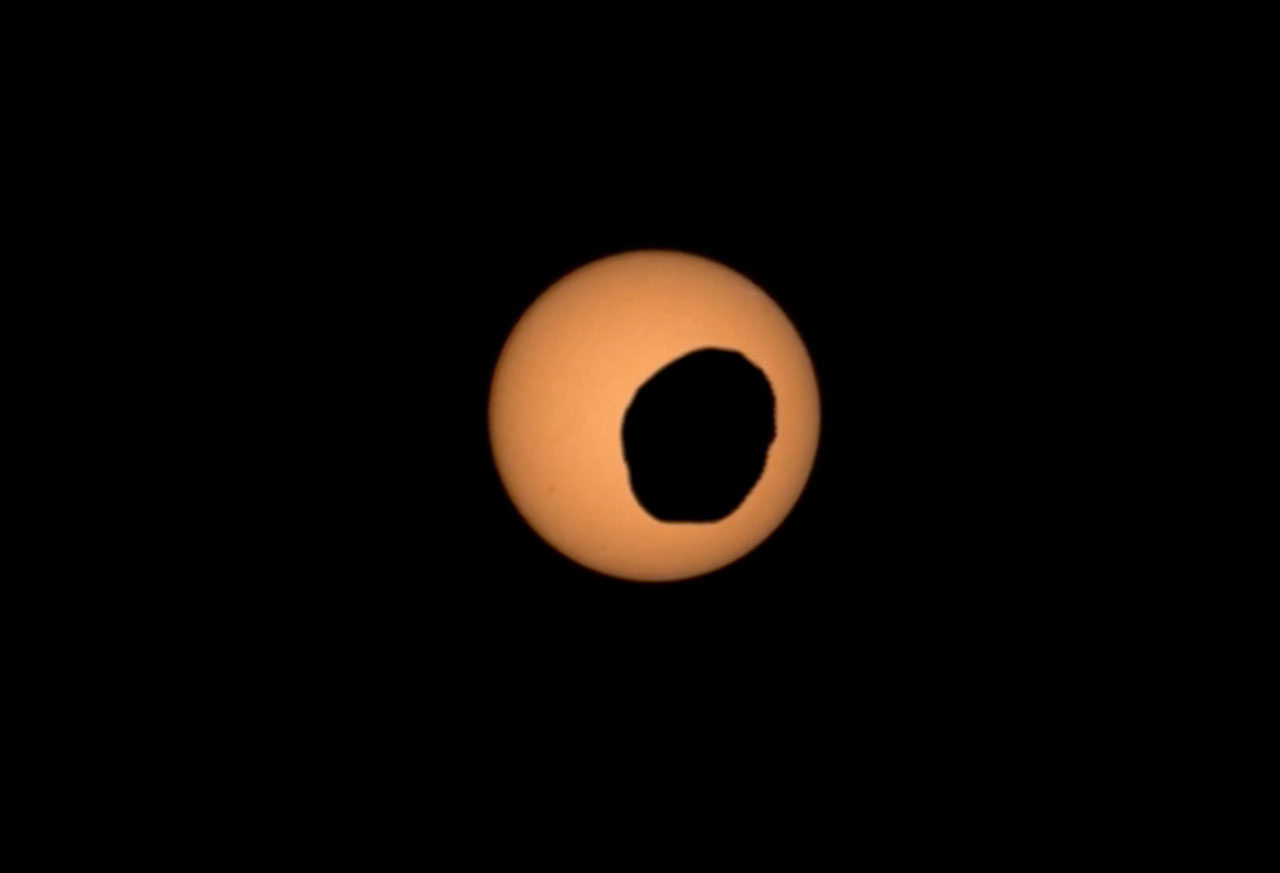
NASA's Perseverance rover has captured fresh imagery of Phobos transiting across the Sun from Mars' surface, adding another data point to the rover's ongoing study of the Red Planet's moon system. On Sol 1948 (August 12, 2026), Perseverance's Mastcam-Z camera recorded Phobos' silhouette as it crossed in front of the solar disk, with the animation processed to represent how human observers would perceive the event.
These transit observations serve multiple scientific purposes beyond their visual appeal. By documenting Phobos' precise position and movement across the solar disk, Perseverance refines our understanding of the moon's orbital mechanics. Each transit captures timing data that helps scientists calculate Phobos' position with greater accuracy, information essential for future crewed missions to Mars that will require precise knowledge of the Martian moon system.
Phobos ranks among the solar system's most intriguing celestial bodies. The moon orbits Mars every 7.7 hours, closer to its parent planet than any other moon to its primary in the solar system. This proximity creates tidal forces that gradually pull Phobos toward Mars. Calculations indicate Phobos will either crash into Mars or shatter into a ring system within 30 to 50 million years, making the moon geologically ephemeral on cosmic timescales.
Perseverance's Mastcam-Z provides a unique vantage point for these observations. The camera system, mounted on the rover's mast, offers both wide-angle and telephoto imaging capabilities, allowing detailed documentation of solar transits that ground-based telescopes struggle to resolve with comparable precision. Previous rovers, including Curiosity, have captured similar events, but each new observation adds to a cumulative archive that tracks orbital variations and validates predictive models.
The rover's transit imaging program serves broader exploration goals. Precise measurement of Phobos' position helps constrain models of Mars' gravity field and internal structure. The moon's orbit responds to Mars' gravitational asymmetries, and careful tracking of these effects yields geophysical data about how mass distributes within the Martian interior. This information informs understanding of Mars' thermal evolution and crustal composition.
Transit observations also prepare for future human exploration. NASA's Artemis-adjacent plans include eventual Mars missions where astronauts will operate on the surface and potentially study or orbit around the Martian moons. Pre-positioned orbital data about Phobos' exact trajectory, derived from observations like Perseverance's, reduces navigation uncertainty for future spacecraft. Accurate ephemerides become critical infrastructure for mission planning and safety.
Perseverance continues its science campaign in Jezero Crater after more than four years on Mars. The rover has exceeded its primary mission duration and maintains full operational capability across its instrument suite. Transit observations represent one component of Perseverance's comprehensive Mars characterization, complementing its core focus on seeking biosignatures and understanding Jezero's habitability history.
Such observations exemplify how rover missions generate data across multiple scientific disciplines simultaneously. A single imaging sequence contributes to planetary science, orbital mechanics validation, and human exploration preparation. As Perseverance ages, each observation becomes part of the foundational knowledge base that will enable humanity's next phase of Mars exploration.