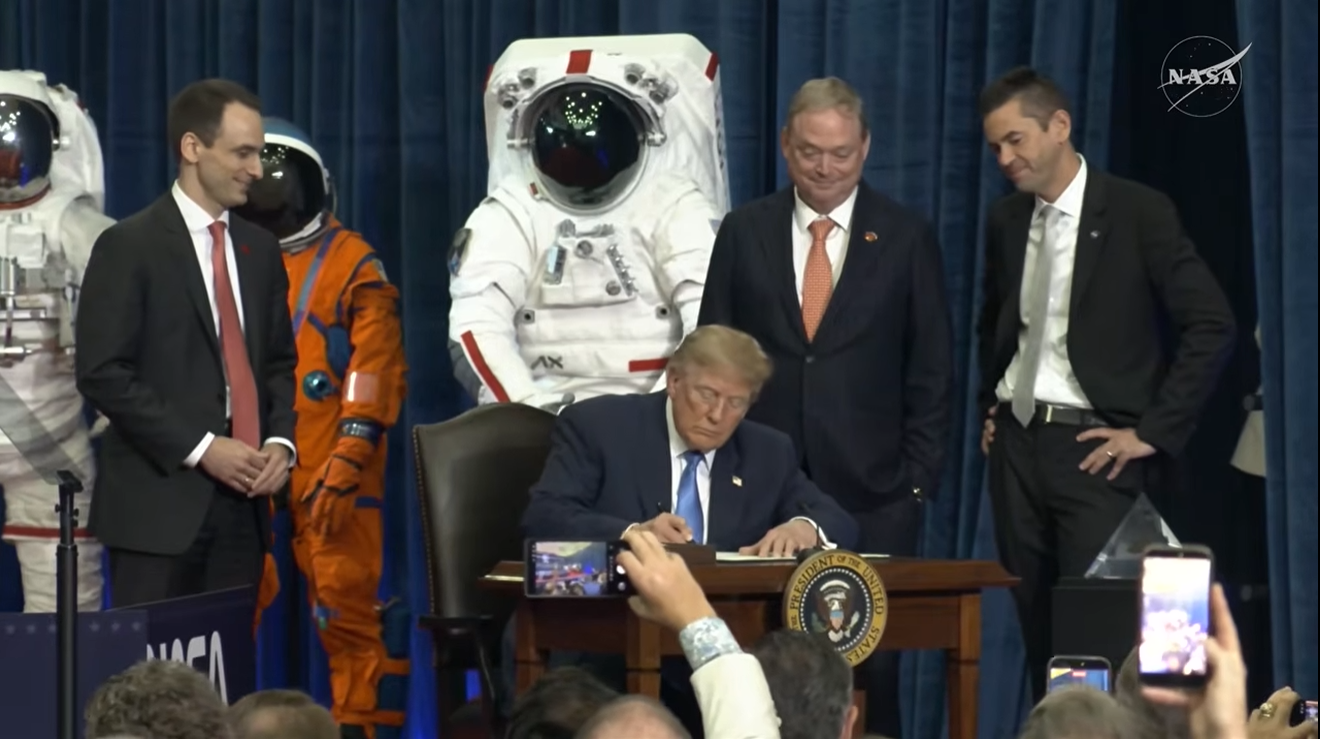
President Donald Trump signed an executive order Friday establishing the United States Space Academy, the nation's first dedicated institution for training space professionals and leaders. The order frames space exploration and operations as cornerstones of national security, economic competitiveness, and technological advancement.
The Space Academy will function as a centralized training and education hub designed to develop the next generation of space workforce talent. The executive order identifies space as a critical domain alongside defense, commerce, and science. Administration officials emphasized that a dedicated academy structure mirrors successful models in military and aviation sectors, where specialized academies have produced cohesive professional cadres for decades.
The timing reflects the accelerating role space plays in American strategic interests. Commercial spaceflight companies including SpaceX, Blue Origin, and Axiom Space have expanded launch capacity and reduced costs. Simultaneously, the Department of Defense and Space Force have expanded operations across orbital altitudes. NASA missions to the Moon under Artemis and long-term Mars exploration plans require trained personnel at scale.
Details about curriculum, location, and timeline remain sparse. The executive order signals intent but delegates implementation specifics to relevant agencies. The Space Force, which currently operates Space Force Academy in Colorado Springs and runs officer training programs, will likely play a central coordinating role. NASA and the Department of Commerce may contribute expertise in civilian space operations and commercial industry partnerships.
Workforce development represents a genuine challenge for the space sector. SpaceX, NASA, and the Space Force compete for engineers, software developers, and mission specialists. A Space Academy could standardize entry-level training, establish shared professional standards, and create career pathways across government and private sectors. Such coordination benefits all entities by reducing duplication and building bench strength.
The academy concept draws from aerospace precedent. The Air Force Academy, founded in 1954, produces officers who lead military aviation and space operations. The Commercial Astronaut Training Program under NASA certification recognizes private sector spaceflight personnel. A Space Academy could formalize what currently happens through scattered institutional channels.
Educational institutions including MIT, Caltech, and the University of Colorado already produce space engineers and scientists. A federally chartered Space Academy would differ by focusing on professional credential development, operational training, and workforce pipeline management rather than academic degree conferral. The model might resemble the Naval Academy or Air Force Academy but with explicit dual-track emphasis on military space operations and commercial industry readiness.
International context matters here. China and Russia operate state-sponsored space training systems. European nations coordinate through the European Space Agency. A consolidated American Space Academy signals institutional commitment to maintaining space leadership as competition intensifies.
Implementation challenges include budget allocation, facility construction, faculty recruitment, and curriculum design. Coordinating across the Space Force, NASA, commercial partners, and civilian agencies requires sustained interagency cooperation. The executive order initiates that process but does not resolve operational details.
The executive order represents organizational infrastructure for ambitions already underway. Artemis missions targeting lunar return by 2026 require trained personnel. Deep Space Gateway construction and eventual Mars missions demand specialized expertise. Commercial space stations and orbital manufacturing ventures need qualified crews. A dedicated Space Academy aims to supply that talent systematically rather than through ad hoc hiring and training.