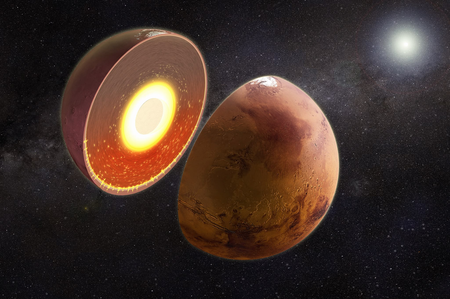
NASA's Jet Propulsion Laboratory and international collaborators have discovered a striking thermal asymmetry within Mars. The southern hemisphere's interior runs approximately 400 degrees Celsius hotter than the northern hemisphere, according to seismic data analyzed from the InSight lander's mission on Mars.
The InSight Mars Lander, which operated from 2018 to 2022, deployed seismometers that detected and measured marsquakes. By analyzing how seismic waves traveled through the planet's crust and mantle, scientists reconstructed a thermal map of Mars's interior. This revealed that the southern region maintains substantially elevated temperatures compared to the north.
This temperature gradient has profound implications for understanding Mars's geological history and current internal dynamics. The warmer southern hemisphere suggests active or recently active geothermal processes occurring beneath the surface. Heat retained in the south could drive residual volcanic activity, mineral alteration, and possibly subsurface water reservoirs. These subsurface environments represent potential habitats for microbial life forms, making them priority targets for future human exploration and sample-return missions.
The thermal disparity reflects Mars's cooling history. The Red Planet lost its global magnetic field approximately 4 billion years ago, exposing its thin atmosphere to solar wind erosion. This same cooling process that shut down the dynamo generating the magnetic field also triggered planetary-scale geological changes. The asymmetry suggests uneven heat loss or variable crustal composition between hemispheres.
Scientists theorize multiple mechanisms could account for this difference. The southern highlands contain thicker crust composed of ancient material, while the northern lowlands feature thinner crust overlying warmer mantle. Alternatively, concentrated geothermal heat sources beneath the southern hemisphere such as residual radioactive decay of uranium, thorium, and potassium in the mantle could maintain elevated temperatures locally.
The discovery comes from InSight's unprecedented seismic catalog. The lander recorded over 1,300 marsquakes during its operational life, far exceeding initial expectations. This data stream enabled researchers to construct detailed three-dimensional images of Mars's internal structure using techniques borrowed from terrestrial seismology. Waves traveling through different rock types at different speeds revealed density and temperature variations invisible to surface observation.
This research directly informs NASA's Artemis program goals and long-term Mars exploration strategy. If the southern hemisphere harbors subsurface heat and liquid water, drilling operations could access these reservoirs. The resulting data would revolutionize astrobiology by revealing whether Mars hosted or still hosts microbial ecosystems. Geothermal heat sources could also support human habitats during future crewed missions to Mars, providing warmth and potentially driving resource extraction operations.
Future missions will build on InSight's foundation. The Seismic Experiment for Interior Structure (SEIS) technology demonstrated on InSight influenced designs for next-generation seismic networks planned for upcoming landers. NASA and international partners are developing more sensitive instruments to penetrate deeper into Mars's interior. These advances will map crustal variations with higher resolution, identify additional thermal anomalies, and potentially locate subsurface aquifers or volcanic reservoirs.
The 400-degree temperature difference represents one of the most significant discoveries from InSight's seismic campaign. It rewrites understanding of Mars's current internal state and opens new pathways for both scientific exploration and eventual human settlement on another world.