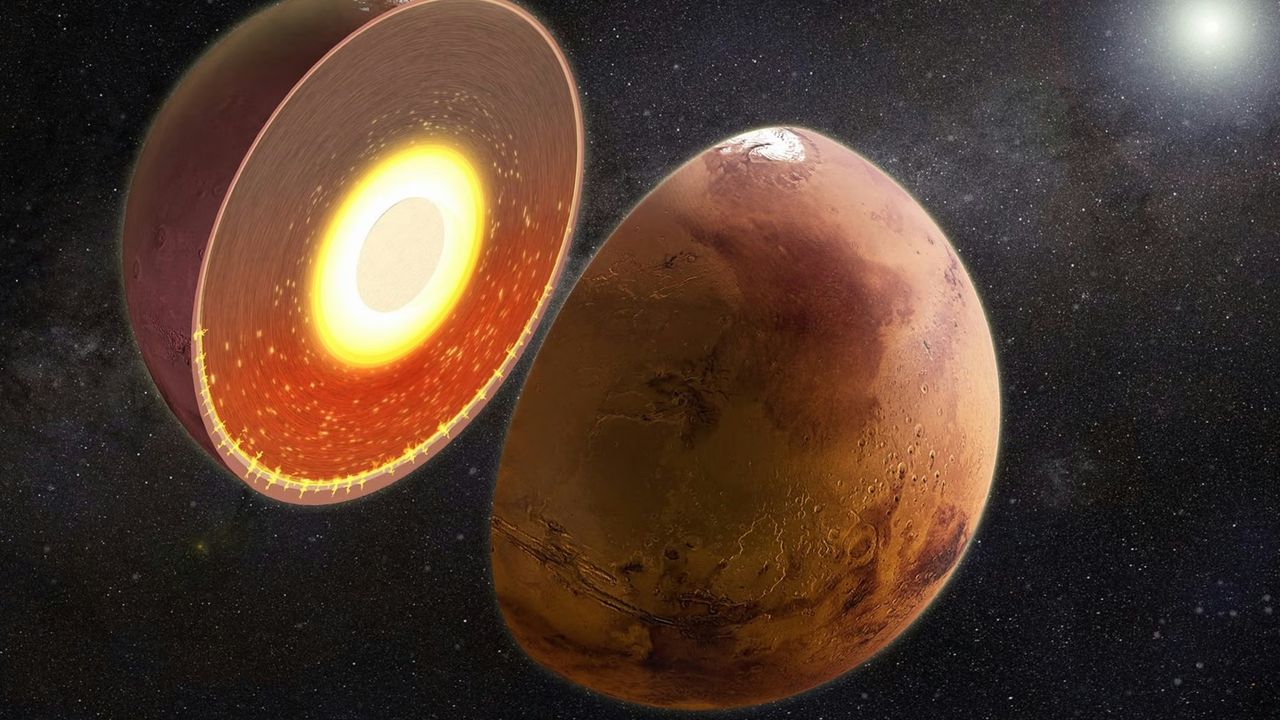
# Scientists Uncover Massive Thermal Anomaly in Mars' Interior
Researchers investigating Mars' subsurface structure have identified a substantial thermal anomaly, revealing new details about the stark geological divisions within the Red Planet. This discovery deepens our understanding of Martian planetary evolution and the processes that shaped two dramatically different hemispheres.
Mars has long puzzled scientists with its pronounced dichotomy. The northern lowlands consist of smooth volcanic plains, while the southern highlands feature ancient, heavily cratered terrain. The southern regions also sit roughly 6 kilometers higher in elevation than the north. Understanding what drives these differences requires examining what occurs beneath the surface, where temperature gradients and internal heat flow tell the story of planetary history.
The thermal anomaly detected by researchers suggests concentrated regions of elevated heat within Mars' crust or mantle. Such anomalies typically result from residual magmatism, variations in radiogenic heat production from decaying elements like uranium and thorium, or differences in crustal thickness. The location and magnitude of this feature provide clues about the planet's cooling history and internal composition.
Mars possesses no global magnetic field today, but evidence indicates it once maintained a magnetosphere early in its history. The loss of this field may relate to changes in the planet's interior dynamics. By mapping thermal variations, scientists can infer whether the Martian core still generates heat, how efficiently that heat escapes, and whether active geological processes continue beneath the surface.
Recent orbital missions, particularly NASA's Mars Reconnaissance Orbiter and MAVEN spacecraft, along with seismic data from NASA's InSight lander (which concluded operations in 2022), have provided unprecedented resolution of Martian subsurface conditions. These instruments detect temperature variations through multiple methods, including gravity measurements, magnetometer readings, and direct seismic analysis. The thermal anomaly likely represents a composite finding from this multimethod approach.
The northern-southern dichotomy poses questions about Mars' early evolution. One leading hypothesis suggests a giant impact billions of years ago altered the planet's spin axis and crustal properties. Another theory proposes asymmetric cooling of the mantle or differences in crustal formation processes. A thermal anomaly concentrated in one hemisphere could support these models by showing uneven heat distribution today.
For future Mars exploration, this discovery holds practical importance. Subsurface heat sources could represent locations where microbial life might persist protected from radiation. Ground-penetrating radar aboard rovers and orbiters can more precisely map these anomalies. Identifying geothermal zones also informs landing site selection and resource prospecting for eventual human missions, as thermal features often correlate with hydrothermal mineral deposits.
NASA's Perseverance rover and the Chinese Zhurong rover continue collecting surface data that complement orbital thermal studies. The next-generation ExoMars rover from the European Space Agency, delayed but still planned, will drill deeper than previous missions to sample subsurface materials. These tools will refine understanding of how interior heat influences surface geology and whether conditions favorable for past or present life exist underground.
The thermal anomaly research confirms Mars remains geologically active in its deep interior, even if surface volcanism ceased billions of years ago. This ongoing internal differentiation shapes the planet's present state and will inform strategies for human exploration, habitability assessment, and the search for biosignatures in Martian rocks.