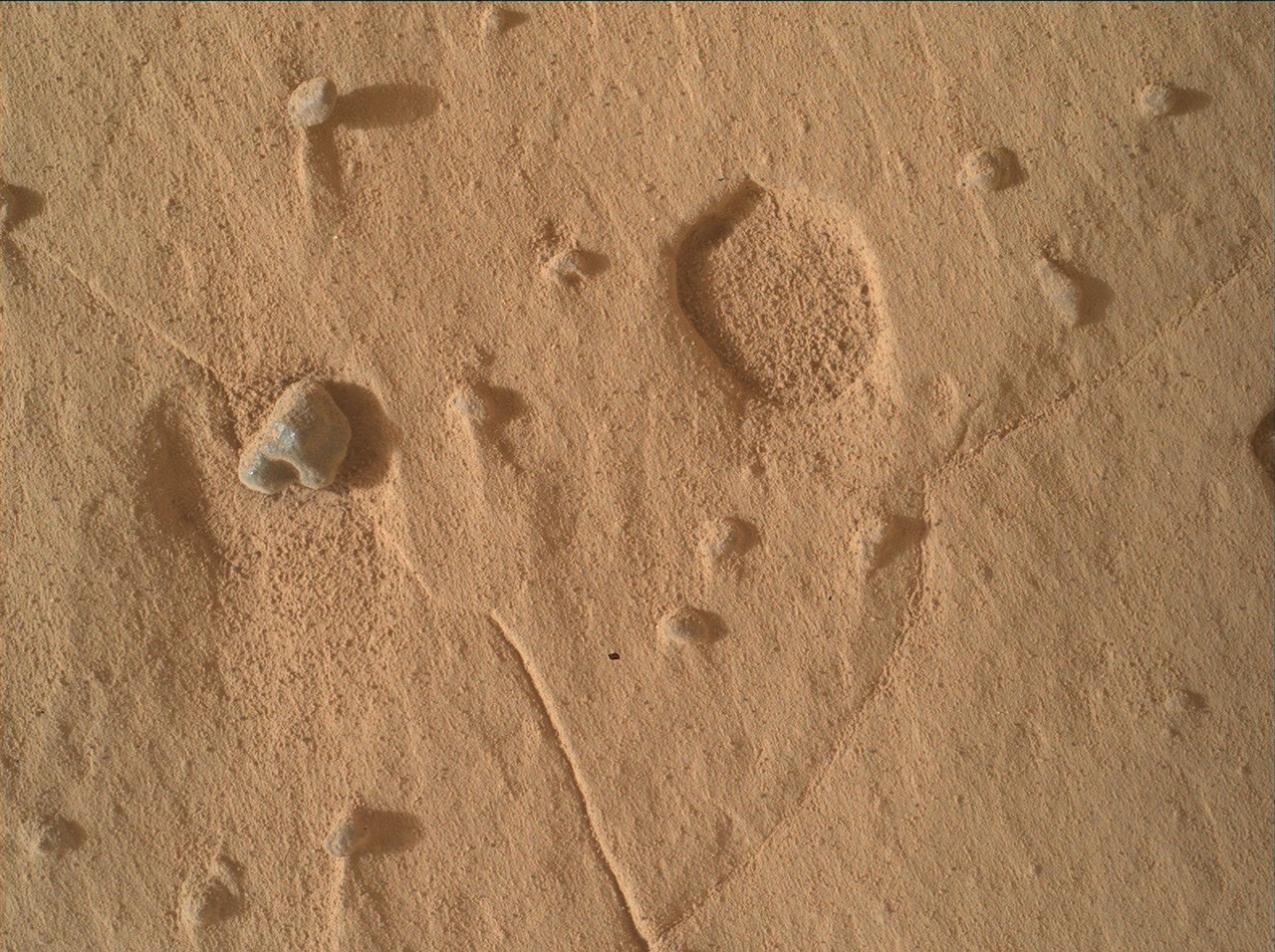
NASA's Curiosity rover, fourteen years into its mission on Mars, continues to reveal geological features that defy the rover's accumulated experience. During sols 4988-4994 (Mars days), the rover encountered broad, shallow pits in two separate work areas, formations that stand apart from anything the mission's science team has documented in nearly a decade and a half of exploration.
The discovery underscores a fundamental truth about planetary science. Mars remains geologically active and diverse. Even after fourteen years and thousands of sols of operation, Curiosity encounters terrain that demands new explanations and expanded understanding of Martian processes.
Curiosity touched down in Gale Crater on August 6, 2012, as part of NASA's Mars Science Laboratory mission. The rover was designed for a two-year mission. Instead, it has operated continuously for more than seven times that duration, far exceeding its original specifications. That longevity has transformed Curiosity from a single-mission rover into a platform for sustained geological reconnaissance.
Michelle Minitti, Deputy Principal Investigator for MAHLI (Mars Hand Lens Imager), authored this week's blog entry. MAHLI serves as Curiosity's microscopic camera, capable of capturing details at scales impossible for the rover's other instruments. The instrument has proven essential for understanding fine-scale mineralogy and surface textures, precisely the level of detail needed to comprehend unusual features like these shallow pits.
The pits themselves present a puzzle. Broad, shallow excavations in Martian regolith and bedrock can form through multiple mechanisms. Wind erosion across eons can create deflation features. Subsurface ice loss, followed by surface collapse, produces thermokarst terrain. Erosion along bedding planes in layered deposits leaves behind step-like features. Distinguishing between these processes requires detailed observation of pit geometry, internal structure, and surrounding terrain.
Curiosity's science team operates in real time from Earth. The rover receives commands daily, adjusted based on what previous sols revealed. This adaptive approach allows scientists to investigate unexpected features immediately rather than following a predetermined script. The team can direct Curiosity to image unusual formations from multiple angles, deploy instruments for close-up analysis, and revise the next day's plan accordingly.
The rover's Radiation Assessment Detector measures cosmic ray interactions and solar radiation, data essential for future human missions. The Sample Analysis at Mars (SAM) instrument suite continues drilling into bedrock and analyzing volatiles. Radiation measurements and organic compound detection inform decisions about where humans can safely land and work on Mars.
Curiosity's journey through Gale Crater has mapped a geological narrative spanning billions of years. The crater floor contains layered deposits that record ancient climate conditions. Mount Sharp (Aeolis Mons), rising 5.5 kilometers above the crater floor, presents a cross-section through Martian history written in stone.
At fourteen years, Curiosity operates with a worn wheel and degraded solar panels. Parts that have conducted trillions of measurements show their age. Yet the rover remains functional enough to surprise a team that has studied Mars with it longer than any human has visited Earth continuously. These shallow pits, unlike anything seen before, represent precisely the kind of discovery that justifies extended missions to other worlds. Mars holds answers that emerge only through sustained, adaptive exploration.