# Two Spacecraft Converge on Mercury: BepiColombo's Epic Arrival Begins
The European-Japanese BepiColombo mission enters the climactic phase of its seven-year journey today. Starting Sept. 3, the twin spacecraft will begin a series of ten orbital maneuvers that will progressively slow their approach to Mercury, the solar system's innermost planet. This marks the culmination of humanity's most ambitious effort to study an extreme world that has largely remained beyond our reach.
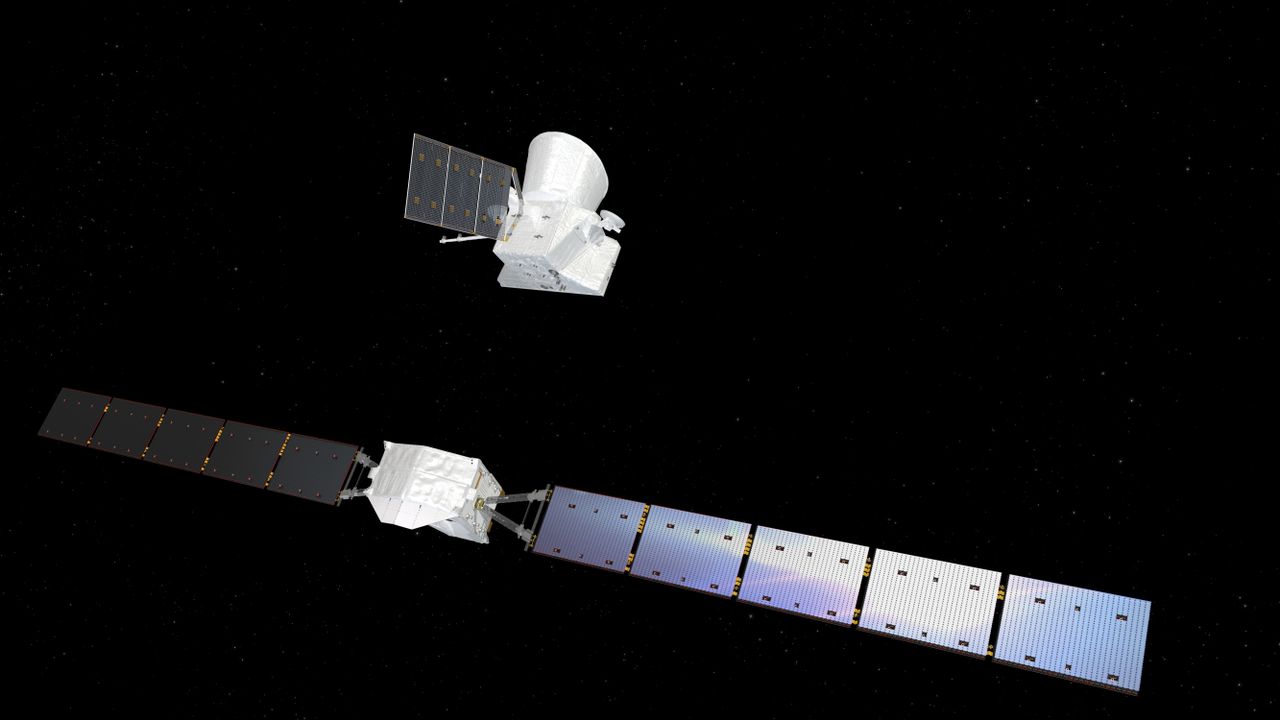
BepiColombo represents a rare partnership between the European Space Agency (ESA) and the Japan Aerospace Exploration Agency (JAXA). The mission comprises two scientific orbiters. The Mercury Planetary Orbiter, built by ESA, will study the planet's geology, interior structure, and magnetic field. The Mercury Magnetospheric Orbiter, built by JAXA, will investigate Mercury's magnetosphere, a region shaped by the solar wind's intense pressure so close to the sun.
The spacecraft launched from French Guiana in October 2018 aboard an Ariane 5 rocket. Rather than traveling directly to Mercury, they took a long route, conducting gravity assists at Earth, Venus, and Mercury itself. This indirect path allowed engineers to slow the spacecraft gradually without excessive fuel consumption. Direct trips to Mercury require enormous velocity changes because the sun's gravity constantly pulls spacecraft toward it.
Mercury poses exceptional challenges for spacecraft. Daytime temperatures reach 430 degrees Celsius (800 Fahrenheit), hot enough to melt lead. The planet orbits faster than any other, completing one circuit around the sun every 88 Earth days. Its magnetic field, though weak, generates surprising complexity. Its geology remains partially mysterious. The Mariner 10 spacecraft flew past Mercury three times in the 1970s, mapping only about 45 percent of its surface. NASA's MESSENGER orbiter operated from 2011 to 2015, gathering unprecedented data. BepiColombo will build on MESSENGER's findings with instruments designed to peer deeper into Mercury's structure and behavior.
The arrival phase will not conclude instantly. After entering Mercury orbit on Dec. 5, the mission enters a two-year science phase during which the spacecraft will gradually settle into final operational orbits. Throughout September, October, and November, the spacecraft will conduct braking maneuvers powered by onboard thrusters. Ground teams will monitor every engine burn. The maneuvers will slow BepiColombo from its current velocity of roughly 147,000 kilometers per hour to speeds that Mercury's gravity can capture and hold.
The timing reflects Mercury's unusual orbital mechanics. The spacecraft cannot arrive when Mercury hangs far from Earth, because communication would become unreliable. Instead, BepiColombo's trajectory aligns with Mercury's position to maintain a favorable geometry for contact with ground stations. This constraint, combined with the physics of orbital mechanics, shapes every maneuver.
This mission represents the first time two spacecraft from different space agencies will simultaneously study Mercury's magnetosphere and surface. Data from both orbiters will illuminate Mercury's geological history, its tiny but intriguing magnetic field, and its role in understanding terrestrial planet formation. The arrival begins today, with live coverage available through ESA and JAXA channels.