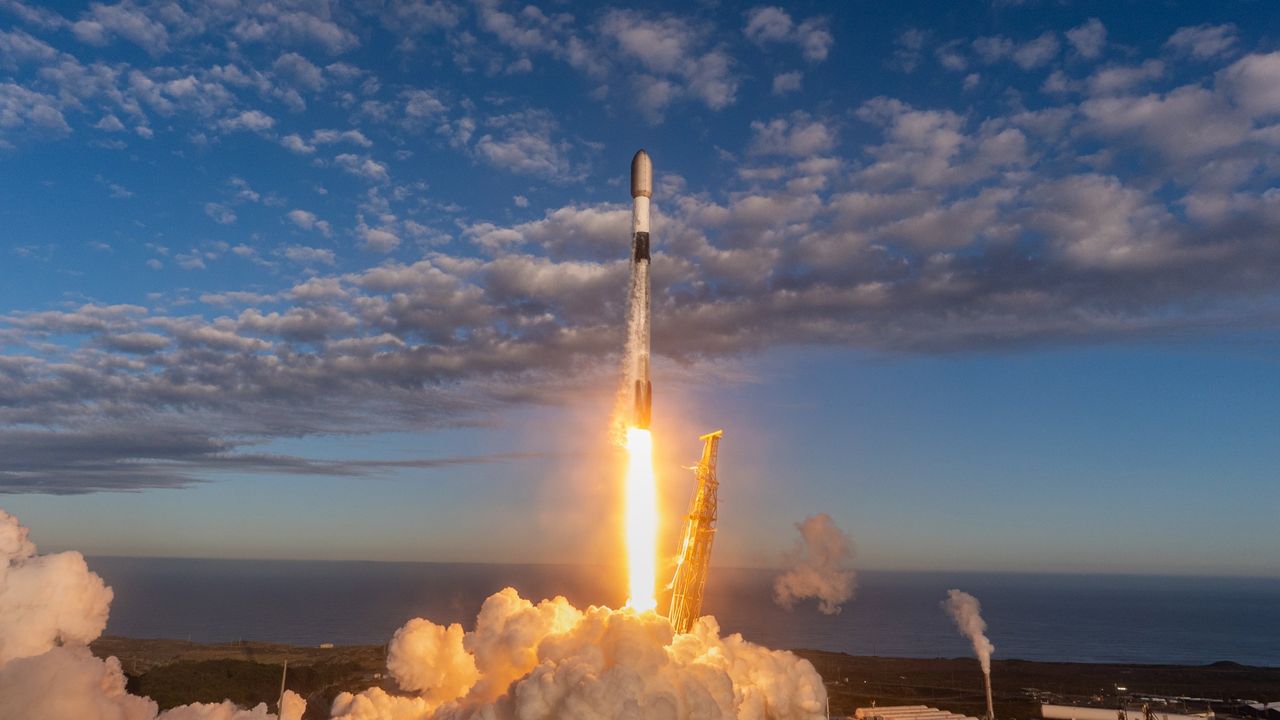
SpaceX launched 27 Starlink satellites on September 6 from Vandenberg Space Force Base on California's central coast aboard a Falcon 9 rocket. The mission represents the latest deployment in SpaceX's massive constellation effort to provide global broadband coverage.
The first stage booster completed its ascent and descended to a drone ship stationed in the Pacific Ocean, executing a successful landing at sea. This recovery marks another routine success in SpaceX's reusable rocket operations, a capability that has transformed launch economics over the past decade. The company now lands and refurbishes Falcon 9 first stages regularly, dramatically reducing the cost of spaceflight.
Starlink has grown into one of the largest satellite constellations in orbit, with over 5,000 satellites already deployed across multiple orbital shells. Each Falcon 9 launch carries between 20 and 60 satellites depending on mission profile and fuel requirements. SpaceX conducts these deployment missions on a cadence of weeks, maintaining its pace toward constellation completion. The network serves users across North America, South America, Europe, Asia, and other regions, providing connectivity in areas traditionally underserved by terrestrial infrastructure.
The Vandenberg Space Force Base launch facility sits on the California coast near Santa Maria, roughly 200 miles north of Los Angeles. This location provides optimal geometry for polar and sun-synchronous orbits, making it ideal for Starlink deployment flights that target inclinations around 97 to 98 degrees. Vandenberg has hosted Space Force military missions for decades and now serves as a critical hub for commercial spaceflight operations under SpaceX's exclusive multi-year launch agreement.
Starlink satellites operate in low Earth orbit at approximately 550 kilometers altitude. At this elevation, they complete orbits in roughly 97 minutes, allowing the constellation to maintain persistent global coverage. The satellites communicate with ground stations and user terminals via phased-array antennas, handling data transmission across frequency bands allocated by international regulatory bodies. SpaceX's second-generation Starlink satellites, known as Starlink Gen 2, offer improved capacity and performance compared to earlier variants.
The constellation faces competition from Amazon's Project Kuiper, which has begun prototype launches, and from traditional geostationary satellite operators seeking to compete in the broadband market. SpaceX's rapid launch cadence and cost advantages have positioned Starlink as the dominant player in low Earth orbit broadband provisioning to date. The company has secured regulatory approval in numerous countries and continues expanding service availability to maritime, aviation, and remote terrestrial markets.
SpaceX plans additional Starlink launches throughout 2024 and beyond, with targets potentially including deployment of laser-equipped satellites that can relay data between spacecraft, further densifying the network's throughput capability. Each launch continues to demonstrate the Falcon 9's reliability as the world's most-flown orbital rocket. The combination of routine satellite deployment and booster recovery operations has become the backbone of modern commercial space transportation.