# Anak Krakatau Eruption Sends Ash High Into Atmosphere, Disrupts Regional Air Traffic
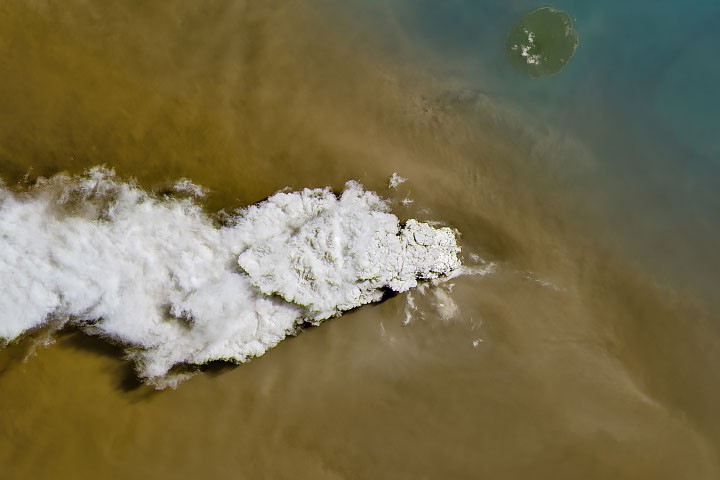
A major eruption from Anak Krakatau, the active volcano in Indonesia's Sunda Strait, ejected massive volumes of ash into the upper atmosphere, triggering widespread flight cancellations across Southeast Asia and degrading air quality across multiple nations. NASA Earth observation satellites captured the eruption and tracked the ash plume's movement, providing real-time data to aviation authorities and meteorological agencies responding to the atmospheric disruption.
Anak Krakatau, whose name means "child of Krakatau," sits on the site of the historic Krakatau volcano that catastrophically erupted in 1883. The 2024 eruption column rose to significant altitude, scattering fine ash particles across vast distances. Airlines operating in Indonesia and neighboring regions grounded flights preemptively, citing reduced visibility and engine damage risks from volcanic particulates. Flight tracking data showed thousands of departures and arrivals delayed or cancelled as ash clouds drifted across major airports in Jakarta, Denpasar, and surrounding cities.
NASA's Earth Observing System satellites, including instruments aboard the Terra and Aqua spacecraft, documented the eruption's intensity and tracked the plume's progression. The space agency's Earth Observatory published satellite imagery showing the ash dispersal pattern, helping atmospheric scientists measure eruption height and predict ash transport. Such satellite data proves essential for volcanic ash advisories issued by the International Civil Aviation Organization, which alerts pilots to airspace hazards.
The eruption degraded air quality measurements across Indonesia and parts of Malaysia and Singapore. Aerosol optical depth readings spiked in affected regions, indicating dense ash concentrations in the lower and middle troposphere. Air quality indices in Jakarta and other population centers exceeded hazardous levels, prompting health authorities to issue respiratory warnings. Schools and outdoor activities faced restrictions in areas downwind of the volcano.
Anak Krakatau remains one of the world's most active volcanoes. The volcano has demonstrated persistent eruptive behavior over the past decades, with notable eruptions occurring in 2018 and 2019. The 2018 eruption and associated underwater landslide triggered a tsunami that killed hundreds across the Sunda Strait region. Scientists maintain continuous monitoring networks on the volcano and surrounding waters to detect precursory signals and assess eruption probability.
The Indonesian Center for Volcanology and Geological Hazard Mitigation maintains real-time seismic and acoustic monitoring of Anak Krakatau. This institutional vigilance, combined with NASA satellite observations, creates a multi-layered monitoring capability that informs evacuation decisions and public safety measures. The volcano's eruptions demonstrate the interconnection between Earth's solid geology and human infrastructure, particularly aviation networks that depend on clear upper-atmosphere conditions.
Regional authorities upgraded alert levels and expanded exclusion zones around the volcano. Airlines coordinated with Indonesia's aviation regulator to navigate alternative routes and reschedule operations as ash concentrations decreased. The eruption underscored the ongoing challenge volcanic activity poses to modern transportation networks, even in an era of advanced Earth observation technology.