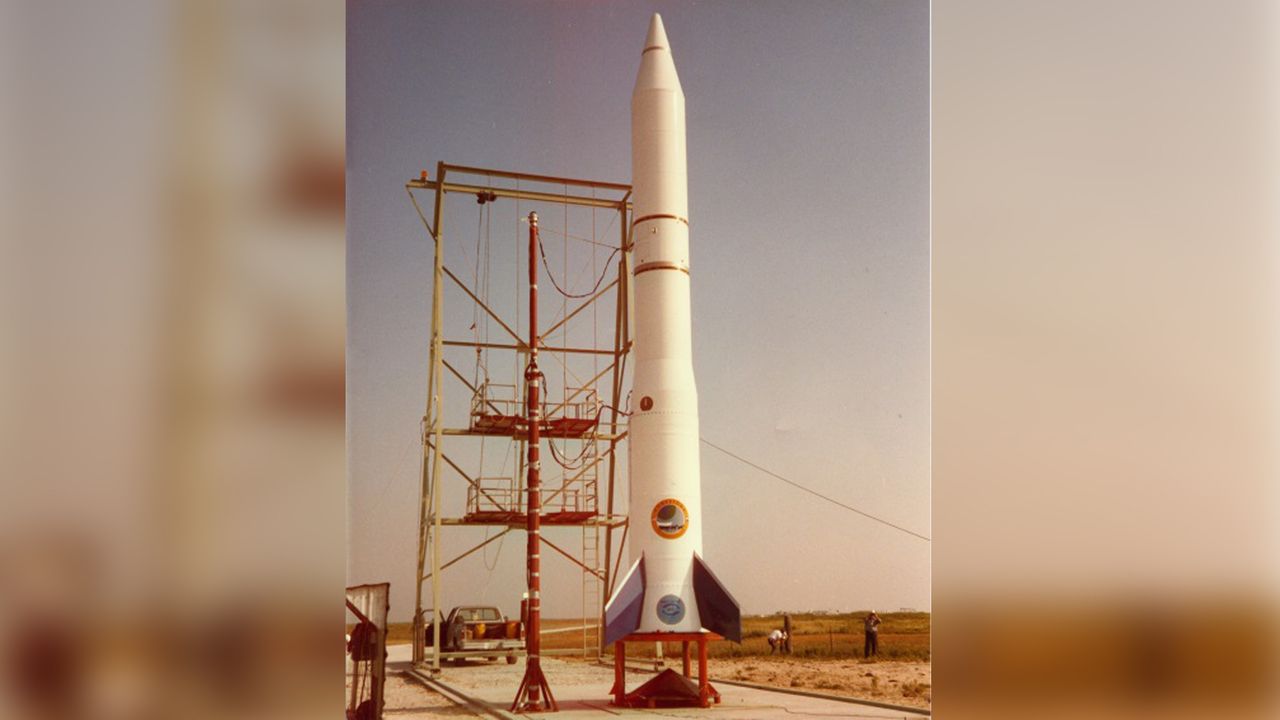
On September 9, 1982, a converted grain silo became a launchpad when Conestoga 1 blasted skyward from a cattle ranch near Matagorda, Texas. That flight marked the first orbital launch attempt by a private company, fundamentally shifting how humanity accessed space.
Space launch had belonged exclusively to government agencies since Sputnik entered orbit in 1957. The Soviet Union, the United States, and a handful of other nations controlled the technology and the infrastructure. Conestoga 1, built by Space Services Inc. of America, challenged that monopoly. The rocket stood 80 feet tall and incorporated technology adapted from decommissioned military hardware. The company's founder, David Hannah Jr., financed the venture privately, betting that commercial space access could work.
The rocket carried no payload beyond a telemetry package. Its mission was pure proof of concept: could a private entity, without government contracts or subsidies, build and launch a vehicle to orbit? The answer mattered enormously for the future of spaceflight.
Conestoga 1 lifted off and climbed through the Texas sky, but the flight fell short of orbital velocity. The rocket reached suborbital altitude before falling back to Earth. Technically, it failed to achieve its objective. Yet the mission succeeded in its larger purpose. It demonstrated that private enterprise could operate a launch complex, manage propulsion systems, and coordinate a space launch independently.
The flight occurred during a pivotal moment in space policy. The Space Shuttle had entered service only eight months earlier, promising routine, affordable access to orbit through NASA's reusable spacecraft program. Meanwhile, the commercial space industry was emerging from regulatory limbo. President Ronald Reagan's administration had begun opening space to private enterprise through licensing and contract opportunities.
Conestoga 1 proved that private companies possessed the technical competence to launch vehicles. That validation paved the way for the commercial space sector that followed. Companies like Orbital Sciences Corporation, Space Shuttle launch services, and satellite operators began expanding through the 1980s and 1990s. Those firms did not revolutionize spaceflight overnight, but they established a market principle: access to space could be privatized.
The ripple effects reached decades forward. SpaceX's Falcon 1, which launched in 2006, achieved orbital velocity where Conestoga 1 had not. Falcon 9, Dragon spacecraft, and Starship descended from that foundational principle that Space Services Inc. demonstrated four decades earlier: private companies could build rockets and operate spaceports.
Today's commercial launch industry, worth billions annually, owes intellectual lineage to that grain-silo launchpad in Texas. Blue Origin, Rocket Lab, Axiom Space, and numerous international competitors operate in a space economy that Conestoga 1 helped create. The rocket itself became a museum piece, but its legacy persists in every private launch that now routinely places satellites and crew into orbit.
That September morning in 1982, a modest Texan venture opened space to entrepreneurship and competition. The technology evolved dramatically, but the principle remained unchanged: private companies could reach for orbit.