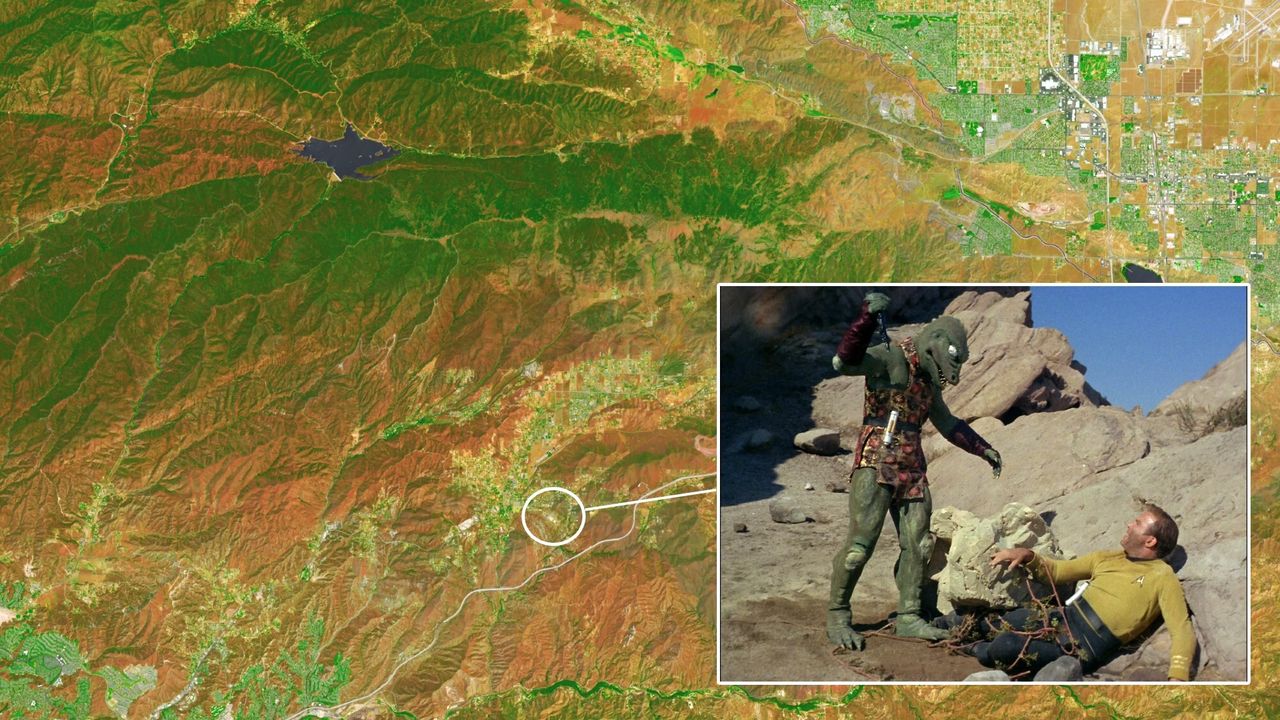
A satellite photograph has captured Vasquez Rocks in Kern County, California, the desert landscape that served as a backdrop for one of Star Trek's most memorable episodes. The rock formations appear in the 1967 episode "Arena," where Captain James T. Kirk battled a Gorn creature in hand-to-hand combat. The distinctive geological formations, shaped by tectonic uplift and erosion over millions of years, remain recognizable from orbit.
Vasquez Rocks Natural Area Park sprawls across roughly 932 acres near Agua Dulce, about 40 miles north of Los Angeles. The site's dramatic sandstone and shale formations rise at steep angles, creating a visually striking landscape that has attracted filmmakers and photographers for decades. Beyond Star Trek, the location has appeared in The Twilight Zone, The Outer Limits, Bonanza, The X-Files, and numerous films. Its accessibility from the Los Angeles area and unusual geology make it an ideal stand-in for alien worlds.
The satellite image demonstrates the capability of modern Earth observation systems to document recognizable terrestrial landmarks with precision. Space agencies and commercial satellite operators routinely use such imagery for geological surveys, environmental monitoring, and educational purposes. The photograph serves as a bridge between two distinct human endeavors: space exploration itself and the science fiction that inspired generations of space explorers.
Vasquez Rocks formed during the Miocene epoch, roughly 15 to 25 million years ago, when tectonic forces compressed and tilted sedimentary rock layers. The resulting formations create angles as steep as 50 degrees, producing the otherworldly appearance that caught the eye of Star Trek producers scouting filming locations. The rocks sit along the San Andreas Fault system, making them geologically dynamic even today.
The connection between Star Trek filming locations and actual space exploration runs deep. NASA and other space agencies have credited Star Trek with inspiring thousands of scientists, engineers, and astronauts to pursue careers in space. The original series aired during the Apollo program, when the moon landing seemed like science fiction itself. Real spacecraft now orbit Earth with capabilities that match or exceed the technology depicted in 1960s television.
Capturing Vasquez Rocks from orbit highlights how satellite technology has become sufficiently advanced to resolve features recognizable to terrestrial observers. Modern commercial satellites operated by companies like Maxar Technologies and Planet Labs achieve resolutions of 30 centimeters per pixel or better. This capability enables everything from disaster response coordination to historical site documentation.
The photograph also underscores how Earth observation serves educational and cultural purposes alongside its practical applications. Satellite imagery allows millions of people to explore locations worldwide without traveling there physically. For Star Trek fans, viewing the actual "Arena" battlefield from space creates a tangible connection between the fictional universe and planetary geography.
Vasquez Rocks remains accessible to the public through the Vasquez Rocks Natural Area Park. Hikers, photographers, and Star Trek enthusiasts visit the site regularly. The location continues to draw film and television productions, ensuring its place in popular culture. From space, it appears as a distinctive geological formation. From the ground, it remains a landscape where imagination and reality converge.