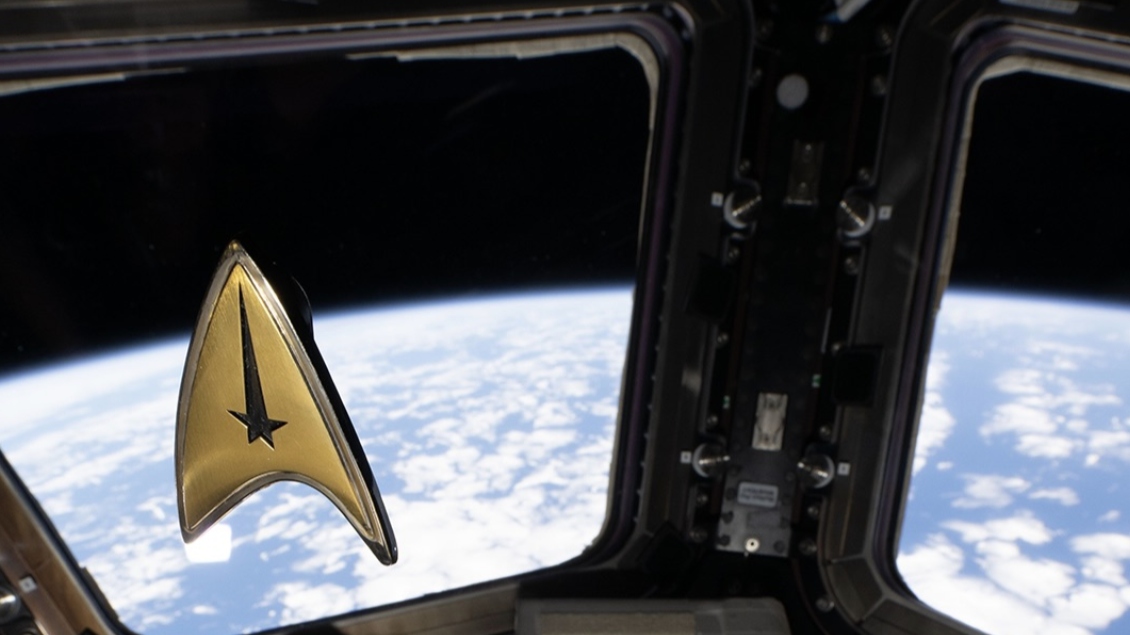
European Space Agency astronaut Sophie Adenot marked Star Trek's 60th anniversary by donning Captain Pike's Starfleet insignia aboard the International Space Station, bridging science fiction's most enduring vision of space exploration with the reality of orbital operations happening 250 miles above Earth.
Adenot's gesture carries weight beyond nostalgia. Star Trek, which premiered in 1966, shaped how generations of scientists, engineers, and astronauts approached their work. The show's optimistic portrayal of human spaceflight, multinational cooperation, and scientific discovery influenced real space programs from NASA to ESA. Many astronauts have cited the series as inspiration for their careers. By wearing Captain Pike's badge, Adenot acknowledged this lineage while performing actual work in the environment that Trek imagined.
Captain Pike, portrayed by Jeffrey Hunter in the original series pilot and later by Sean Kenney and Anson Mount in subsequent productions, commanded the USS Enterprise with intellectual curiosity and ethical restraint. The Starfleet insignia represents those values: exploration tempered by responsibility. Adenot's choice to wear it while orbiting Earth underscores how the fictional ideal continues to frame real-world space operations.
The International Space Station itself embodies Star Trek's vision of multinational cooperation. The orbiting laboratory operates as a joint venture between NASA, ESA, Roscosmos, JAXA, and CSA. Astronauts and cosmonauts from dozens of nations work together in microgravity, conducting research that serves all humanity. This collaborative model echoes Star Trek's Federation, where diverse species unite around common exploration goals.
Sophie Adenot joined ESA's astronaut corps in 2022 and launched to the ISS aboard a SpaceX Crew Dragon vehicle as part of Expedition 70, representing both the legacy of government space agencies and the emerging commercial spaceflight industry. Her presence on the station reflects how space exploration has evolved since Trek's debut. The ISS conducts experiments in biology, physics, materials science, and Earth observation that directly advance human knowledge and technological capability.
Star Trek's cultural impact extends beyond inspiring career choices. The show introduced concepts that became technical vocabulary. The "tractor beam" influenced actual discussions of electromagnetic containment. Communicators preceded smartphone development by decades and shaped engineering philosophy around personal mobile devices. Medical tricorders inspired real diagnostic tools in development. While not all Trek predictions materialized as imagined, the show's methodology of extrapolating from known science proved remarkably prescient.
Adenot's tribute occurs during a period of renewed momentum in space exploration. NASA's Artemis program aims to return humans to the Moon and establish sustainable lunar presence. Commercial companies like SpaceX pursue Mars missions. International partnerships expand as nations from India to the UAE successfully deploy lunar orbiters and landers. These initiatives align with Trek's fundamental premise that space exploration drives human progress and brings people together across borders.
The 60th anniversary acknowledgment from orbit makes a statement about continuity. The dreams articulated in Trek's 1960s scripts materialized into ISS operations, Artemis hardware, and SpaceX rockets. Science fiction and science fact have grown closer. Adenot's badge serves as a symbol of that convergence, honoring the show's role in inspiring the astronauts and engineers who now make space exploration routine.