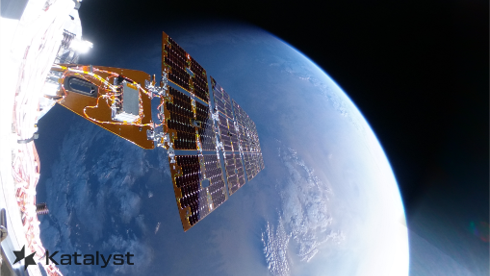
Katalyst Space's LINK spacecraft conducted a proximity operation near NASA's Swift Observatory but ultimately failed to execute the orbital reboost that would have extended the gamma-ray observatory's operational life. The mission, designed to demonstrate commercial satellite servicing capabilities, leaves Swift on a trajectory toward atmospheric reentry within the coming years.
Swift has operated since 2004, detecting gamma-ray bursts across the cosmos and contributing to our understanding of some of the universe's most violent phenomena. The 1,400-kilogram observatory has exceeded its original five-year design life by nearly two decades, but its decaying orbit threatens to end this productive run. Without intervention, Swift will re-enter Earth's atmosphere sometime in the 2030s.
Katalyst Space launched LINK to perform what would have been the first commercial orbital refueling and reboost operation on an active NASA mission. The approach represented a new paradigm in space operations: rather than decommissioning aging but scientifically valuable spacecraft, commercial servicing satellites could extend their missions and preserve the scientific data streams they provide. LINK carried propellant and maneuvering thrusters designed to dock with Swift and push it into a higher, more stable orbit.
The spacecraft successfully navigated to proximity with Swift, demonstrating that the autonomous rendezvous technology functioned as intended. However, the mission did not proceed to the docking and reboost phase. Details surrounding why LINK could not complete the final stage remain limited, though the operation highlights the technical challenges inherent in on-orbit servicing of uncrewed scientific satellites. Swift was not originally designed for such interventions, and proximity operations with non-cooperative spacecraft demand precision navigation and fail-safe protocols.
Katalyst Space continues operating LINK despite this setback. The company, which focuses on in-space logistics and satellite servicing, views this mission as a stepping stone toward more ambitious commercial space operations. The attempt itself provides valuable data on real-world proximity operations near active NASA assets, information that will inform future servicing missions.
Swift's impending retirement nonetheless marks a significant loss for gamma-ray astronomy. The observatory's rapid-response capabilities have proven invaluable for studying transient phenomena, particularly gamma-ray bursts that signal the deaths of massive stars or mergers of neutron stars. Coordinated observations with ground-based telescopes triggered by Swift alerts have opened windows into physics that cannot be replicated in laboratories.
NASA has not announced plans for an immediate successor to Swift's gamma-ray burst detection mission, though concepts for future gamma-ray observatories exist. The Vera Rubin Observatory and other ground-based facilities will continue monitoring the cosmos, but they lack Swift's space-based vantage point and rapid response capability.
The LINK mission underscores both the promise and the current limitations of commercial satellite servicing. While the technology to approach and rendezvous with orbiting spacecraft now exists, the operational execution of docking and propellant transfer remains a frontier challenge. Future missions will build on lessons from this attempt, potentially enabling the preservation of other aging but scientifically productive space assets.