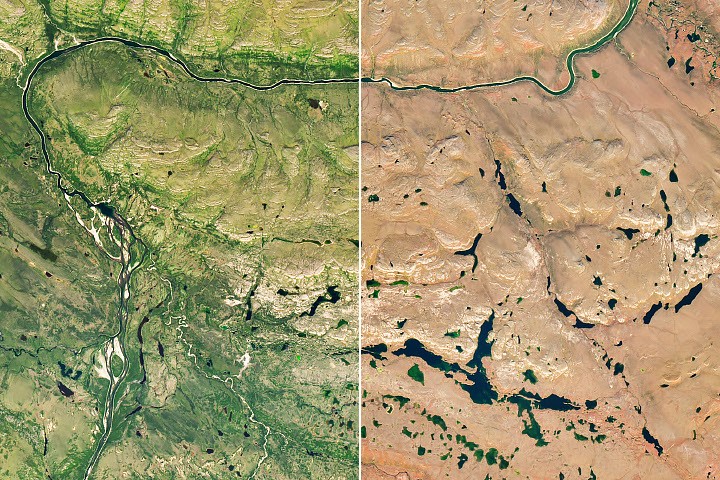
# NASA Satellites Track Early Fall Color Shift Across Canadian Arctic
NASA satellites are documenting an unusually early onset of autumn foliage across Nunavut's tundra landscapes, with reds, yellows, and oranges already sweeping northward across the Canadian Arctic. The observation represents a direct measurement of how climate patterns are reshaping seasonal cycles in one of Earth's most sensitive ecosystems.
The data comes from NASA's Earth-observing satellites, which monitor vegetation changes through spectral imaging technology. These instruments detect chlorophyll levels and plant stress signals across vast regions, providing objective records of when landscapes shift colors. In Nunavut this year, that transition arrived earlier than historical baselines indicate.
Arctic tundra vegetation responds acutely to temperature shifts. When growing seasons shorten or warm periods end abruptly, plants enter senescence ahead of schedule. The pigments that drive photosynthesis break down, revealing carotenoids and anthocyanins beneath. These compounds produce the vibrant fall colors now visible across Nunavut's landscape.
This pattern carries implications beyond aesthetic observation. Early autumnal transitions affect wildlife migration cycles, caribou and musk ox feeding windows, and the delicate timing of plant reproduction in an environment where the growing season already spans only weeks rather than months. Indigenous communities who depend on these ecosystems feel the changes directly through shifts in traditional harvesting periods.
NASA's satellite record documents these shifts systematically. Instruments aboard Landsat satellites and the Moderate Resolution Imaging Spectroradiometer (MODIS) aboard NASA's Aqua and Terra spacecraft capture multi-spectral data weekly or daily from the same locations year after year. Analysts then compare current observations to 20, 30, or 40 years of historical data, establishing whether seasonal timing changes represent noise or genuine shifts.
The Canadian Arctic has warmed roughly twice as fast as the global average over the past few decades, a phenomenon climate scientists call Arctic amplification. This accelerated warming manifests in longer ice-free seasons, earlier spring snow melt, and compressed growing windows. Early fall color emergence fits this pattern directly.
Nunavut's tundra landscape consists primarily of low-growing shrubs, grasses, and sedges adapted to extreme cold and limited sunlight. Unlike southern forests where tree species dominate, Arctic vegetation changes reflect stress across the entire plant community simultaneously. When satellite sensors detect widespread color shifts, they register ecosystem-level responses rather than individual tree responses.
NASA shares these satellite observations publicly through platforms including the Earth Observatory and NASA's Scientific Visualization Studio. Researchers, environmental monitors, and policy makers access the imagery to track environmental changes across the Arctic. This transparency enables independent verification and supports climate research across institutions and nations.
The early fall color observations from Nunavut join a broader dataset of Arctic change. Scientists track permafrost thaw, glacier retreat, sea ice extent, and vegetation boundaries using the same satellite infrastructure. Collectively, these measurements establish that Arctic ecosystems are shifting at rates not seen in millennia.
Understanding when and how Arctic landscapes change informs climate models, conservation strategies, and planning for northern communities adapting to rapid environmental shifts. The red and gold sweeping across Nunavut's tundra this fall represents nature's response to planetary-scale warming, captured in real time from orbit.