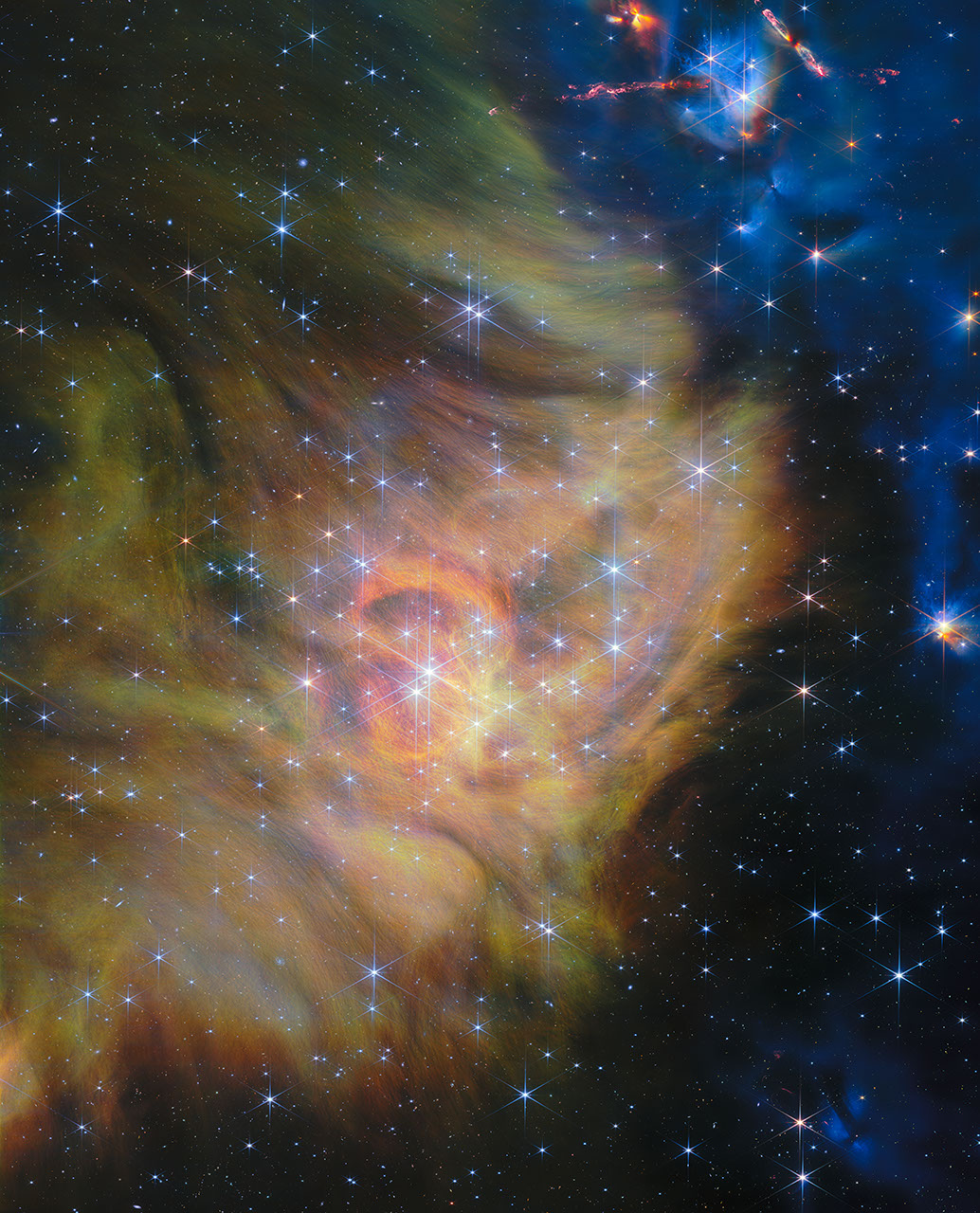
NASA's James Webb Space Telescope has captured one of its largest images to date, revealing the star-forming region IC 348 in unprecedented detail. The observation represents a major advance in how astronomers study the earliest stages of stellar birth across an entire cluster rather than isolated pockets.
The Webb team targeted IC 348 specifically to hunt for brown dwarfs, those enigmatic objects that occupy the mass gap between planets and stars. Brown dwarfs form through the same collapse of gas and dust that creates stars, but they never accumulate enough mass to ignite hydrogen fusion in their cores. This distinction makes them laboratories for understanding the boundary between planetary and stellar formation.
The discovery of brown dwarfs with masses just twice that of Jupiter reshapes what astronomers know about the lower mass threshold for objects forming in star-forming regions. Previous surveys missed many of these ultra-low-mass objects because they are faint and require the infrared sensitivity that Webb provides. The telescope's ability to observe in infrared wavelengths penetrates the dust clouds where young stars and brown dwarfs hide, revealing populations that visible-light telescopes cannot detect.
IC 348 lies roughly 1,000 light-years away in the constellation Perseus. The region actively spawns stars today, making it an ideal laboratory for studying how stellar systems assemble. The panoramic scale of Webb's observation allows researchers to map the spatial distribution of young objects across the entire cluster, not just within small fields. This panoramic approach reveals how brown dwarfs and stars populate the same nurseries and how their properties relate to environmental conditions.
The implications extend beyond brown dwarf demographics. Understanding the full population of low-mass objects forming in star clusters informs models of planet formation. Brown dwarfs can host planetary systems just as stars do, and their discovery in IC 348 suggests that substellar companions may be more common than previously thought. The data also constrains how stellar mass functions develop during the cluster's early evolution.
Webb's infrared instruments, particularly the Near-Infrared Camera and the Mid-Infrared Instrument, captured the IC 348 panorama by stitching multiple observations together. The resulting image encompasses a region far larger than what previous infrared observatories like Spitzer could survey in one pointing. This capability transforms how astronomers approach the study of star-forming regions, shifting from sampling small areas to mapping entire clusters in single observations.
The research team plans to continue exploiting Webb's panoramic potential across other nearby star-forming regions. The Orion Nebula, the Carina Nebula, and other stellar nurseries within a few hundred light-years of Earth will receive similar treatment. These surveys will build a comprehensive census of substellar objects across multiple environments, revealing whether brown dwarf populations vary systematically with cluster age, size, or density.
Each discovery of brown dwarfs at the mass limit of substellar formation refines the physics of gravitational collapse and disk fragmentation. Webb continues to push those boundaries lower, testing whether even lower-mass objects remain possible or whether nature sets a hard floor on what can form through the standard mechanism.