# How Distance Rewrites What We See in Space
Perspective transforms everything in astronomy and exploration. A moon barely 14 miles across can loom as large as Earth's sun when viewed from its surface. A building stretching 525 feet tall shrinks to invisibility from orbit. This principle of apparent size, governed by angular size rather than actual dimensions, shapes how we perceive the cosmos and design our missions to explore it.
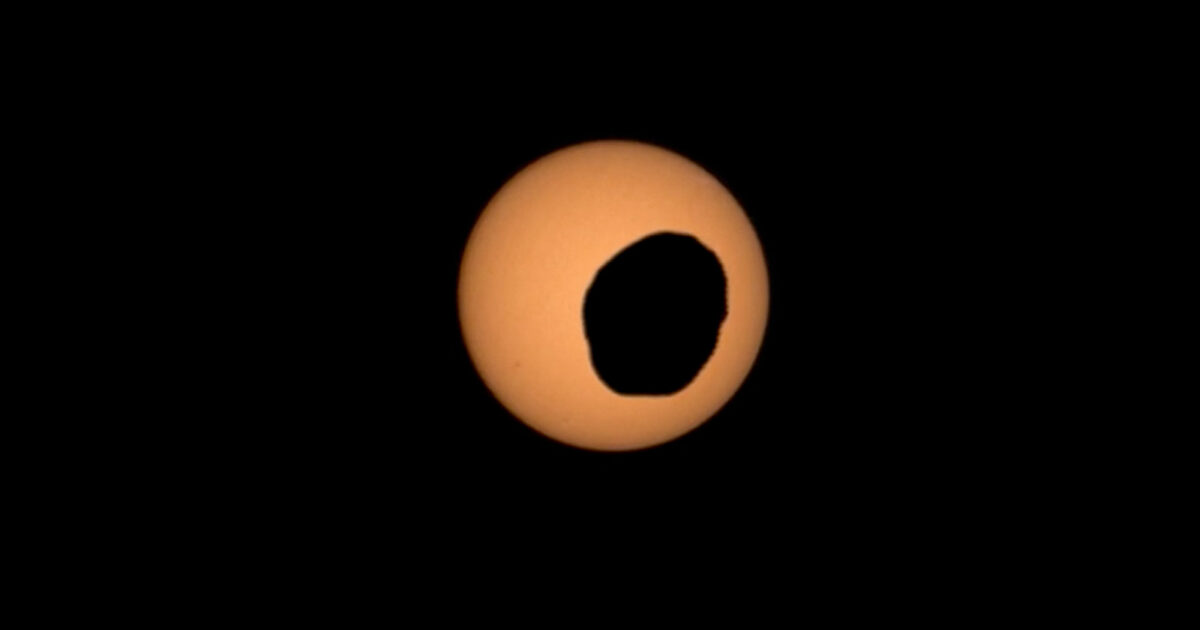
Phobos exemplifies this optical truth. The Martian moon orbits closer to its planet than any other moon in the solar system, circling Mars every 7.7 hours. From the surface of Mars, Phobos would appear as large as Earth's moon looks from our planet. Yet Phobos itself measures only 14 miles at its widest point. An astronaut standing on the Martian plains would witness a celestial sight utterly foreign to Earth experience. From space, however, Phobos becomes a speck barely visible to the naked eye.
NASA's Vehicle Assembly Building in Florida provides the terrestrial counterpart. This structure covers 518,000 square feet and towers 525 feet high, making it one of the largest buildings on Earth by volume. Astronauts and engineers working inside it perceive it as a massive cathedral of engineering. From low Earth orbit, the building vanishes into the landscape, indistinguishable from the Kennedy Space Center's sprawling facilities. From the International Space Station, 250 miles overhead, no human eye could resolve it at all.
Angular size depends on a simple calculation: the object's actual diameter divided by its distance from the observer. This geometry governs not just human perception but scientific observation. Radio telescopes, optical instruments, and spacecraft sensors all measure objects using angular resolution. The Webb Space Telescope can resolve objects separated by just 0.1 arcseconds, allowing it to distinguish galaxies billions of light-years away. Rovers on Mars navigate terrain using cameras engineered to resolve features inches across from distances of several hundred feet.
This principle matters for exploration planning. Mission designers must account for what astronauts and robots can actually see and measure from their vantage points. Engineers place instruments at specific distances to achieve the resolution needed for their tasks. A rover's wheel camera positioned near the ground observes fine details; an overhead orbiter captures broader context.
The human experience of space hinges on perspective. An astronaut orbiting Earth sees continents curve away. An observer on Mars watching Phobos traverse the sky witnesses a moon moving faster than any Earth satellite. The same physics that makes Phobos seem large from Mars makes our moon seem small from deep space probes like the New Horizons mission, now almost five billion miles from Earth.
Apparent size reminds us that the universe has no inherent scale. Dimensions become meaningful only when measured against distance. Every spacecraft, every telescope, every mission captures data constrained by this fundamental relationship between distance and perception. Understanding apparent size becomes understanding how humans and robots actually encounter the cosmos, not as it objectively exists, but as it appears from wherever we position ourselves to look.