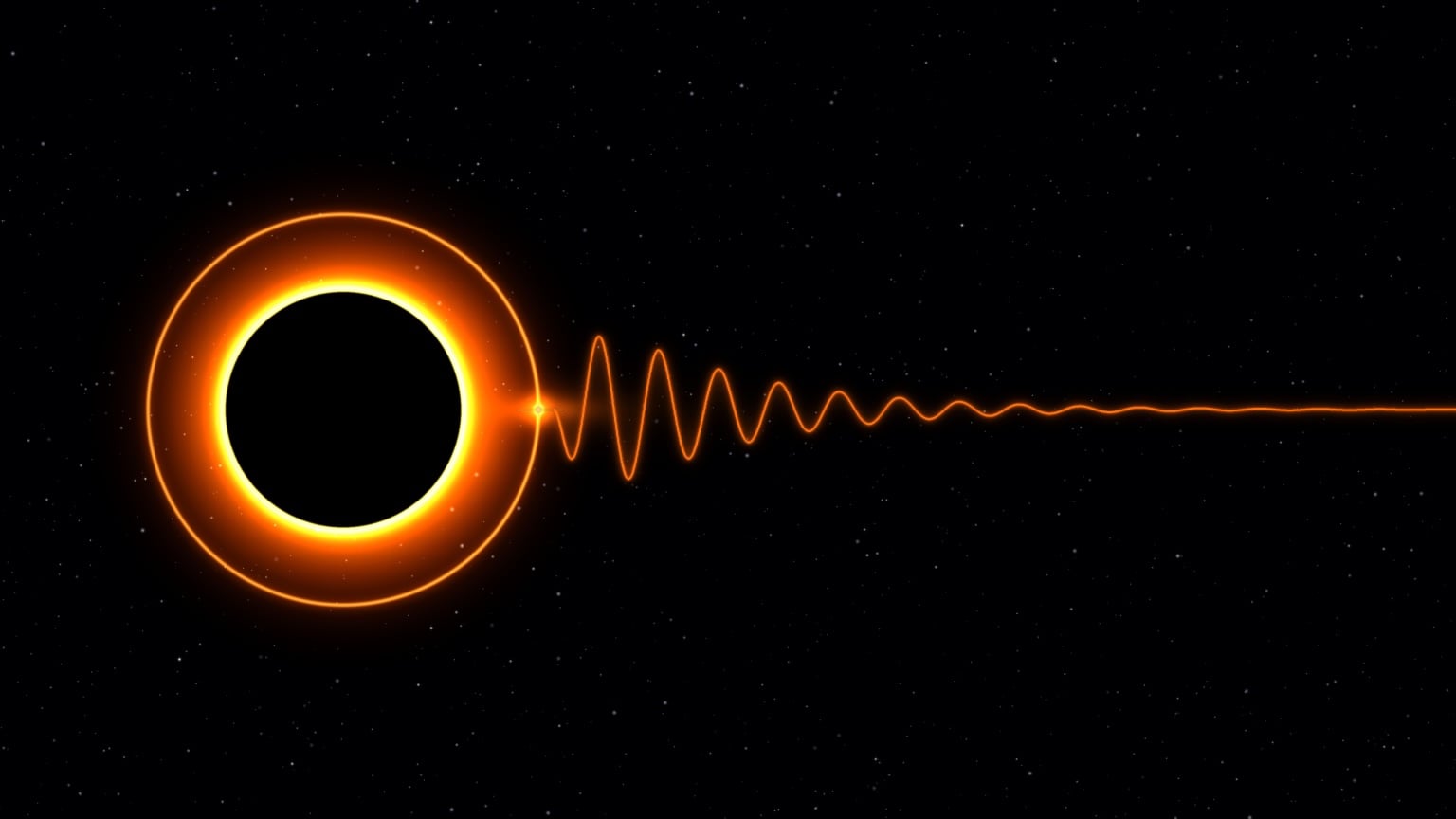
Black holes may not be as bald as Albert Einstein predicted. Physicists at Nagoya University and collaborating institutions have determined that if black holes possess "hair" (exotic features beyond mass, spin, and charge), gravitational wave observations of merging black holes could detect it. The discovery offers a path to test one of general relativity's most famous assertions: the no-hair theorem.
The no-hair theorem states that all black holes can be completely described by just three properties: mass, angular momentum, and electric charge. Everything else gets erased once matter crosses the event horizon. This prediction has stood for decades, but theoretical physics allows for alternatives. Modified theories of gravity and certain quantum effects could permit black holes to retain additional features, or "hair." These might manifest as scalar fields, vector fields, or other exotic properties wrapped around the event horizon.
When two black holes merge, they undergo a violent dance. Their spacetime distorts catastrophically, releasing tremendous energy as gravitational waves. After the merger completes, the resulting black hole settles into a stable state through a process called ringdown. During ringdown, the newly formed black hole radiates away excess energy and angular momentum as gravitational wave echoes. These waves carry a unique signature: a specific frequency pattern that depends on the black hole's properties.
Researchers discovered that if black holes possess hair, that extra structure leaves an imprint on the ringdown signal. Different types of hair produce distinct frequency patterns. By analyzing gravitational wave data from merging black holes, astronomers and physicists could identify whether ringdown frequencies match the no-hair theorem predictions or deviate in ways that reveal hidden structure.
The Laser Interferometer Gravitational-Wave Observatory (LIGO) and its European counterpart Virgo have already detected over 90 confirmed black hole mergers since 2015. These detectors measure spacetime distortions smaller than a proton's width, capturing the entire merger process including ringdown. With each new detection, the ringdown signal becomes clearer and more precise.
Future gravitational wave detectors promise even greater sensitivity. The Einstein Telescope and Cosmic Explorer, both under development, will observe black hole mergers with unprecedented precision. They may detect ringdown overtones (higher-frequency echoes) that current detectors miss. These overtones offer multiple frequency measurements from a single merger, allowing researchers to test for hair across different frequency bands.
The no-hair theorem remains one of general relativity's boldest predictions. Testing it through gravitational waves represents a fundamentally new experimental approach. Previous tests relied on observing black hole shadows, radiation around black holes, or orbital dynamics of stars near the galactic center. Ringdown analysis offers direct access to the black hole's spacetime structure at the moment of formation.
If observational data reveals deviations from no-hair predictions, physicists would need to revise their understanding of gravity itself. Such findings could point toward quantum gravity effects, extra dimensions, or entirely new physics operating near the event horizon. Conversely, if ringdown signals consistently confirm the no-hair theorem across dozens or hundreds of mergers, that would strengthen general relativity's most mysterious prediction: that black holes are, at their core, remarkably simple objects.