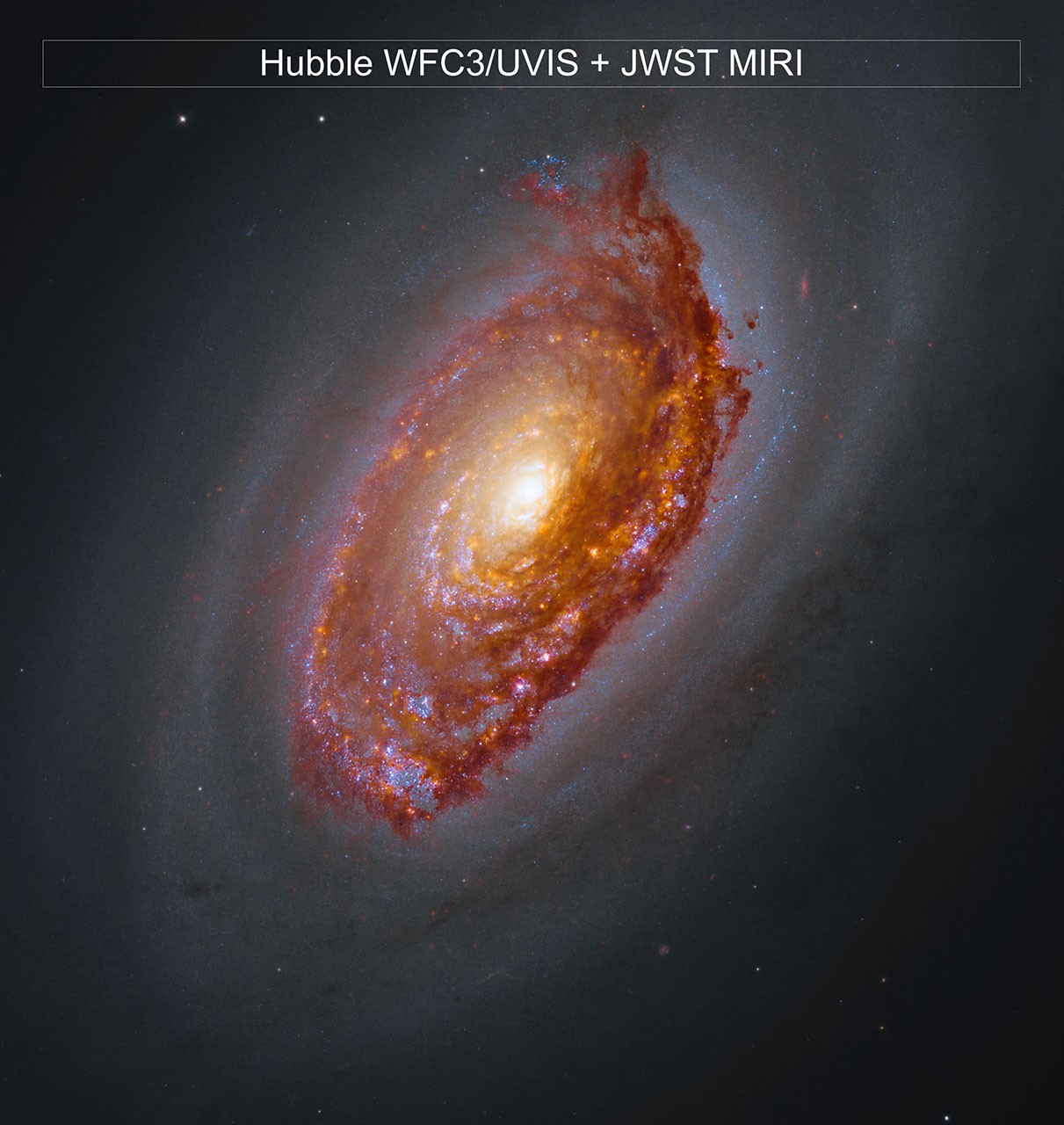
The James Webb Space Telescope has captured a stunning new infrared view of M64, the Black Eye Galaxy, revealing intricate dust structures and stellar populations invisible to optical telescopes.
M64, located approximately 17 million light-years away in the constellation Coma Berenices, takes its common name from the dark dust lane that bisects its bright core. Webb's infrared capabilities penetrate this obscuring dust, exposing the galaxy's true architecture for the first time with such clarity. The telescope's Near-Infrared Camera and Mid-Infrared Instrument detect heat signatures from dust grains and reveal populations of young, hot stars embedded within regions previously hidden from view.
The Black Eye Galaxy represents an unusual spiral system. Unlike typical spiral galaxies, M64 rotates in the opposite direction from its outer disk, a characteristic that astronomers attribute to a past collision or gravitational interaction with another galaxy. This collision likely triggered the inflow of gas and dust that now creates the distinctive dark lane running across the galactic plane. Understanding M64's structure provides clues about galactic mergers and their long-term effects on galaxy evolution.
Webb's infrared observations excel where Hubble's optical instruments reach their limits. The mid-infrared data traces cold dust throughout the galaxy, mapping regions where new stars form. The near-infrared imaging pierces through dust clouds to reveal mature stellar populations and the galaxy's true morphology. Combined, these datasets create a comprehensive picture of M64's present state and its evolutionary history.
The Black Eye Galaxy holds particular scientific interest for researchers studying active galactic nuclei. A supermassive black hole resides at M64's center, though it remains far less active than those in more luminous galaxies. This makes M64 an ideal laboratory for understanding how black holes interact with their host galaxies across a range of activity levels. The contrast between M64's modest central engine and its dramatic dust features offers insights into how galaxies regulate star formation and black hole growth.
APOD, NASA's Astronomy Picture of the Day, has featured thousands of space images since its 1995 launch. Each image includes detailed scientific explanation, making cutting-edge astronomy accessible to the general public. Today's M64 observation demonstrates how space telescopes like Webb continue transforming our understanding of galactic structure and evolution.
The infrared revolution in astronomy persists as Webb operates at the second Sun-Earth Lagrange point, roughly one million miles from Earth. Its primary mirror, composed of beryllium segments coated with gold, collects infrared radiation from the universe's most distant and dusty objects. M64, while relatively nearby in cosmic terms, benefits enormously from Webb's sensitivity and resolution. Future observations will likely reveal even finer details of the Black Eye Galaxy's dust morphology and star-forming regions.