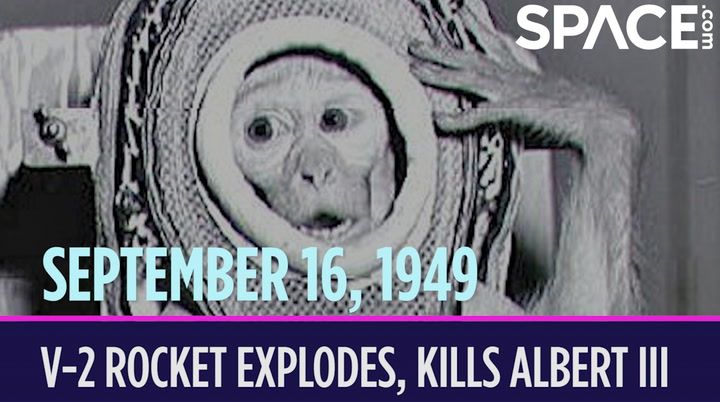
# The First Primate Casualty of Space Exploration
On September 16, 1949, the United States launched a V-2 rocket from White Sands Missile Range in New Mexico carrying a rhesus macaque named Albert III. The rocket exploded during ascent, killing the monkey and marking the first fatality in the American spaceflight program.
Albert III was part of a deliberate research initiative to understand the physiological effects of high-altitude flight and radiation exposure on living organisms before humans ventured beyond Earth's atmosphere. The U.S. Army Signal Corps and the Applied Physics Laboratory at Johns Hopkins University jointly managed the biomedical research program using captured German V-2 rockets, which became the backbone of early American rocketry after World War II.
The V-2 rocket itself represented revolutionary technology. Nazi Germany had developed this ballistic missile during World War II, and after the war, the United States secured both examples of the hardware and the German engineers who built it. Wernher von Braun and his team became central figures in America's nascent space program. The V-2 was the most advanced missile of its era, and modifying these weapons for scientific research provided the U.S. with a platform to test life support systems and study the effects of acceleration, weightlessness, and radiation on biological systems.
Albert III's mission was part of a series of primate launches that would eventually pave the way for human spaceflight. Between 1948 and 1951, the U.S. conducted numerous launches with monkeys and chimpanzees aboard, measuring blood pressure, heart rate, and other vital signs during flight. These creatures experienced G-forces exceeding what humans had ever endured and provided crucial data on survival at extreme altitudes.
The rocket failure that killed Albert III occurred during the ascent phase, before the capsule reached its intended peak altitude. The disaster highlighted the hazards inherent in pushing the boundaries of spaceflight technology. Unlike later programs, these early launches operated without sophisticated recovery systems. Animals were often killed not in the vacuum of space but in explosions, parachute failures, or violent re-entry impacts.
Albert III's death underscored the real risks of space exploration. Between 1948 and 1961, the U.S. launched at least 32 animals on high-altitude missions, with numerous fatalities. Yet these sacrifices generated irreplaceable data. Scientists learned that life could survive brief periods of weightlessness, that the G-forces of launch and re-entry were survivable, and that animal physiology could adapt to the space environment.
This knowledge directly informed Project Mercury, which carried astronauts like Alan Shepard and John Glenn into space less than a decade later. The monkey and chimpanzee programs demonstrated that mammals could tolerate the conditions of spaceflight and return alive. NASA's later missions with chimpanzee Ham in 1961 validated systems that would carry humans to space mere months afterward.
Albert III's legacy persists in the historical record as a symbol of spaceflight's early cost. The animal program conducted between 1948 and 1951 was ruthless by modern standards, yet it provided the biological and medical foundation upon which human spaceflight rested. Every astronaut who orbited Earth owed a debt to these early test subjects.