# How Vampire White Dwarfs Become Neutron Stars
Scientists have cracked a long-standing puzzle about stellar death and rebirth. White dwarfs that pull material from companion stars can transform into neutron stars under precise conditions, researchers report. The discovery resolves questions about how some of the universe's most extreme objects form.
A white dwarf is the dense stellar remnant left after a star like our sun dies. It packs Earth's mass into an object the size of Earth itself. A neutron star compresses that same mass into a sphere merely 20 kilometers across. The difference in density is almost incomprehensible.
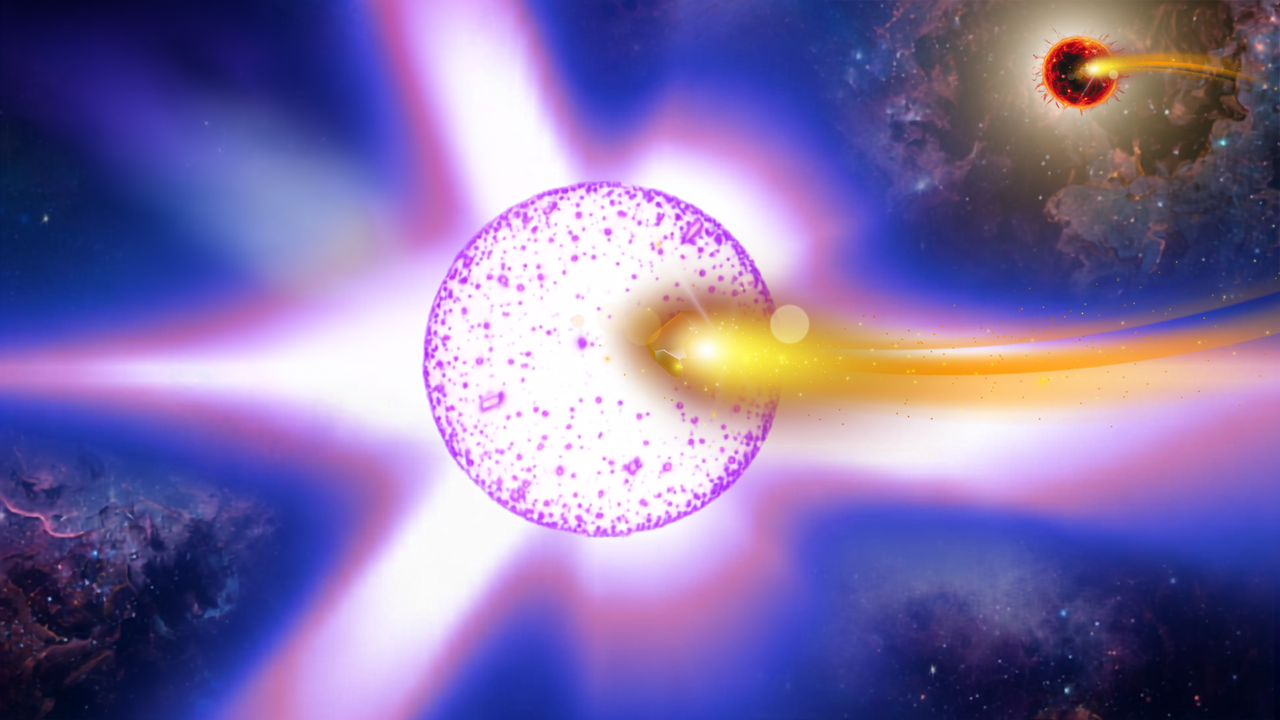
In certain binary star systems, a white dwarf orbits close enough to steal material from a neighboring star. The pulled gas spirals inward, heating to millions of degrees before impacting the white dwarf's surface. This cosmic vampire scenario explains the name "vampire white dwarf." Astronomers have long suspected these systems could somehow produce neutron stars, but the mechanism remained opaque.
New research reveals the transformation requires a delicate balance. The white dwarf must accumulate material at a specific rate from its companion star. Too slow, and the pressure and temperature never climb high enough to trigger the nuclear fusion needed for the conversion. Too fast, and the white dwarf explodes as a thermonuclear supernova before transformation completes.
The "just right" zone sits in an intermediate range. At this precise accretion rate, nuclear burning creates the extreme conditions necessary to force the white dwarf's core into neutron-star density. The entire process unfolds over billions of years, making direct observation impossible. Computer models and theoretical calculations provide the only window into this stellar alchemy.
This finding answers a fundamental question in stellar evolution. Astronomers previously struggled to connect white dwarfs and neutron stars in a consistent theoretical framework. The vampire white dwarf pathway provides a missing link in the cosmic narrative.
The implications extend beyond pure stellar physics. Understanding how neutron stars form constrains models of stellar populations in galaxies and mergers. Neutron stars emit distinctive gravitational waves when colliding with each other or black holes. Identifying all formation channels for neutron stars helps astronomers predict detection rates for missions like LIGO and the upcoming Einstein Telescope.
The research also illuminates the fate of binary systems containing white dwarfs and main-sequence companion stars. Thousands of such systems likely orbit within our galaxy. Some may currently sit in the narrow parameter space where transformation occurs. Over cosmological timescales, these systems represent a steady factory for creating neutron stars.
Future observations of vampire white dwarf systems offer testing ground for these predictions. X-ray telescopes can detect the superhot accretion disks around feeding white dwarfs. Comparing observations to theoretical models will refine understanding of the exact conditions triggering transformation.
This discovery represents another step in mapping the cosmic lifecycle of stars. From birth in nebulae to death as compact remnants, the universe's stellar pathways grow increasingly complete.