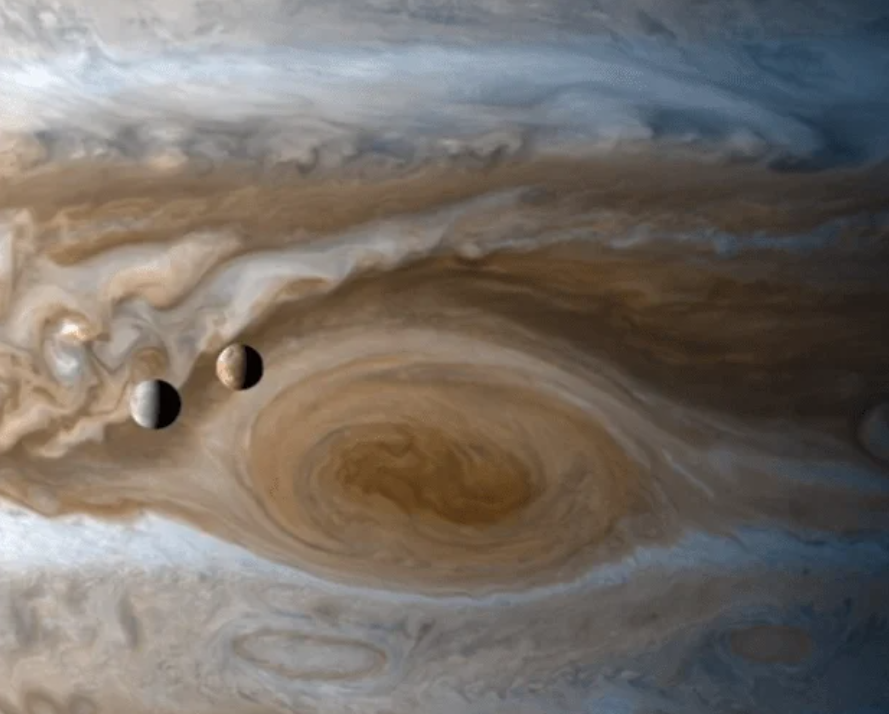
Jupiter's four largest moons will enter a rare alignment next year that offers Earth-based observers and space agencies an exceptional window to study the orbital mechanics and physical properties of these Galilean satellites.
Beginning in late 2026 and extending into early 2027, Io, Europa, Ganymede, and Callisto will pass in front of one another from Earth's perspective. Astronomers call this phenomenon mutual transit-eclipse season. These events occur roughly once per decade, aligned with Jupiter's orbital geometry relative to Earth's position in the solar system.
During mutual eclipse season, the moons occult and eclipse each other in patterns that reveal precise orbital positions, moon diameters, and atmospheric properties. When one moon passes directly in front of another, astronomers measure the exact timing and light curves to refine models of the Galilean system's dynamics. When one moon enters another's shadow, the resulting light curve indicates atmospheric composition and thickness.
This observational window holds particular value ahead of NASA's Europa Clipper mission, which launched in October 2024 and will conduct detailed reconnaissance of Jupiter and its moon system starting in 2024. The Clipper orbiter will make dozens of close flybys of Europa, searching for signs of habitability in its subsurface ocean. Ground-based mutual eclipse observations provide complementary data about all four major moons, offering researchers a complete picture of the Jovian system's architecture.
The 2026-2027 season follows previous eclipse seasons in 2015 and 2009. Each event refines astronomers' knowledge of the orbital elements and physical characteristics of Io, Europa, Ganymede, and Callisto. These moons continue to yield surprises. Io remains the most volcanically active body in the solar system, driven by tidal heating. Europa harbors a subsurface water ocean that may support microbial life. Ganymede, larger than Mercury, possesses its own magnetic field. Callisto's heavily cratered surface records billions of years of bombardment history.
Amateur astronomers and professional observatories worldwide typically participate in mutual eclipse season observations. Coordinated timing across multiple sites on Earth yields redundancy and confirms measurements. Modern telescopes and high-speed cameras allow precise photometry during these events. Organizations like the International Astronomical Union's Minor Planet Center coordinate observational campaigns.
The 2026-2027 season will span several months, with different pairs of moons crossing paths on different dates. Observers will need clear skies, stable equipment, and patience. Jupiter itself remains relatively bright and easy to locate, but resolving individual moons and detecting the subtle dimming during mutual events demands optical quality and technical skill.
This recurring decade-long rhythm stems from Jupiter's 12-year orbit and Earth's annual circuit around the sun. Every 11 to 12 years, Earth's orbital plane aligns favorably with the plane containing Jupiter's major moons. The geometry that produces mutual transits and eclipses lasts only a few months before misalignment resumes.
The 2026-2027 mutual eclipse season arrives at an optimal moment for the space exploration community. Europa Clipper's early observations will inform ground-based strategies. Subsequent analysis of the data collected during this season will enhance understanding of the Galilean moons for decades.