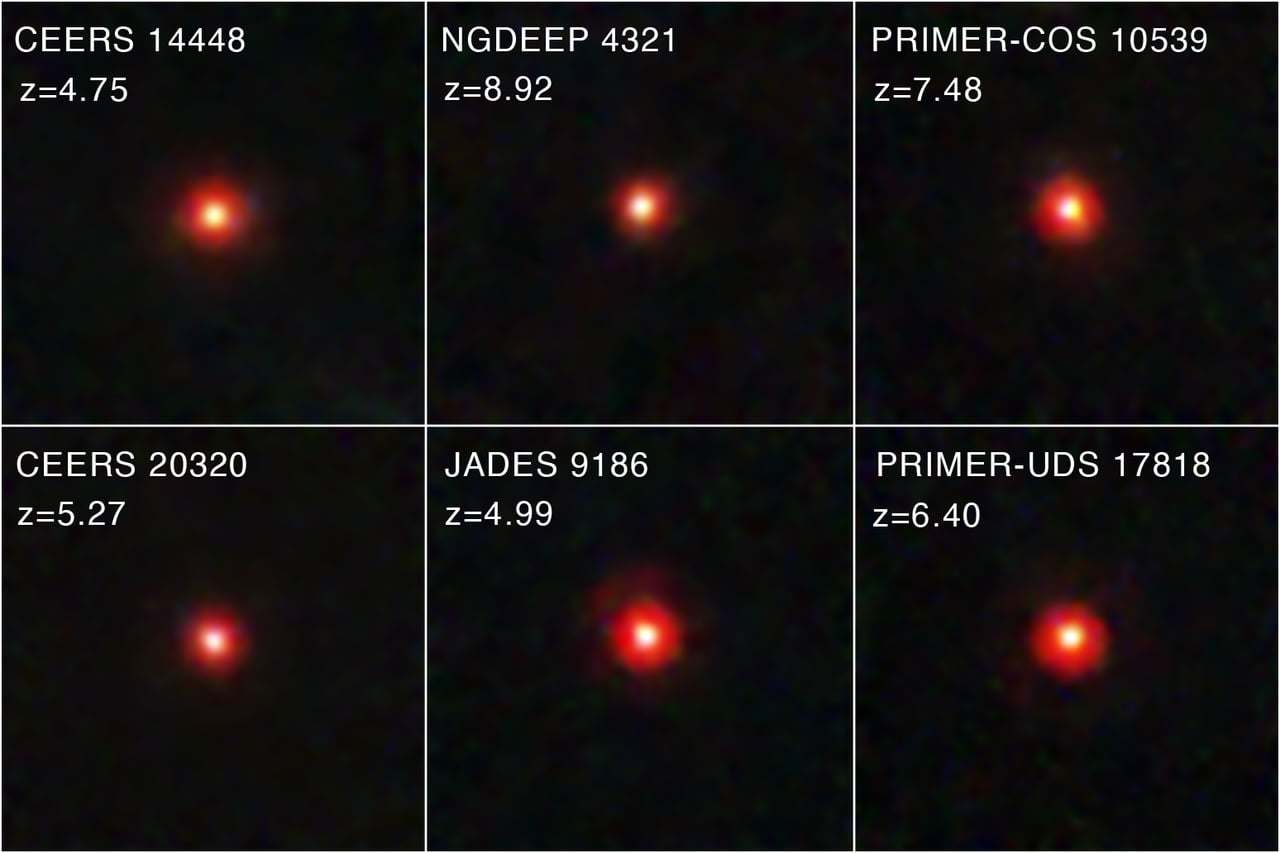
The James Webb Space Telescope has detected enigmatic objects called Little Red Dots in the early universe, and new computer simulations reveal their true identity: the seeds of supermassive black holes and future quasars.
A team led by Dale Kocevski at Colby College used JWST's NIRCam detector to observe these faint, reddish objects across the cosmos. The dots appeared smaller and dimmer than expected for their epoch, roughly 500 to 750 million years after the Big Bang. This visual discrepancy sparked investigation into what these objects actually represented.
The breakthrough came from detailed modeling. Kocevski's simulations demonstrate that overmassive black holes form readily in the early universe under standard physics conditions. These theoretical black holes, when modeled in the infrared spectrum, match the observational signatures of the Little Red Dots captured by JWST. The spectroscopic data provides the crucial connection between theory and observation.
This discovery reshapes our understanding of black hole evolution. Conventional models predicted that supermassive black holes took billions of years to grow from stellar-mass seeds through accretion. Finding overmassive black holes in the universe's first billion years contradicted that timeline. Little Red Dots now offer a solution to this puzzle: they represent an intermediate stage where black holes rapidly accumulate mass and energy, eventually igniting as luminous quasars visible across billions of light-years.
The Little Red Dots themselves appear red because of redshift, the stretching of light waves as the universe expands. Observations at these distances reveal the universe as it existed over 13 billion years ago. The infrared wavelengths captured by JWST's NIRCam prove essential because visible and ultraviolet light from such distant objects has shifted into infrared frequencies by the time it reaches Earth.
JWST's unprecedented sensitivity in infrared wavelengths has transformed how astronomers study the early universe's structure. The telescope's revolutionary collecting power reveals populations of objects that ground-based observatories and earlier space telescopes simply could not detect. Little Red Dots exemplify this capability. Their discovery forces astrophysicists to revise models of black hole formation and growth.
The connection between Little Red Dots and future quasars suggests a evolutionary pathway. Active galactic nuclei powered by supermassive black holes grow through multiple phases. Early accretion-driven phases correspond to what we observe as Little Red Dots. As these systems mature, they transition into the brilliant quasars and active galaxies that dominated the universe's middle epochs. Today's quiescent supermassive black holes, including Sagittarius A* at the Milky Way's center, represent the endpoint of this 13.8-billion-year journey.
Understanding this progression matters for cosmology. Black holes regulate galaxy formation through feedback mechanisms. Accreting black holes inject enormous energy into their surroundings, heating gas and halting star formation. Tracing how this process began in the early universe illuminates how galaxies assembled themselves into the structures we observe today.
Future observations with JWST and complementary facilities will expand this catalog of Little Red Dots and test the simulations further. Each observation constrains black hole growth models and refines estimates of how quickly the universe's earliest supermassive black holes assembled. The seeds planted in the first cosmic moments grew into the engines powering galaxies across billions of years.