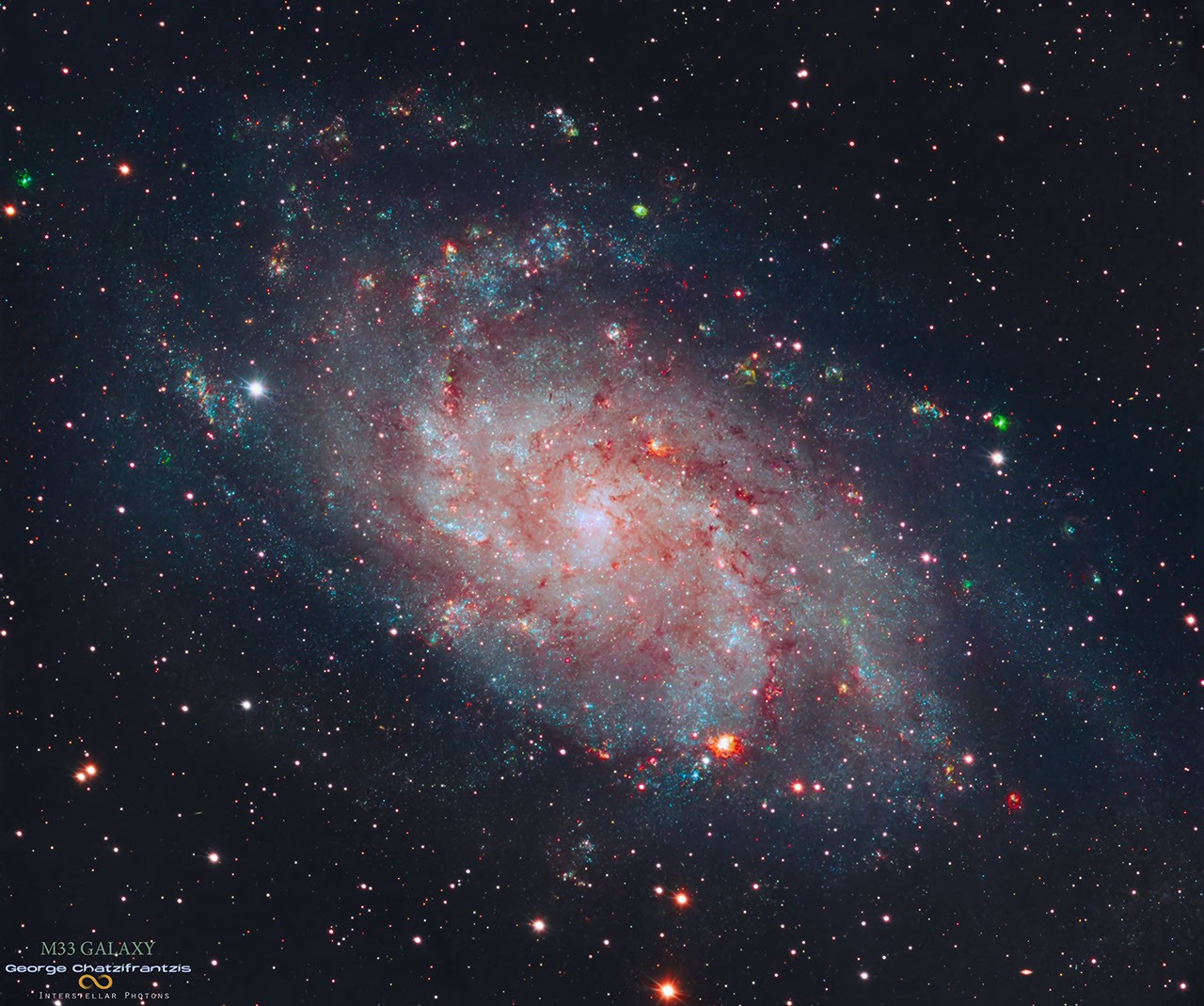
# Messier 33 Reveals the Architecture of a Nearby Spiral Galaxy
Messier 33, the Triangulum Galaxy, dominates the September 18, 2026 Astronomy Picture of the Day selection from NASA. This spiral galaxy sits approximately 2.7 million light-years from Earth, making it one of the closest large galaxies to the Milky Way and a primary target for ground-based and space telescope observations.
The Triangulum Galaxy earned its designation as the 33rd object in Charles Messier's 18th-century catalog of nebulae and star clusters. Astronomers catalog it as NGC 604, reflecting its entry in the New General Catalogue compiled by John Dreyer in the 19th century. Despite its prominence in Northern Hemisphere skies, Messier 33 remains less famous than its neighbors, the Andromeda Galaxy and the Milky Way.
The galaxy displays the textbook features of a grand-design spiral structure. Two primary spiral arms wind outward from a central bar of stars, traced by dust lanes and regions of active star formation. Unlike the tightly wound Andromeda Galaxy, Messier 33 presents more open spiral arms, revealing the underlying disk structure. This morphology provides astronomers with an excellent laboratory for studying how spiral density waves propagate through galactic disks and trigger the collapse of molecular clouds into new stars.
The galaxy harbors an estimated 40 billion stars, substantially fewer than the Milky Way's estimated 200 to 400 billion stars. This lower stellar population reflects Messier 33's classification as a flocculent spiral rather than a grand-design spiral, meaning its structure emerges from the combined gravity of billions of stars rather than a persistent density wave pattern. The result produces a galaxy that appears less symmetric but equally dynamic.
Observations from NASA's Hubble Space Telescope and ground-based observatories including the Keck telescopes and the Very Large Array have mapped stellar populations, measured rotation curves, and traced ionized hydrogen regions where young, massive stars ionize surrounding gas. These studies confirm that Messier 33 contains a supermassive black hole at its center, though significantly smaller than those found in larger spiral galaxies. The black hole's relatively modest mass hints at relationships between galactic bulge properties and central black hole growth.
The galaxy's proximity makes it invaluable for distance ladder calibration. Cepheid variable stars within Messier 33 serve as standard candles for measuring cosmic distances. These pulsating stars maintain a predictable relationship between their pulsation period and intrinsic luminosity, allowing astronomers to calculate their distance and, by extension, the galaxy's distance from Earth. This measurement anchors the cosmic distance scale used to determine ages and sizes of distant structures throughout the universe.
Current surveys continue mapping Messier 33's structure at multiple wavelengths. Infrared observations penetrate dust lanes to reveal hidden star formation. Radio observations trace cold molecular gas reservoirs that fuel ongoing stellar birth. X-ray data from NASA's Chandra observatory reveals the energetic signatures of supernova remnants and accretion processes around compact objects.
The Triangulum Galaxy remains a proving ground for galactic physics. Its manageable size, nearby location, and face-on orientation offer a complete view of spiral galaxy mechanics that drives stellar evolution and chemical enrichment across cosmic time.