# The Shape of Everything: Astronomers Chase the Universe's Hidden Geometry
For decades, astronomers have wrestled with a deceptively simple question: what is the actual shape of the cosmos? This quest for cosmic topology, the large-scale geometric structure of the universe itself, sits at the frontier of modern astrophysics, promising to reshape how we understand reality at its grandest scales.
Cosmic topology addresses whether the universe is flat, spherical, or saddle-shaped, and whether it loops back on itself or extends infinitely. These are not mere abstractions. The universe's topology determines fundamental properties: how gravity operates across billions of light-years, how light from distant galaxies reaches Earth, and whether we might be seeing the same objects multiple times across the sky due to light traveling around a finite universe.
For most of the 20th century, observations suggested the universe is flat, extending infinitely in all directions. Measurements from the Cosmic Microwave Background (CMB), the afterglow of the Big Bang captured by satellites like WMAP and Planck, appeared to support this picture. Yet growing numbers of astrophysicists argue that subtle features in CMB data hint at a more complex topology. Some evidence points toward a dodecahedral universe, a closed three-dimensional shape that repeats its geometry. Other researchers propose a universe with a torus-like structure, where traveling far enough in one direction brings you back to where you started.
What makes cosmic topology so elusive is that detecting it requires statistical patterns across observations of billions of galaxies and CMB photons. No single measurement proves topology definitively. Instead, researchers stack evidence: patterns in galaxy distributions, alignments in gravitational lensing data, cold spots and other anomalies in the CMB. The Planck satellite's high-resolution maps of the early universe, released over multiple years, provided the most precise data yet for topology analysis, yet the measurements remain tantalizing rather than conclusive.
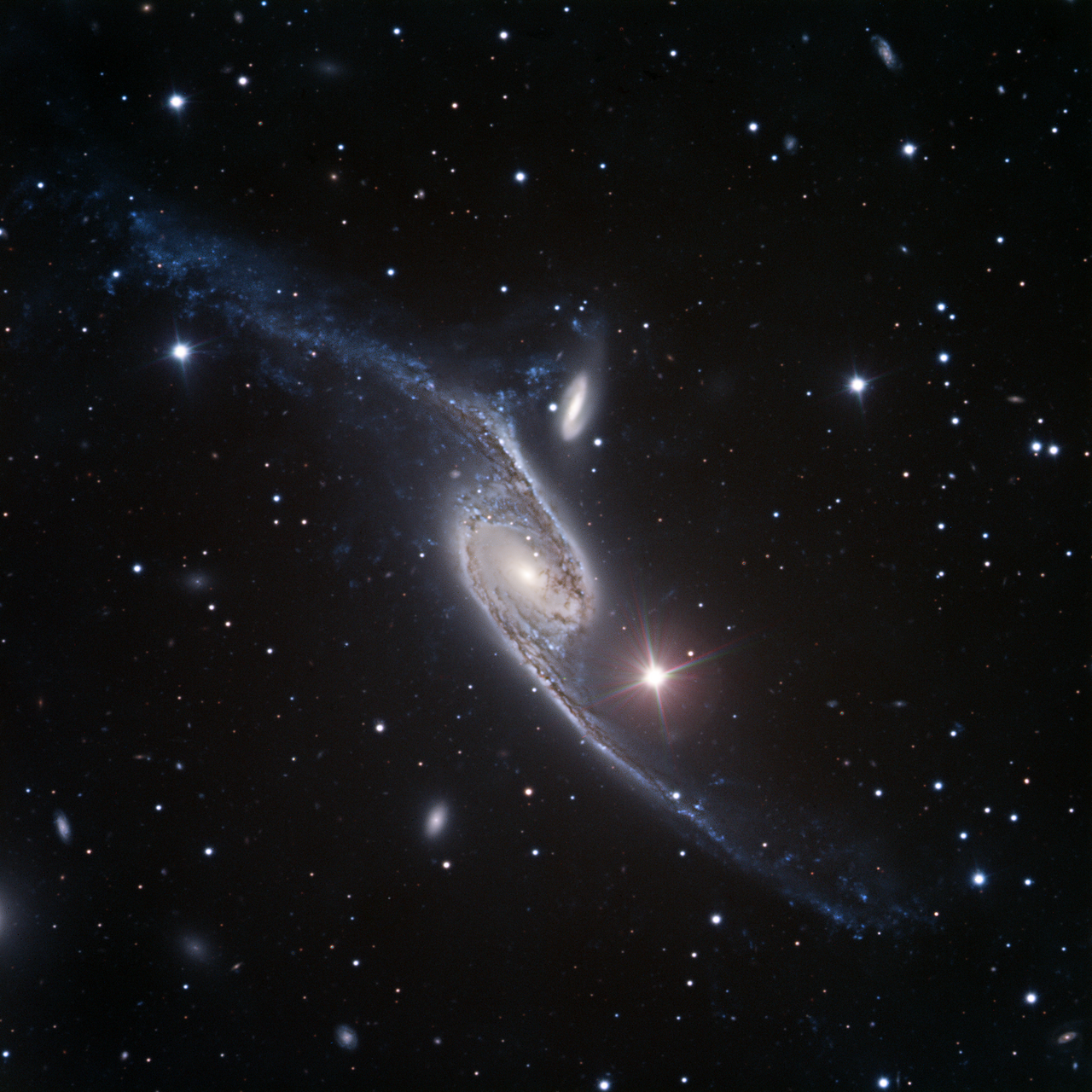
Recent observations of massive galaxies offer fresh angles on this puzzle. By studying how the largest galaxies formed and evolved across cosmic time, astronomers gain insight into how the universe's geometry shaped structure formation. A universe with different topology would have produced galaxies in different spatial distributions. Surveys like the Sloan Digital Sky Survey and upcoming spectroscopic surveys will map billions of galaxies with unprecedented precision, creating three-dimensional maps of cosmic structure that may reveal topological signatures.
The James Webb Space Telescope adds another tool to this hunt. Its infrared observations peer deeper into cosmic history, showing how galaxies clustered in the early universe. These patterns depend partly on topology. As JWST data accumulates, astronomers will search for correlations in galaxy positions that only exist if the universe has a specific shape.
Why does this matter for exploration and understanding? If the universe is finite and topologically complex, it fundamentally changes our cosmic perspective. It affects calculations for future observations, predictions about where to find primordial gravitational waves, and our understanding of dark energy and cosmic acceleration. Determining topology also tests whether our physics theories hold across the full universe or whether something deeper governs its structure.
The quest continues across multiple fronts. Astrophysicists combine CMB data, galaxy surveys, gravitational wave detections, and theoretical modeling to constrain possibilities. Most consensus favors a flat universe, but the alternatives remain scientifically viable. As observational technology improves and datasets grow larger, the cosmic topology riddle inches toward resolution, potentially revealing that the universe has a far stranger shape than our intuition suggests.