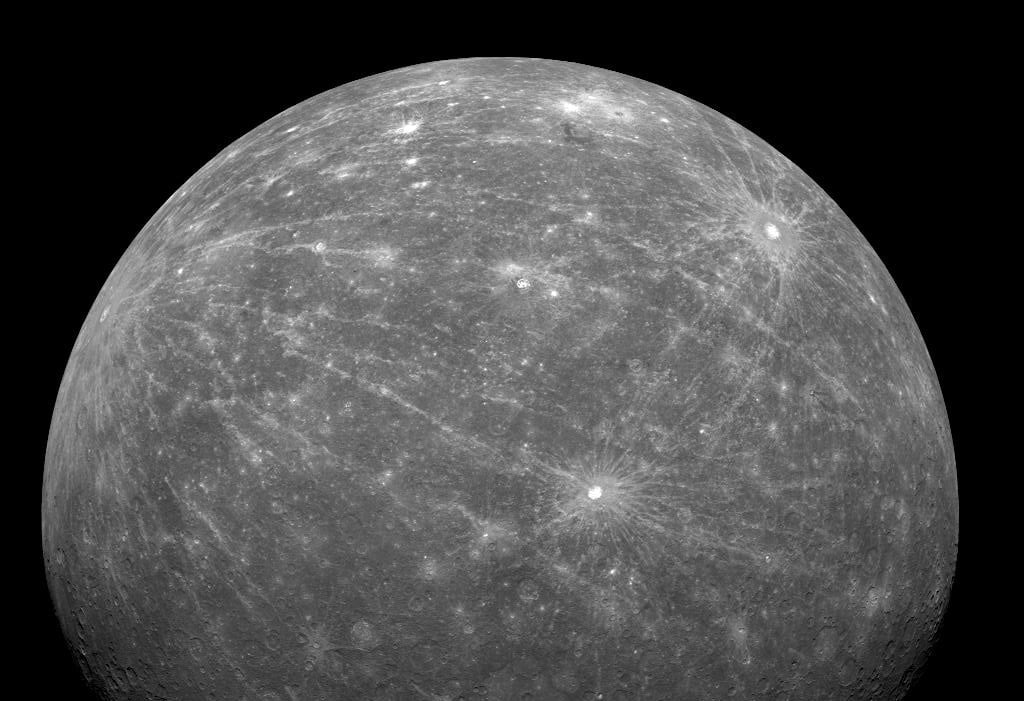
Mercury is contracting faster than scientists previously calculated, with the planet shrinking at roughly 30 percent above earlier estimates. New analysis of data from NASA's MESSENGER spacecraft reveals that the smallest planet in our solar system has been losing volume more rapidly than models based on earlier observations suggested.
The discovery stems from a closer examination of Mercury's heavily cratered surface. Planetary scientists had relied on visible surface features to track the planet's contraction over time, but impact debris and the planet's rough terrain obscured the true rate of shrinkage. When researchers accounted for these surface irregularities more carefully, they found evidence of faster cooling and contraction in Mercury's interior.
Mercury shrinks because its large iron core gradually cools. As the molten outer core solidifies, the entire planet contracts. This process has been occurring for billions of years and continues today. The revised contraction rate suggests the planet's interior is cooling faster than previous models indicated, which reshapes our understanding of Mercury's thermal evolution and internal structure.
The MESSENGER spacecraft, which orbited Mercury from 2011 to 2015, provided the detailed topographic data that made this analysis possible. The mission mapped Mercury's surface with unprecedented precision, revealing thousands of cliffs called scarps that form when the planet's crust buckles and breaks during contraction. Scientists used this scarping pattern to infer internal cooling rates more accurately than before.
This finding carries implications beyond Mercury alone. The revised contraction rate provides new constraints on how Mercury's core cooled and when major geological activity ceased on the planet's surface. It also offers insight into how terrestrial planets evolve internally over geological timescales. Mercury's rapid cooling history contrasts with Earth's, where a large iron core continues to drive a magnetic field and heat the surface through volcanism and plate tectonics.
The study underscores how seemingly minor adjustments in observational data can shift our understanding of planetary interiors. Surface features that appear insignificant at first glance contain encoded information about deep interior processes. By recognizing that rough terrain had masked the true pattern of contractional scarps, researchers extracted more accurate information from MESSENGER's orbital measurements.
Mercury remains one of the least explored terrestrial planets, yet it holds clues to how rocky worlds form and evolve. NASA's BepiColombo spacecraft, a joint mission with the European Space Agency, is currently en route to Mercury and will arrive in 2025. This orbiter will conduct an even more detailed investigation of Mercury's surface, interior, and magnetic field. The new contraction findings give BepiColombo's science team a sharper baseline for interpreting the mission's forthcoming measurements.
The revised contraction rate also refines models of Mercury's internal composition and structure. A faster cooling rate suggests either a larger core than some models proposed or different thermal properties in the mantle and crust. These details matter for understanding planetary formation and the diversity of planetary interiors within our solar system.