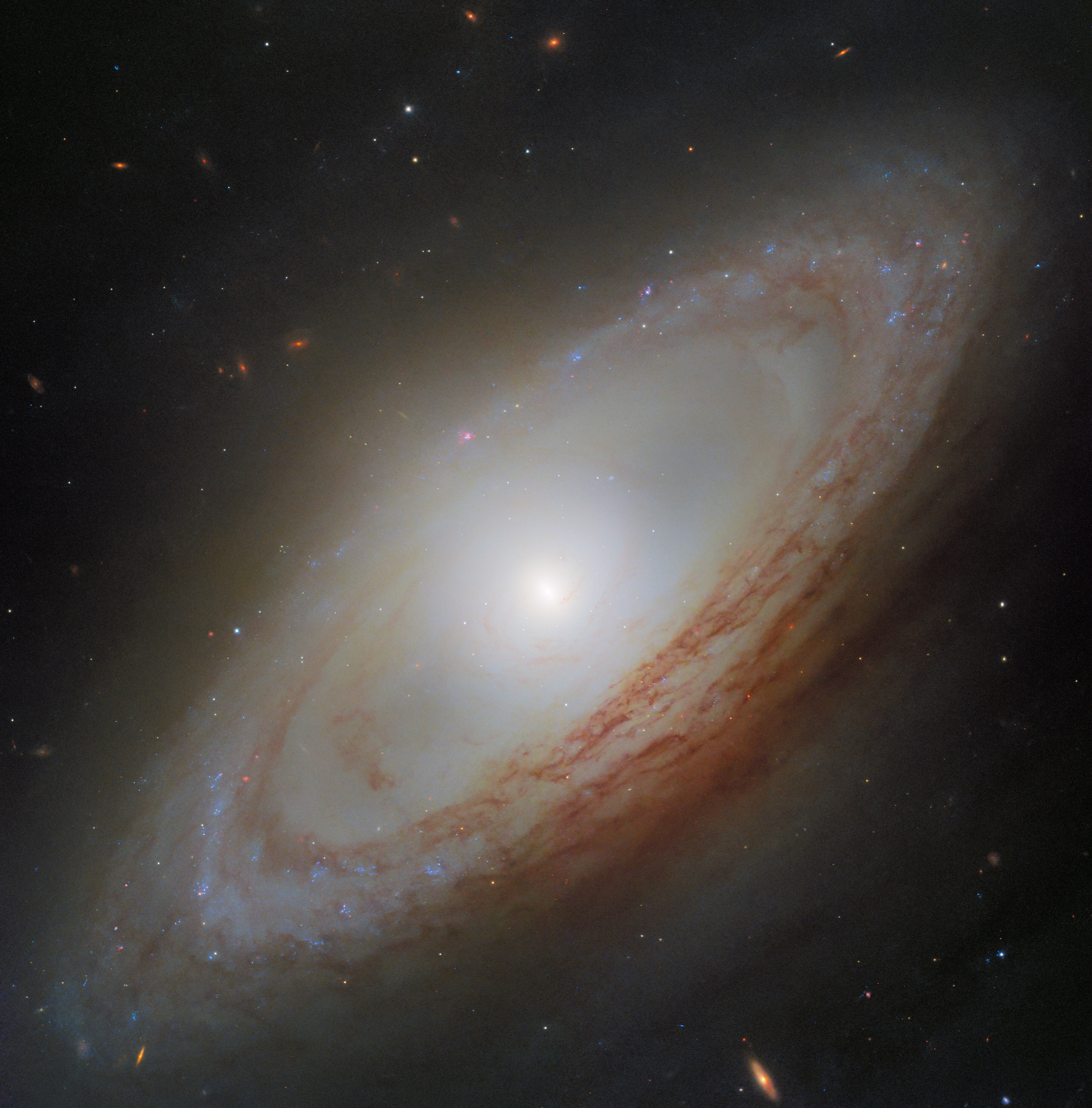
NASA's Hubble Space Telescope has captured new observations of NGC 4698, a spiral galaxy 55 million light-years distant in the constellation Virgo, revealing internal dynamics that defy typical rotational patterns. The galaxy belongs to the Virgo Cluster, a gravitationally bound assembly of more than one thousand galaxies nearest to our own galactic neighborhood. What distinguishes NGC 4698 from its spiral-galaxy cousins is a fundamental misalignment: its disk and bulge rotate in opposite directions.
This counter-rotating structure represents an uncommon configuration in the universe. Most spiral galaxies exhibit unified rotation where all components spin in the same direction, a legacy of their formation through gradual accretion and merging processes. NGC 4698 breaks this rule. The galaxy's central bulge rotates one way while its outer disk rotates the opposite direction, suggesting a violent past involving galactic collision and merger.
Astronomers interpret such counter-rotation as forensic evidence of galactic interaction. When two galaxies collide and merge, their differing angular momenta can produce lasting rotational conflicts in the merger product. NGC 4698 likely experienced a merger event millions of years ago that disrupted its original motion patterns. Rather than reaching dynamical equilibrium, the galaxy settled into this unusual state where different regions maintain opposite spins.
The Hubble Space Telescope's Advanced Camera for Surveys captured the structural details that reveal this phenomenon. By analyzing spectroscopic data, astronomers measure the velocity of gas and stars at different galactic radii, determining direction and speed of motion. Negative velocities in the bulge versus positive velocities in the disk confirm the counter-rotation hypothesis. The instrument's sensitivity allows researchers to distinguish these subtle kinematic signatures across millions of light-years.
NGC 4698 belongs to a rare subclass of counter-rotating galaxies. Surveys suggest perhaps five to ten percent of all galaxies exhibit some degree of counter-rotation in their disks. The Virgo Cluster's proximity makes it an ideal laboratory for studying such anomalies. Located roughly 65 million light-years away at the cluster's center, Virgo provides access to diverse galaxy morphologies and interaction histories unavailable elsewhere.
Understanding counter-rotating systems informs broader theories of galaxy formation and evolution. N-body simulations indicate that galaxy mergers produce temporary counter-rotation as a natural outcome of angular momentum transfer. Over billions of years, dynamical friction and tidal interactions typically realign these systems. NGC 4698's persistence suggests either recent merger activity or conditions that resist realignment. Each observed counter-rotating system refines models of how galaxies coalesce and stabilize.
The Hubble observations contribute to ongoing census work mapping the Virgo Cluster's population. As the nearest large cluster, Virgo serves as a template for understanding similar structures billions of light-years distant where current telescopes cannot resolve individual galaxies. NGC 4698's hidden chaos, rendered visible through Hubble's optics, demonstrates how apparently serene cosmic objects often harbor complex histories written in their kinematics and structure.