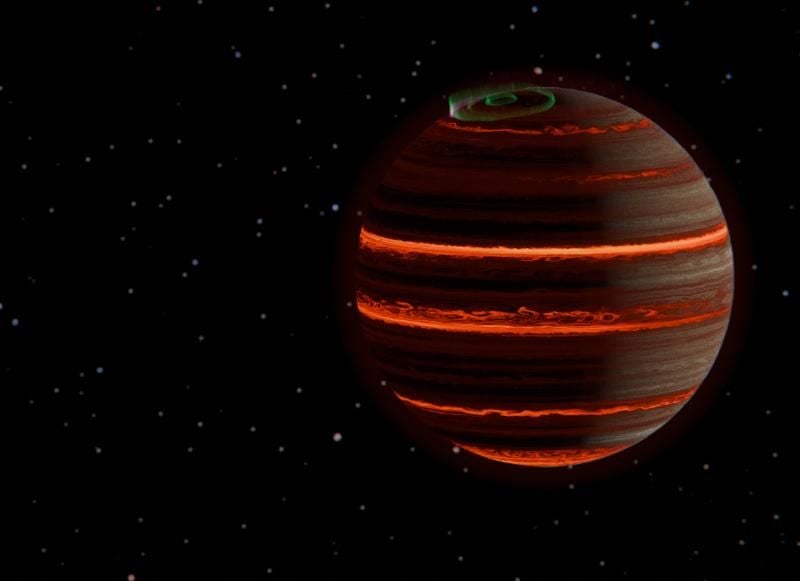
Astronomers from Trinity College Dublin have developed a novel method to decode atmospheric weather patterns on distant brown dwarfs, opening a new window into conditions on worlds beyond our solar system. The technique, applied to the brown dwarf SIMP 0136, reveals that its weather operates under surprisingly simple rules dominated by temperature fluctuations and cloud structure changes.
Brown dwarfs occupy a strange middle ground between planets and stars. They possess enough mass to generate internal heat through gravitational compression, but lack sufficient mass to sustain hydrogen fusion in their cores. SIMP 0136, located approximately 200 light-years from Earth, represents one of the nearest known brown dwarfs and has long intrigued researchers because of its connection to auroral phenomena resembling Earth's Northern Lights.
The Trinity researchers employed spectroscopic analysis combined with atmospheric modeling to track how SIMP 0136's appearance changes over time. By monitoring variations in infrared brightness, they identified periodic brightness oscillations consistent with rotating cloud formations. This rotation allowed them to map which atmospheric regions produce changing amounts of light as the brown dwarf spins.
The breakthrough centers on isolating the dominant physical processes shaping this distant world's weather. Rather than invoking complex interactions involving wind shear, chemical reactions, and multiple cloud layers, the team discovered that vertical cloud structure variations and temperature changes account for most observable atmospheric behavior. This parsimony suggests that brown dwarf atmospheres may operate under fundamentally different principles than planetary atmospheres like Jupiter's or Earth's, where multiple competing processes create elaborate storm systems.
SIMP 0136's connection to auroral activity adds another layer of interest. Like planets with strong magnetic fields, this brown dwarf generates an aurora through interactions between its magnetosphere and stellar radiation. The correlation between atmospheric weather patterns and auroral brightness suggests that upper atmospheric conditions influence these energetic phenomena, creating coupled systems that astronomers are only beginning to understand.
The methodology developed by the Trinity team applies directly to exoplanet atmospheres observable through current and future telescopes. The James Webb Space Telescope, now conducting routine observations of distant worlds, increasingly captures spectroscopic data from exoplanet atmospheres. Techniques that can extract weather information from photometric variations provide independent confirmation of conditions derived from transmission spectroscopy.
Understanding atmospheric dynamics on brown dwarfs serves multiple purposes. These worlds provide natural laboratories for testing atmospheric physics under extreme conditions that exceed anything in our solar system. Temperatures reach thousands of Kelvin, pressures become crushing, and chemical compositions differ radically from terrestrial or jovian atmospheres. Knowledge gained from brown dwarf studies directly informs models of hot Jupiter atmospheres and ultra-short-period exoplanets, many of which orbit close enough to their parent stars to reach brown-dwarf-equivalent temperatures.
The research also addresses a fundamental question in exoplanet science: How do atmospheres behave across the spectrum of planetary and substellar masses? By characterizing weather on SIMP 0136, astronomers gain insight into the transition zone between planetary and stellar atmospheres, revealing universal principles that govern atmospheric circulation and cloud formation regardless of a world's mass or composition.