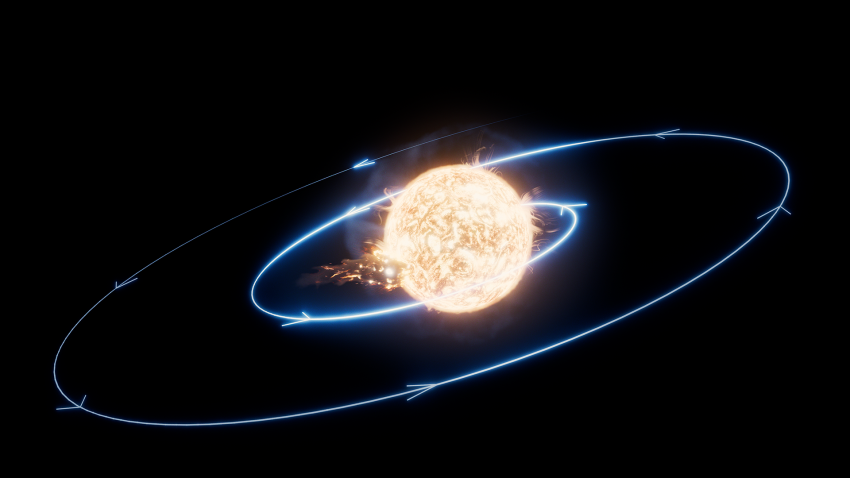
A team of researchers has proposed that the Sun consumed a large planet in the early Solar System, a cataclysmic event that may explain several puzzling properties of our star today.
The investigation centers on anomalies in the Sun's composition and behavior that have long puzzled astrophysicists. Standard models of stellar formation do not easily account for these observations. The hypothesis of planetary ingestion offers a potential mechanism to resolve the discrepancies.
Planetary consumption occurs when a planet's orbit decays through gravitational interactions or orbital resonances, sending it spiraling into its parent star. This process happens in other star systems with measurable frequency. Astronomers observing exoplanet systems have detected direct evidence of such events, including the signature chemical signatures left when a massive object passes through a star's photosphere and merges with its interior.
The research team analyzed what such an event would contribute to the Sun's composition. If a terrestrial or super-Earth planet entered the Sun early in Solar System history, when the star was still contracting and restructuring, the ingested material would have mixed into the stellar interior. The planet's heavy elements and overall chemical makeup would alter the Sun's composition in detectable ways.
Several of the Sun's current characteristics fit this scenario. The team identified specific compositional patterns and behavioral anomalies that match predictions from models of planetary ingestion. These include alterations to the Sun's elemental abundance ratios and potential effects on its internal structure and dynamics.
The timing matters considerably. Early Solar System formation involved complex gravitational interactions among planets and planetesimals. The nebular disk surrounding the young Sun contained numerous bodies. Orbital instabilities could have destabilized planetary orbits, sending them inward. A large planet crossing the Sun's path during this chaotic period would have collided catastrophically with the star.
This work builds on decades of research into planetary migration and Solar System dynamics. NASA's Kepler mission and the European Southern Observatory's exoplanet surveys have documented dozens of systems where planets orbit closer to their stars than Solar System analogs would predict. Many show evidence of past migration. Some host planets that have moved inward destructively.
The Sun's properties have been intensively studied through helioseismology, which measures vibrations in the stellar surface to map the Sun's internal structure. These precise measurements provide constraints that any explanation must satisfy. The ingestion hypothesis passes those observational tests.
Understanding this possibility reshapes how scientists model the early Solar System. It suggests that planetary architecture changed more dramatically than previously thought. The planets we observe today may be survivors of a more violent reorganization process.
Further research will test this hypothesis through detailed modeling of how stellar composition changes following planetary ingestion and through observations of similar events in other star systems. As telescope technology improves, astronomers gain better ability to detect the chemical signatures of planetary destruction around distant stars, offering comparative data for evaluating the Sun's history.