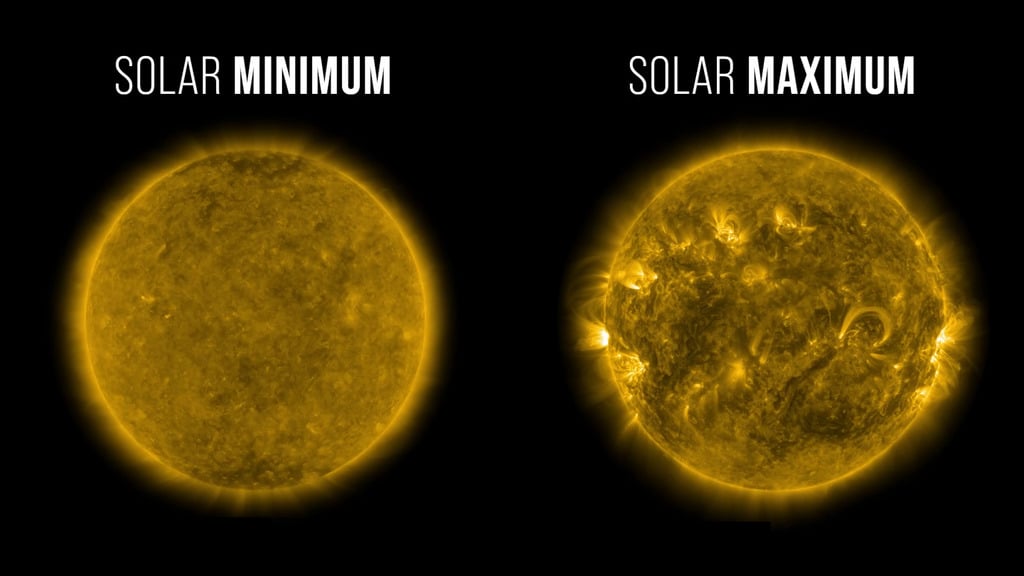
The Sun's 11-year cycle operates like a biological rhythm, with periods of dormancy predicting the intensity of activity that follows. Astronomer Sandra Chapman at the University of Warwick has identified a direct connection between solar minimum—when the Sun's surface quiets to near-stillness—and the vigor of the subsequent solar maximum. This discovery rewrites assumptions about solar predictability and provides a new framework for forecasting space weather threats.
Chapman's research demonstrates that the depth and duration of solar minimum serves as a reliable indicator for the next cycle's peak activity. The data reveals a critical threshold point: how long the Sun remains in its sleepy state determines how violently it will awaken. This relationship emerged from systematic analysis of historical solar cycles, tracked through detailed observations and satellite data spanning decades.
The Solar Dynamics Observatory, NASA's space-borne instrument launched in 2010, captured the contrast starkly. December 2019 showed a Sun nearly featureless—smooth, dark, minimal sunspot activity, and weak magnetic turbulence. By May 2024, the same observatory recorded a dramatically different star. Sunspots peppered the photosphere. Coronal mass ejections erupted. Solar flares crackled across all energy bands. The transition from Cycle 24's minimum to Cycle 25's maximum played out in real time.
Understanding this connection matters for multiple practical reasons. Solar maxima drive enhanced geomagnetic storms that disrupt satellites, power grids, and communications systems. Solar Cycle 25 has already produced intense activity—multiple X-class flares, significant geomagnetic disturbances, and challenges for astronauts aboard the International Space Station. Forecast accuracy directly impacts infrastructure resilience and mission planning for both government agencies and commercial operators.
Chapman's work carries an obvious test case. Cycle 25 reached its observed maximum around May 2024, making this one of the most thoroughly documented solar maximums on record. Cycle 26 will reach its predicted maximum in the 2030s. If Chapman's model holds, astronomers will be able to assess the upcoming minimum phase and compare its characteristics against the forecast for Cycle 26's intensity. This creates a falsifiable prediction—rare in solar physics—and a benchmark for validating or refining the mechanism.
The underlying physics remains incompletely understood. The Sun's dynamo operates through convective flows in the interior, magnetic field amplification, and surface eruption patterns. How a quiet minimum predetermines an active maximum suggests feedback loops or constraints in the dynamo mechanism itself. Chapman's correlation provides an observational anchor for theorists attempting to model these processes more precisely.
Solar forecasting benefits the space weather community directly. The National Oceanic and Atmospheric Administration operates the Space Weather Prediction Center; the European Space Agency maintains complementary forecast systems. Improved cycle-to-cycle predictions allow for better resource allocation, maintenance scheduling for satellites, and risk assessment for long-duration spaceflight.
Chapman's discovery represents progress toward the long-standing goal of solar physics: predictive rather than merely reactive understanding of our star's behavior. The 2030s will determine whether the Sun's sleep truly reveals its future waking.