# Stars Leave Chemical Fingerprints After Consuming Rocky Worlds
Astronomers have developed a method to detect when stars have swallowed planets. The technique hinges on beryllium, a rare element that stars do not produce internally, making it a forensic marker for planetary consumption.
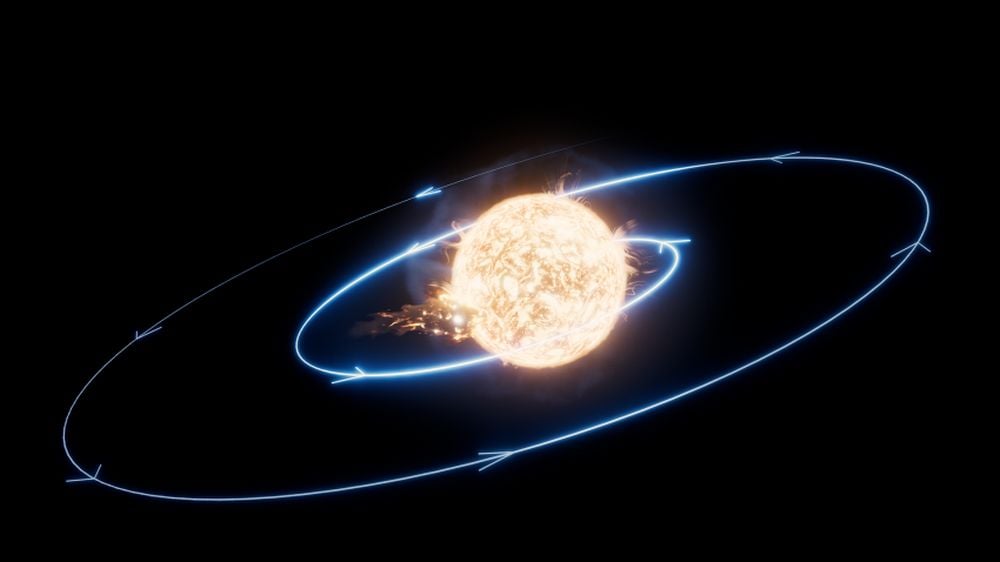
When a star expands and engulfs a rocky planet, the planet's material mixes into the star's outer layers. That material carries beryllium, which originated in the planet itself or in the interstellar medium during the star's formation. Because stars destroy beryllium through nuclear fusion in their cores, any beryllium detected in a star's photosphere must come from an external source. A star that has devoured a planet retains beryllium in its surface layers. A star that has never consumed a planet shows depleted beryllium levels.
This distinction offers astronomers a direct observational test. By measuring beryllium abundances in stellar spectra, researchers can identify which stars have experienced planetary engulfment events. The method works because beryllium is fragile. Inside a star, temperatures exceed 3.5 million Kelvin, and beryllium nuclei fuse into boron. Stars gradually consume their beryllium reserves over billions of years. A detection of excess beryllium compared to a star's age and mass reveals an external source: planetary material.
The timing of this discovery matters. Astronomers have long suspected that planets migrate inward during system evolution, colliding with stars or spiraling into them due to dynamical interactions. Direct evidence remained elusive. The beryllium technique provides concrete proof. It transforms the question from theoretical possibility to observable reality.
Rocky planets, particularly Earth-sized and super-Earth-sized worlds, carry beryllium in their crusts and mantles. When engulfed, they contribute measurable beryllium to their parent star. This works regardless of when the engulfment occurred. A star that consumed a planet billions of years ago may still show elevated beryllium if the mixing depth was shallow enough to prevent the element from sinking into the hotter core.
The implications extend beyond simple detection. The beryllium abundance reveals planetary composition. Different planet types contain different beryllium concentrations. By analyzing the beryllium signature, astronomers infer what kind of planet the star consumed. A planet rich in rocky, terrestrial material leaves a distinct beryllium profile compared to an icy body.
This method also constrains planetary system evolution models. Researchers can now estimate how frequently planets plunge into their stars in different regions of the galaxy. In crowded stellar clusters, planet-star collisions may occur more often. In quieter regions with wider planetary separations, engulfment remains rare. The beryllium abundance across populations of stars provides a cosmic census of planetary loss.
The discovery has practical applications for exoplanet research. When astronomers detect a planet transiting or orbiting a star, they can check whether that star has previously consumed other planets. A history of engulfment suggests a chaotic, dynamically violent system where remaining planets face higher collision risks. Stable systems with no evidence of planetary consumption may host planets in more predictable, long-term orbits.
Going forward, detailed spectroscopic surveys of nearby stars will build a comprehensive beryllium map. Space-based observatories like the Hubble Space Telescope and ground-based spectrographs will measure beryllium in thousands of stars. This data will reveal the prevalence of planetary engulfment across the galaxy and refine understanding of how planetary systems evolve, destabilize, and ultimately disintegrate.