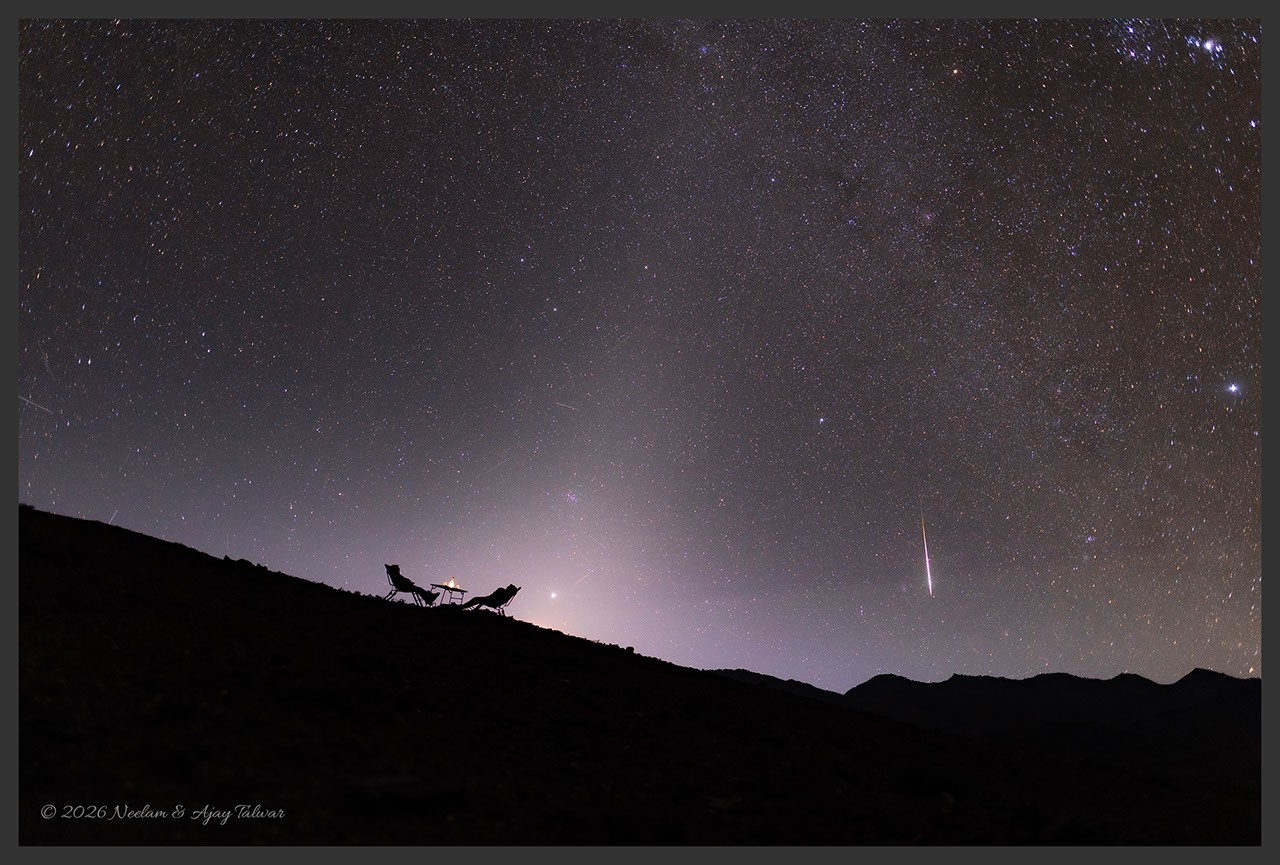
# Zodiacal Light Reveals the Solar System's Dusty Architecture
NASA's Astronomy Picture of the Day program featured a September 2026 observation of the zodiacal light, one of astronomy's most elusive and scientifically revealing phenomena. The zodiacal light appears as a faint cone of illumination along the ecliptic, visible only under dark skies during twilight hours when the sun sits just below the horizon.
The zodiacal light originates from interplanetary dust, small particles distributed throughout the inner solar system in a flattened disk aligned with Earth's orbital plane. These particles, typically measuring a few micrometers across, scatter sunlight toward Earth. Understanding their distribution and composition opens windows into planetary formation history and the ongoing dynamical evolution of our solar system.
This dust population forms through multiple sources. Asteroid collisions generate fragments that gradually migrate inward toward the sun through the Poynting-Robertson effect, a process where radiation pressure gradually reduces orbital energy. Cometary debris contributes additional particles, particularly during periods of heightened cometary activity. Micrometeorites continuously strike larger bodies, creating fresh dust that joins the interplanetary population. The zodiacal light thus traces the fossil record of solar system collisions.
Observing the zodiacal light requires specific conditions. City lights and atmospheric haze render it invisible from urban areas. The phenomenon appears brightest roughly 20 degrees above the horizon along the ecliptic, typically visible for an hour or two after sunset in spring or before sunrise in autumn at mid-northern latitudes. Observers require dark adaptation lasting 20 to 30 minutes and a location far from light pollution, making it a genuine challenge for modern astronomers.
The zodiacal light carries quantifiable scientific data. Measurements of its intensity at different wavelengths reveal particle sizes and composition. Spectroscopic analysis indicates silicate minerals resembling meteoritic material. Infrared observations using space telescopes penetrate the visible dust disk and detect thermal emission from warmer particles closer to the sun. NASA's Infrared Astronomical Satellite, the Spitzer Space Telescope, and ongoing observations continue mapping this dusty architecture in unprecedented detail.
The zodiacal light connects to broader solar system science. Its distribution constrains models of planetary migration and asteroid dynamics. Detecting similar zodiacal light around other stars using space telescopes like the James Webb Space Telescope reveals how common planetary debris disks form around young stars. These observations suggest our zodiacal light represents a scaled-down version of the massive debris disks observed around Vega, Fomalhaut, and Epsilon Eridani.
Professional astronomers incorporate zodiacal light measurements into studies of interplanetary dust population density and evolution. This knowledge impacts spacecraft trajectory planning, since micrometeorite impacts represent hazards for long-duration missions. Understanding dust distribution helps engineers design better micrometeorite shielding for future lunar bases and deep space exploration vehicles.
The September 2026 APOD observation exemplifies how ground-based astronomy continues revealing solar system structure through patient observation of subtle phenomena. The zodiacal light transforms darkness into a teaching moment about planetary genesis, orbital mechanics, and the visible consequences of billions of years of collisions and gravitational interactions within our cosmic neighborhood.