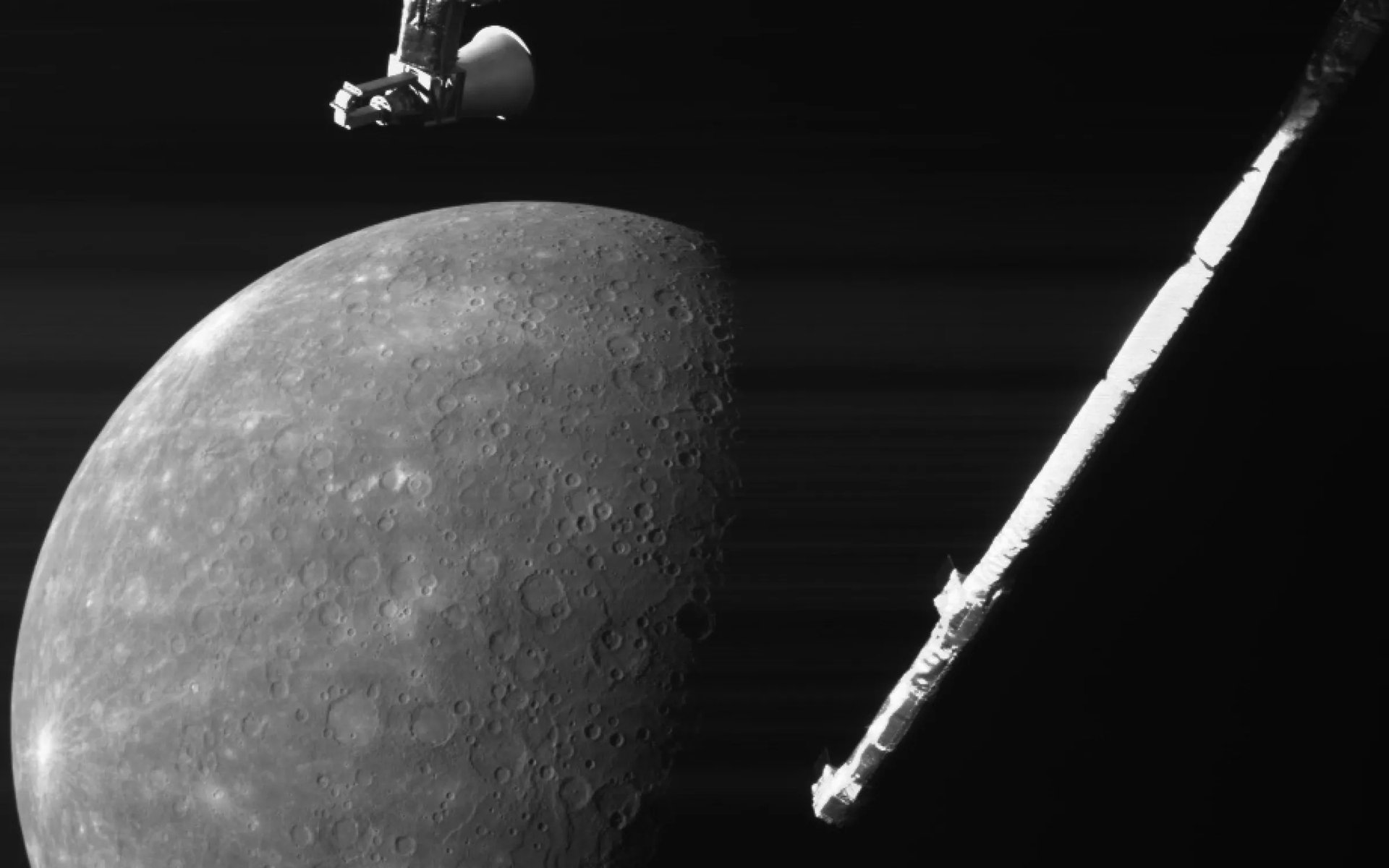
BepiColombo, the joint European and Japanese spacecraft orbiting Mercury, has completed detailed measurements of the charged particle environment surrounding the innermost planet. These observations provide the first close-range data on how solar wind and radiation interact with Mercury's thin exosphere and surface.
The spacecraft carries specialized instruments designed to detect energetic particles streaming from the Sun. During its flybys and orbital passes, BepiColombo quantifies the intensity and composition of this bombardment. Mercury experiences the most intense solar wind in the entire solar system due to its proximity to the Sun, approximately 58 million kilometers away. Understanding this harsh environment reveals how stellar radiation shapes planetary atmospheres and surfaces across space.
The measurements serve two distinct purposes. First, they document Mercury's current conditions for planetary science. Mercury possesses almost no atmosphere. Instead, solar wind directly strikes its rocky surface, slowly stripping away atoms and creating a sparse, dynamic exosphere composed of atoms knocked loose by this bombardment. BepiColombo's particle detectors track this process in real time, showing which elements escape and how quickly the surface loses material over time. This process, called sputtering, fundamentally alters Mercury's geology on billion-year timescales.
Second, these data improve models of how space weather affects Earth. Solar storms produce energy surges that accelerate particles to extreme velocities. By studying Mercury's interaction with an unshielded solar wind, scientists extract principles applicable to Earth's magnetosphere. Our magnetic field protects the atmosphere, but during extreme space storms, particles can penetrate deeper into the upper atmosphere than normal. Understanding the physics at Mercury informs predictions about atmospheric loss on Earth during future geomagnetic storms.
BepiColombo itself represents a collaborative engineering achievement. The European Space Agency (ESA) and Japan's space agency JAXA jointly developed the orbiter to answer fundamental questions about Mercury's composition, magnetic field, and evolution. The mission launched in 2018 and entered Mercury orbit in 2025 after a seven-year spiral inward. The spacecraft carries two distinct orbital modules. ESA's Mercury Planetary Orbiter operates at lower altitudes to study the planet itself, while JAXA's Mercury Magnetospheric Orbiter investigates the magnetic environment. This dual-orbiter design allows simultaneous measurements of the planet and its surrounding space environment.
The particle bombardment data feeds into broader Mercury science. Scientists use these measurements alongside observations from BepiColombo's thermal imaging, magnetometer, and spectrometers to build a complete picture of Mercury. The data reveals how space weather carved Mercury's landscape, why certain regions appear darker than others, and what processes continue reshaping the surface today.
These initial results from BepiColombo's orbit establish baseline conditions for the mission's extended science phase. Future observations will track seasonal variations in particle flux and monitor changes tied to solar activity cycles. As the Sun moves through its 11-year cycle, solar wind intensity fluctuates, creating natural experiments in how planetary environments respond to varying stellar output.