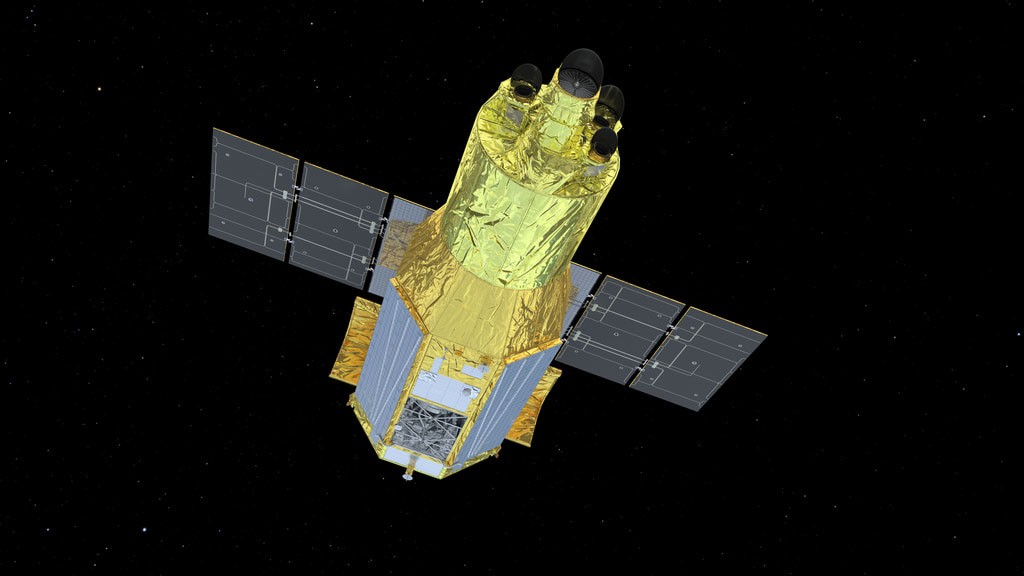
NASA and the Japan Aerospace Exploration Agency have captured direct evidence of a stellar wind feeding a compact object in an exotic binary system using the XRISM observatory. The finding offers new insight into how matter streams between stars and powers some of the universe's most energetic phenomena.
XRISM, the X-ray Imaging and Spectroscopy Mission, detected a giant star ejecting material into space at high velocity. This stellar wind, a continuous outflow of plasma from the star's atmosphere, flows across the orbital gap between the two stars. The companion object, a compact body formed from stellar collapse, intercepts this material. The captured wind accelerates as it falls toward the compact object, heating to millions of degrees and producing intense X-ray emissions that XRISM could measure directly.
This observation represents a direct view of accretion in action. Binary systems where a compact object strips material from a giant companion have long been predicted to work this way, but previous instruments lacked the spectroscopic resolution to watch the process unfold. XRISM, launched by Japan in March 2023 with NASA and other international partners aboard, carries an X-ray microcalorimeter that measures the precise energy of individual X-ray photons. This capability allows astronomers to map the wind's velocity, temperature, and density as it travels through space.
The stellar wind interaction creates powerful X-ray flares. As the wind accelerates and compresses near the compact object, it reaches temperatures exceeding millions of degrees. The energy released appears as sudden brightening in X-rays. XRISM tracked these emissions across specific wavelengths, revealing the wind's motion and physical state with unprecedented detail.
The compact companion in this system is likely either a neutron star or black hole, objects formed from the cores of massive stars that exploded as supernovae. Both types can create intense gravitational fields that pull in surrounding material. When stellar wind material crosses this gravitational boundary and falls inward, it converts gravitational potential energy into radiation. This process powers some of the brightest X-ray sources in the galaxy.
Understanding how stellar winds feed compact objects has applications across astrophysics. These systems serve as laboratories for testing physics under extreme conditions. Neutron stars compress matter to nuclear densities. Black holes probe the spacetime distortions predicted by general relativity. The infalling wind reveals both objects' properties through how it radiates.
XRISM continues NASA's legacy in X-ray astronomy. Previous missions like Chandra and XMM-Newton discovered many wind-fed binary systems, but XRISM's spectroscopic precision surpasses them. The mission's data allows researchers to measure wind properties that earlier instruments could only infer. This capability opens new avenues for studying accretion across multiple astronomical contexts, from stellar binaries to supermassive black holes at galaxy centers.
The observation confirms decades of theoretical predictions about binary star evolution. By directly imaging stellar wind capture, XRISM demonstrates how mass transfer drives the evolution of close binary systems. Some of these systems eventually merge, potentially creating gravitational wave sources detectable by observatories like LIGO. Each XRISM observation adds precision to models predicting their ultimate fate.