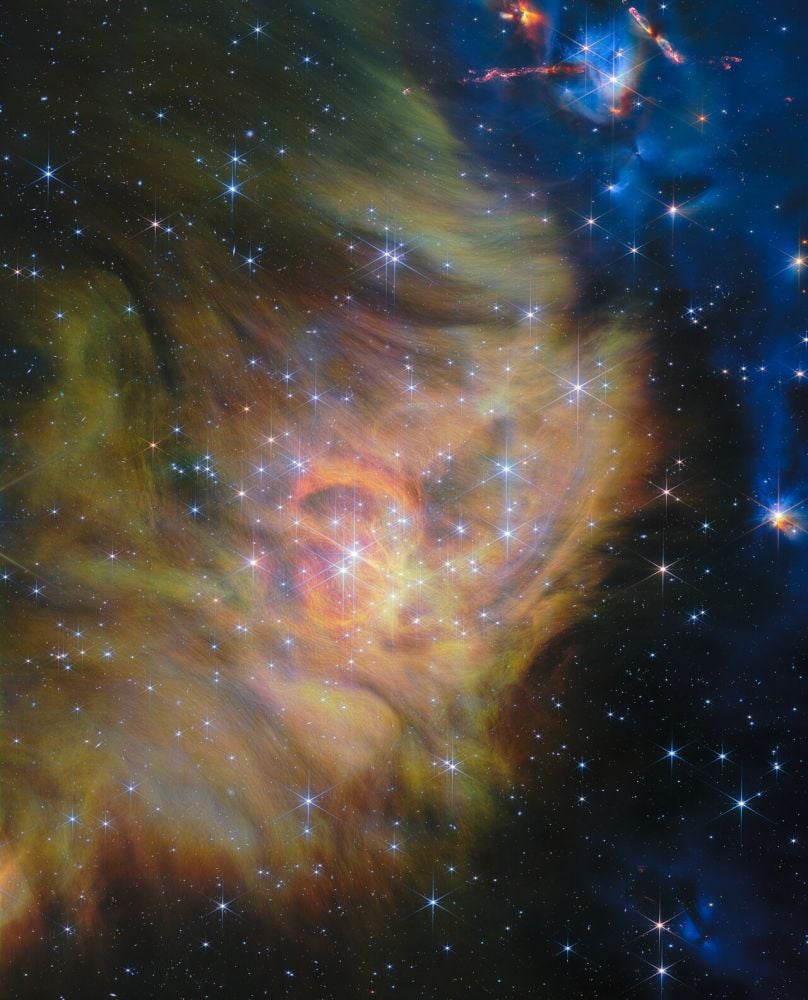
The James Webb Space Telescope has identified a previously undetected population of ultra-low-mass brown dwarfs in the star-forming region IC 348, located roughly 1,000 light-years from Earth. This discovery pushes the boundary of what astronomers classify as brown dwarfs and reshapes understanding of substellar objects.
Brown dwarfs occupy a peculiar niche in astrophysics. They form like stars but never accumulate enough mass to ignite hydrogen fusion in their cores, the defining characteristic that separates stars from these failed stellar remnants. Typically, astronomers classify brown dwarfs by mass ranges and spectral types. The newly discovered objects in IC 348 challenge that framework by existing at the extreme low-mass threshold.
Webb's Near-Infrared Camera, or NIRCam, captured detailed imagery of IC 348, revealing these ultra-low-mass brown dwarfs through their distinctive hydrocarbon spectral signatures. This particular feature marks a departure from previously known brown dwarf populations, indicating a previously uncharacterized class of substellar objects. The discovery matters because it reveals gaps in the current understanding of how these objects form and what physical processes govern their development.
The IC 348 region serves as an ideal laboratory for this research. At 1,000 light-years away, it remains relatively close on cosmic scales, allowing Webb's infrared instruments to resolve individual brown dwarfs in extraordinary detail. The region's active star formation creates a natural laboratory where researchers observe objects at various stages of development. Webb's infrared capabilities penetrate the dust clouds that obscure optical telescopes, revealing populations hidden from previous surveys.
This work directly addresses a fundamental question in brown dwarf science: how small can these objects become while still fitting the definition of a brown dwarf? The lower boundary of brown dwarf mass sits near the upper boundary of planetary masses. Jupiter contains roughly 0.001 solar masses, while the lowest-mass brown dwarfs approach 0.005 solar masses. The newly discovered objects apparently fill gaps within this range, suggesting the mass distribution of substellar objects differs from existing models.
Understanding the lowest-mass brown dwarfs carries implications extending beyond taxonomy. These objects reveal how the star formation process operates at its limits. The presence of specific hydrocarbon features indicates particular atmospheric chemistry and temperature profiles. These signatures provide clues about formation mechanisms and the physics governing the transition zone between planets and stars.
Researchers including K. Luhman and C. Alves De Oliveira conducted this investigation using data from the ESA, NASA, and CSA collaboration that operates Webb. The study exemplifies how the telescope's infrared sensitivity enables discoveries that ground-based observatories and previous space telescopes could not achieve.
Future observations will focus on determining whether these ultra-low-mass brown dwarfs represent a common population or a rare discovery unique to IC 348. Additional star-forming regions will require similar scrutiny to establish whether this class appears throughout the galaxy. Such work strengthens the framework for brown dwarf classification and reveals how stellar and substellar objects populate the low-mass end of the mass spectrum.