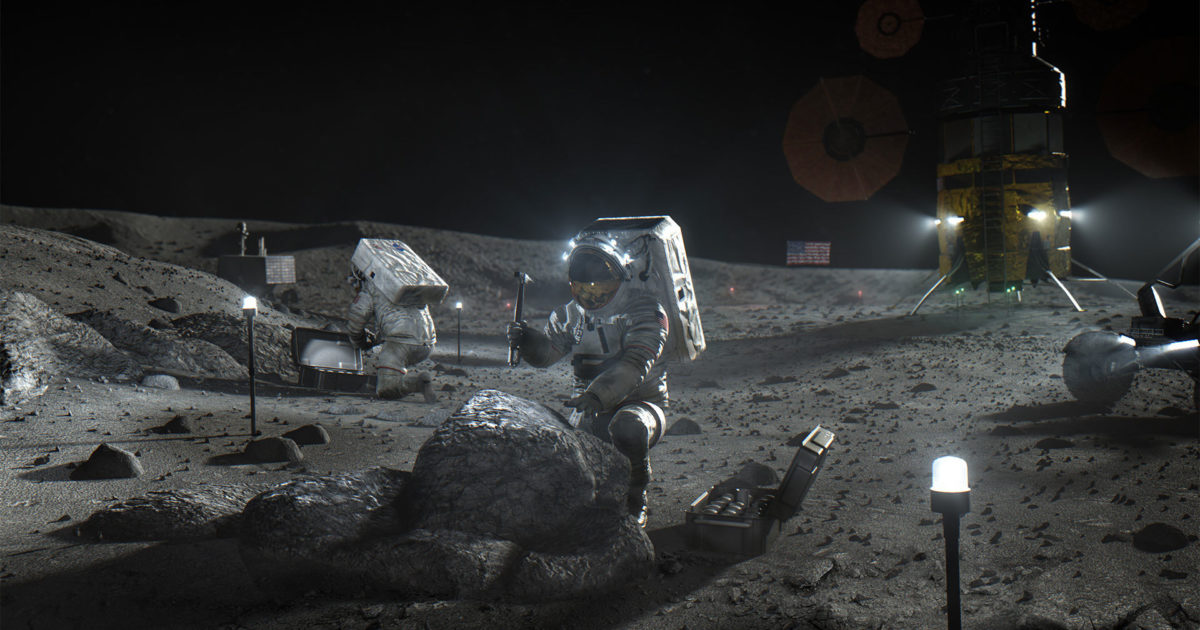
# What Could the Artemis IV Astronauts Discover on the Moon?
NASA has begun laying out the scientific agenda for Artemis IV, the fourth crewed lunar landing mission planned for the mid-2020s. While Artemis III will focus on proving the capability to land near the lunar south pole, Artemis IV represents an opportunity to expand exploration, conduct deeper science, and prepare infrastructure for sustained human presence on the Moon.
The Artemis program itself represents a fundamental shift in lunar exploration. Unlike the Apollo missions of the 1960s and 1970s, which prioritized speed and geopolitical achievement, Artemis frames the Moon as a destination for extended operations. Artemis I launched uncrewed in November 2022, demonstrating the Space Launch System rocket and Orion spacecraft. Artemis II will carry four astronauts on a lunar flyby in 2025. Artemis III will land two astronauts near the south pole, likely in 2026.
Artemis IV builds on these achievements with several overlapping objectives. The mission will likely deploy additional scientific instruments and geological equipment to complement earlier landings. Astronauts may conduct longer extravehicular activities, or spacewalks, allowing deeper exploration of the terrain. The south polar region remains the primary focus because it contains permanently shadowed craters where water ice accumulates. Understanding the composition, distribution, and extractability of this ice answers critical questions about lunar geology and resource availability for future missions.
NASA has identified core science priorities for Artemis IV. Seismic monitoring stations would improve understanding of the Moon's interior structure and tectonic history. Drilled core samples from depth would reveal the lunar subsurface composition and search for volatiles like water, methane, and other compounds frozen in the regolith. Magnetometer arrays would clarify the Moon's magnetic field history. High-resolution imaging of the landing site supports detailed geological mapping and resource assessment.
The mission also serves infrastructure purposes. Astronauts may deploy components of a lunar gateway outpost, establishing a hub for operations and scientific research. Testing life support systems, power generation, and habitat modules in the actual lunar environment provides invaluable engineering data for future permanent bases.
Artemis IV differs from Artemis III in scope and duration. While Artemis III astronauts will spend approximately one week in the lunar vicinity, Artemis IV crews could extend their stay. Longer timelines allow for more ambitious geology, expanded sample collection, and equipment deployment that supports subsequent missions.
The mission timeline remains subject to technical development and budgetary decisions. NASA faces engineering challenges including perfecting the Human Landing System, developing advanced spacesuits rated for longer surface operations, and ensuring the Artemis infrastructure can sustain repeated missions. These challenges have already delayed earlier timelines, and Artemis IV will follow only after Artemis II and III complete successfully.
Beyond the data Artemis IV will collect, the mission represents a turning point in lunar exploration. Rather than a single achievement, it establishes the Moon as a laboratory for planetary science and a testing ground for technologies that will enable Mars exploration. The discoveries made by Artemis IV astronauts will shape decades of lunar research and human spaceflight strategy.