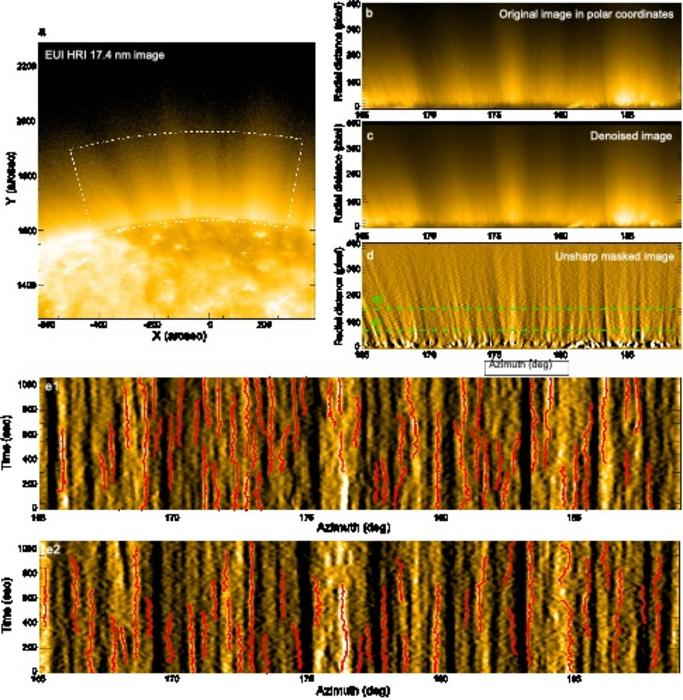
The Solar Orbiter spacecraft has directly observed high-speed transverse waves rippling across the Sun's polar regions. These waves, traveling at speeds up to 140 kilometers per second, appear to play a central role in accelerating the fast solar wind to velocities exceeding 750 kilometers per second.
The discovery addresses a longstanding puzzle in solar physics. Scientists knew the Sun ejected a constant stream of charged particles at extreme speeds, but the mechanism remained unclear. Measurements showed the solar wind leaving the Sun's polar coronal holes far faster than magnetic forces alone could explain. The missing piece was these rapid oscillations in the Sun's upper atmosphere, the corona.
Dr. Yuhang Gao's team used the Extreme Ultraviolet Imager (EUI) aboard Solar Orbiter to detect the wave motion. The EUI captures unprecedented detail of the solar atmosphere, revealing fine plumes and transverse vibrations that previous instruments could not resolve. The waves propagate perpendicular to the Sun's magnetic field lines, which extend from the polar regions into interplanetary space like invisible highways for energetic particles.
Solar Orbiter, a collaborative mission between the European Space Agency (ESA) and NASA, orbits closer to the Sun than any previous spacecraft except NASA's Parker Solar Probe. This proximity allows instruments aboard Solar Orbiter to observe the corona with resolution down to 70 kilometers. The mission's elliptical orbit carries it within 42 million kilometers of the Sun's surface at closest approach, positioning it to witness the corona's fine structure and dynamic behavior.
The transverse waves convert magnetic energy into kinetic energy, accelerating electrons and ions to tremendous velocities. This process directly contributes to solar wind acceleration. Understanding this mechanism has implications for space weather prediction. The solar wind shapes the interplanetary magnetic field and directly impacts Earth's magnetosphere. When the solar wind strengthens or intensifies, geomagnetic storms result. Better understanding of wave-driven acceleration improves forecasts of these events.
The polar coronal holes emit the fast solar wind component that dominates the space environment during solar minimum phases of the Sun's 11-year cycle. Lower-density coronal holes allow magnetic field lines to open directly into space without the dense plasma found in other coronal regions. Particles escaping through these holes accelerate to characteristic speeds of 700-800 kilometers per second. The newly observed waves provide the energy transfer mechanism that had eluded researchers.
This work validates theoretical models predicting that Alfven waves, a specific class of magnetohydrodynamic waves, could account for solar wind acceleration. Previous observations lacked the spatial resolution to directly detect these oscillations. Solar Orbiter's capabilities finally provided the observational evidence needed to confirm decades of theoretical predictions.
The findings open new research directions. Scientists now examine how wave properties vary with solar cycle phase, magnetic field configuration, and coronal structure. Future observations from Solar Orbiter and coordination with Parker Solar Probe, which measures the solar wind downstream, promise deeper insights into the dynamic processes governing solar wind acceleration and the physics of the inner heliosphere.