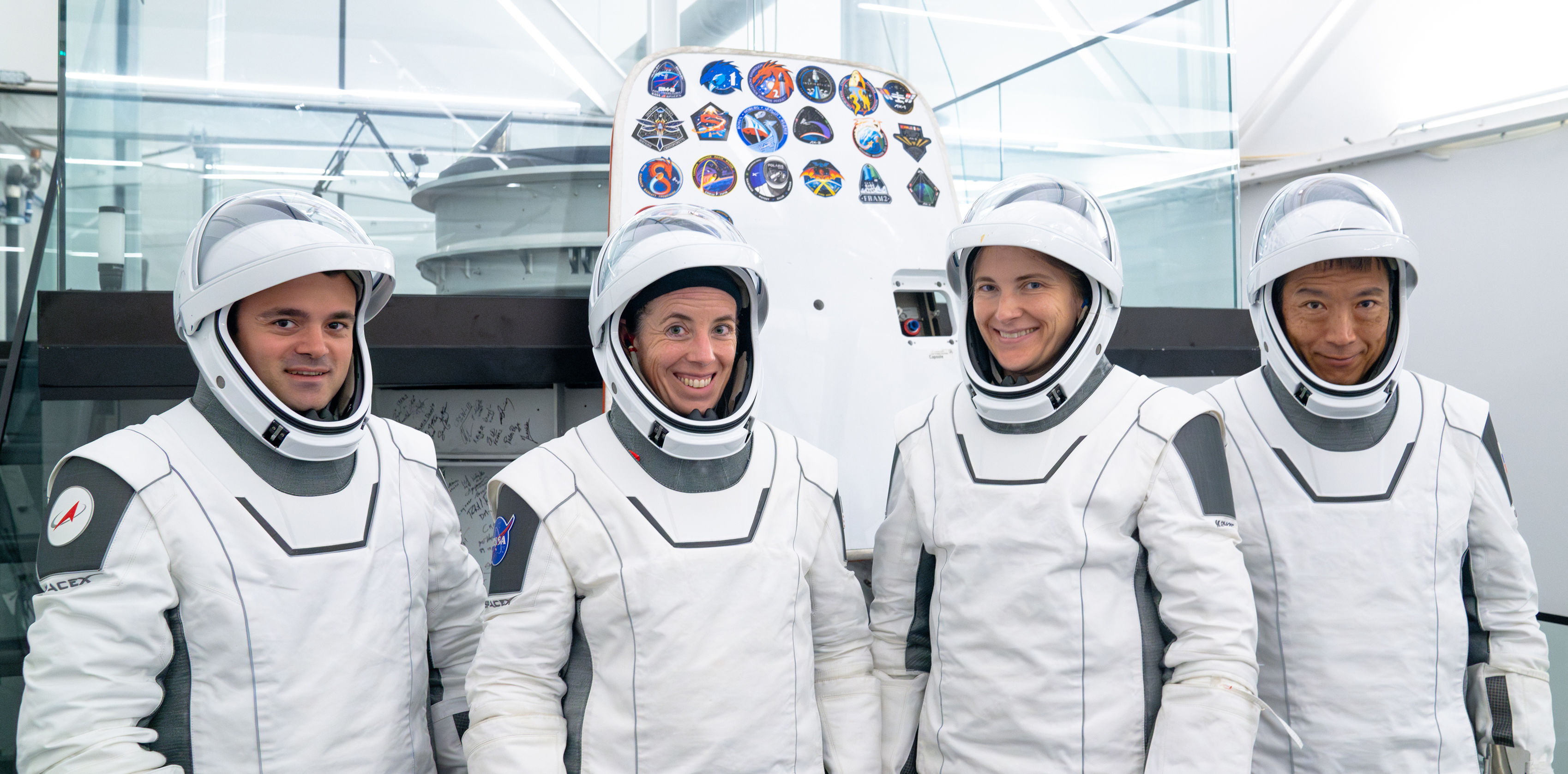
NASA assigned four spaceflyers to the SpaceX Crew-14 mission launching no earlier than spring 2027 to the International Space Station. The crew comprises NASA astronauts Kayla Barron and Chris Birch, Japan Aerospace Exploration Agency astronaut Makoto Suwa, and a Roscosmos cosmonaut, representing three nations on a long-duration expedition.
Barron commands the mission as spacecraft commander while Birch serves as pilot. Both astronauts bring extensive spaceflight experience. Barron previously flew aboard SpaceX Crew-3 in late 2021, logging six months aboard the station. Birch marks a career milestone with his first spaceflight assignment. Suwa represents JAXA's continuing participation in American-crewed missions and brings expertise from Japan's robotics and life sciences programs. The Roscosmos representative completes the four-person crew, continuing the collaborative presence Russia maintains at the station despite geopolitical tensions.
Crew-14 follows the established cadence of NASA's Commercial Crew Program, the partnership with SpaceX that replaced American reliance on Russian Soyuz spacecraft after the shuttle program ended in 2011. The mission continues six-month expedition rotations that NASA and its partners established two decades ago. Each crew arriving at the station overlaps with the departing crew for several days of transition, ensuring continuity of station operations and research.
The spring 2027 launch window positions Crew-14 within NASA's operational schedule for Commercial Crew missions. The cadence typically spaces launches roughly six months apart, maintaining a steady presence of experienced operators managing the orbital laboratory. SpaceX's Crew Dragon spacecraft carries the crew to the station's Harmony module, the primary docking port for American commercial vehicles since Dragon operations began in May 2020.
The long-duration expedition assignment reflects the core mission of maintaining the ISS as an orbital research platform. Astronauts and cosmonauts conduct microgravity experiments across materials science, pharmaceutical development, combustion physics, and biology. Japanese astronaut Suwa's presence connects JAXA's Japanese Experiment Module to the broader ISS ecosystem. The station currently operates as a partnership between NASA, Roscosmos, ESA, JAXA, and the Canadian Space Agency, with crew transfers managed through bilateral agreements despite diplomatic strain.
SpaceX's role as sole provider of crewed American spaceflight to the station extends through the current decade. NASA's Commercial Crew Program contracts guarantee reliable access while reducing dependence on any single launch provider or international partner. The program has executed over a dozen successful crew rotations since 2020, establishing Dragon as a proven workhorse for human spaceflight.
Crew-14 preparations will involve eighteen months of training at NASA's Johnson Space Center in Houston, the European Astronaut Centre near Cologne, Star City near Moscow, and JAXA facilities in Tsukuba, Japan. Barron and Birch will spend particular focus on Dragon systems, orbital rendezvous, docking procedures, and emergency response protocols. The overlapping international training schedule reflects the station's fundamentally multinational design and operational requirements.
The 2027 timeframe places Crew-14 within a period of potential station evolution. NASA and its partners have extended ISS operations through 2030, with discussions ongoing about eventual commercial successors to the aging orbital outpost. Crew-14 astronauts may participate in final years of the current configuration or help transition operations to emerging commercial space stations.